The sample copy of this report is available for access.
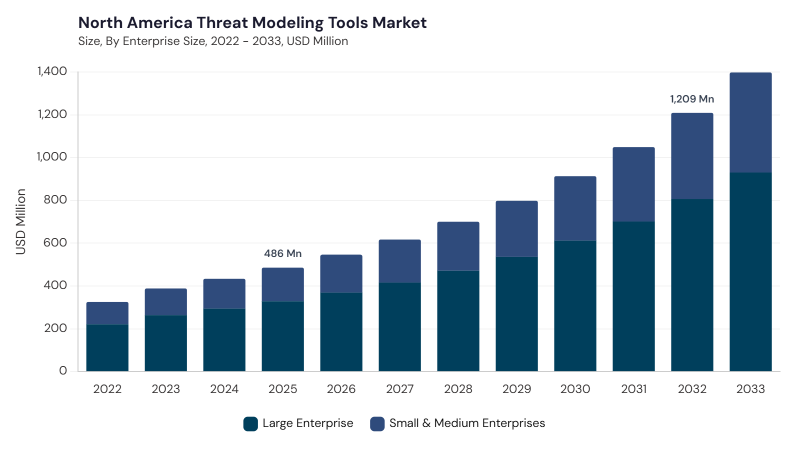
The North America Threat Modeling Tools Market is expected to reach USD 1,209.01 million by 2032, growing at a CAGR of 14.4% during 2026 - 2033.
The North America Threat Modeling Tools Market evolved from the growing need to proactively identify and mitigate cybersecurity risks during software development and IT infrastructure planning. Initially adopted by government agencies and large enterprises for structured risk assessment, threat modeling gradually became an essential component of secure software development as cyber threats grew more sophisticated. Advancements in cloud computing, DevSecOps practices, artificial intelligence, and automation have transformed threat modeling tools into integrated platforms capable of continuous risk assessment, attack simulation, compliance management, and real-time threat intelligence integration. Growing concerns regarding software supply chain attacks, cloud security, API vulnerabilities, and regulatory compliance continue to drive market growth across North America.
Based on Component, the market is segmented into Solutions and Services. The Solutions market dominated the North America Threat Modeling Tools Market by Component in 2025, and would continue to be a dominant market till 2033; thereby, achieving a market value of USD 903.27 million by 2032, growing at a CAGR of 14.1 % during the forecast period. The Services market is expected to witness a CAGR of 15.2% during (2026 - 2033).
Solutions account for the largest share of the market due to increasing demand for automated threat identification, risk scoring, attack path analysis, compliance mapping, and workflow integration capabilities. Organizations increasingly deploy threat modeling platforms to strengthen secure software development and DevSecOps initiatives. Services form an important supporting segment, encompassing consulting, implementation, customization, training, governance development, and managed threat modeling services that help organizations improve cybersecurity maturity and address complex security environments.
Based on Deployment, the market is segmented into Cloud, Hybrid, and On-premise. The Cloud market dominated the North America Threat Modeling Tools Market by Deployment in 2025, and would continue to be a dominant market till 2033; thereby, achieving a market value of USD 572.73 million by 2032, growing at a CAGR of 13.9 % during the forecast period. The Hybrid market is expected to witness a CAGR of 14.6% during (2026 - 2033).
Cloud deployment dominates the market owing to growing SaaS adoption, distributed development teams, scalability requirements, and seamless integration with cloud-native development environments. Hybrid deployment is gaining traction among organizations operating across both cloud and legacy infrastructures, enabling flexible threat modeling across diverse environments. On-premise deployment remains relevant in highly regulated industries and government agencies where strict data control, confidentiality, and compliance requirements necessitate internal infrastructure management.
Based on Enterprise Size, the market is segmented into Large Enterprises and Small & Medium Enterprises. The Large Enterprise market dominated the North America Threat Modeling Tools Market by Enterprise Size in 2025, and would continue to be a dominant market till 2033; thereby, achieving a market value of USD 806.49 million by 2032, growing at a CAGR of 14.1 % during the forecast period. Additionally, The Small & Medium Enterprises market is expected to witness highest CAGR of 14.9% during (2026 - 2033).
Large enterprises represent the leading segment due to their complex application portfolios, extensive cybersecurity investments, stringent regulatory obligations, and mature DevSecOps practices. These organizations require scalable threat modeling platforms with advanced automation and governance capabilities. Small and Medium Enterprises are increasingly adopting cloud-based threat modeling tools to improve security posture, support compliance initiatives, and address growing cyber risks through cost-effective and easy-to-deploy solutions.
Based on Industry Vertical, the market is segmented into BFSI, IT & Telecom, Government & Defense, Healthcare & Life Sciences, Manufacturing & Industrial, and Other Industry Verticals. BFSI holds a significant share due to increasing regulatory pressure, digital banking expansion, fraud prevention requirements, and protection of financial transactions. IT & Telecom continues to be a major adopter owing to rapid software development, cloud infrastructure growth, and API security concerns. Government & Defense organizations utilize threat modeling to secure mission-critical systems and sensitive information. Healthcare & Life Sciences leverage these tools to protect patient data, telehealth platforms, and connected medical systems. Manufacturing & Industrial sectors increasingly adopt threat modeling solutions to secure connected factories, operational technology environments, and industrial IoT infrastructures.
Free Valuable Insights: The Global Threat Modeling Tools Market will hit USD 3,784. Million billion by 2033, at a CAGR of 15.1%
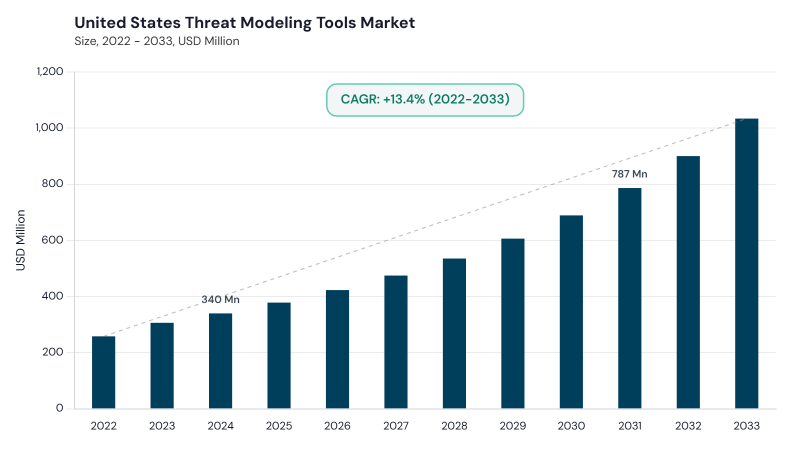
Based on Country, the market is segmented into the US, Canada, Mexico, and Rest of North America. The US market dominated the North America Large Enterprise Market by Country in 2025, and would continue to be a dominant market till 2033; thereby, achieving a market value of USD 599.43 million by 2032, growing at a CAGR of 13.4 % during the forecast period. The Canada market is expected to witness a CAGR of 16.2% during (2026 - 2033).
The United States dominates the market due to advanced cybersecurity infrastructure, strong adoption of DevSecOps methodologies, increasing software security investments, and stringent regulatory requirements. Canada is witnessing steady growth supported by expanding cybersecurity initiatives, growing cloud adoption, and compliance-focused security strategies. Mexico is experiencing rising demand as organizations strengthen cybersecurity defenses amid increasing digital transformation efforts. The Rest of North America presents growth opportunities driven by growing awareness of proactive risk management, cloud security requirements, and increasing adoption of secure software development practices across both public and private sectors.

By Component
By Deployment
By Enterprise Size
By Industry Vertical
By Country
Set to reach $1,209.01 Million by 2032, growing at 14.4% CAGR during 2026-2033.
The US leads with $599.43 million by 2032, growing at a CAGR of 13.4% during the forecast period.
Rising demand for cloud-based solutions, reaching $572.73 million by 2032 at 13.9% CAGR during the forecast period.
Solutions segment will achieve $903.27 million by 2032, growing at a CAGR of 14.1% during the forecast period.
The Canada market is expected to witness a CAGR of 16.2% during 2026-2033.
Large Enterprises will reach $806.49 million by 2032, growing at a CAGR of 14.1% during the forecast period.
Our team of dedicated experts can provide you with attractive expansion opportunities for your business.




 Unique Offerings