The sample copy of this report is available for access.
The Asia Pacific Threat Modeling Tools Market is expected to reach USD 633.39 million by 2030, growing at a CAGR of 16% during 2026 - 2033.
The Asia Pacific Threat Modeling Tools Market originated alongside the early adoption of cybersecurity practices in the region, where organizations initially relied on vulnerability assessments and manual risk analysis to secure digital assets. As digital transformation accelerated across sectors such as BFSI, healthcare, government, manufacturing, and telecommunications, the need for proactive threat identification became increasingly important. The evolution of cloud computing, IoT ecosystems, mobile-first applications, and interconnected enterprise environments created new attack surfaces, driving the adoption of advanced threat modeling solutions. Over time, the market transitioned from manually intensive frameworks toward automated, AI-enhanced platforms capable of predictive risk assessment, continuous threat intelligence integration, and real-time vulnerability prioritization.
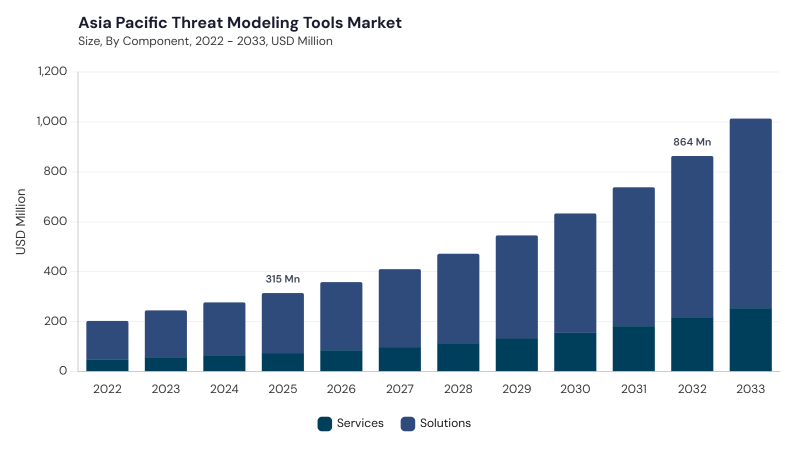
Based on Component, the market is segmented into Solutions and Services. The Solutions market dominated the Asia Pacific Threat Modeling Tools Market by Component in 2025, and would continue to be a dominant market till 2033; thereby, achieving a market value of USD 478.37 million by 2030, growing at a CAGR of 15.7 % during the forecast period. The Services market is expected to witness a CAGR of 16.9% during (2026 - 2033).
Solutions account for the dominant share owing to increasing demand for automated threat identification, attack path analysis, architecture visualization, risk scoring, workflow automation, and integration with DevSecOps environments. Organizations across Asia Pacific are increasingly investing in platforms that help standardize security reviews and support secure-by-design development practices. Services also represent a significant segment, encompassing consulting, implementation, integration, training, managed threat modeling, and compliance advisory services. Service demand remains particularly strong among organizations that require expertise in deploying threat modeling frameworks and adapting cybersecurity practices to local regulatory requirements and industry-specific needs.
Based on Deployment, the market is segmented into Cloud, Hybrid, and On-premise. The Cloud market dominated the Asia Pacific Threat Modeling Tools Market by Deployment in 2025, and would continue to be a dominant market till 2033; thereby, achieving a market value of USD 304.23 million by 2030, growing at a CAGR of 15.6 % during the forecast period. The Hybrid market is expected to witness a CAGR of 16.3% during (2026 - 2033).
Cloud deployment holds a significant position due to rapid cloud adoption, SaaS-based security solutions, digital-native businesses, and the growing need for collaboration across geographically distributed development teams. Hybrid deployment is witnessing strong growth as organizations seek to balance cloud scalability with compliance requirements, legacy systems, and local infrastructure investments. Hybrid environments enable enterprises to manage risk consistently across public cloud, private cloud, and on-premise assets. On-premise deployment continues to maintain relevance in sectors such as government, defense, banking, healthcare, and critical infrastructure, where data sovereignty, confidentiality, and regulatory compliance remain key priorities.
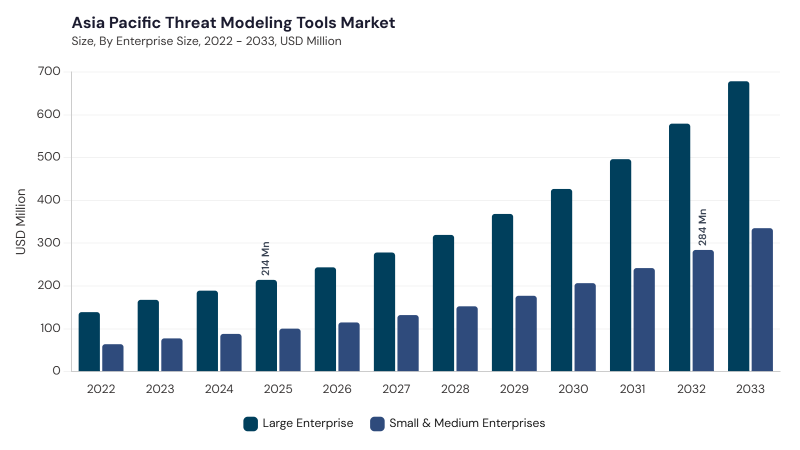
Based on Enterprise Size, the market is segmented into Large Enterprises and Small & Medium Enterprises. Large enterprises constitute the largest revenue contributor due to complex IT infrastructures, extensive software portfolios, multi-country operations, and increasing cybersecurity investments. These organizations require centralized governance, advanced automation, reusable threat libraries, workflow management, and integration with enterprise risk management systems. Small and Medium Enterprises are emerging as an important growth segment, supported by cloud-based deployment models, digital commerce expansion, fintech innovation, and increasing awareness of cybersecurity risks. SMEs primarily seek cost-effective, easy-to-deploy solutions that improve security posture while minimizing operational complexity and resource requirements.
Based on Industry Vertical, the market is segmented into BFSI, IT & Telecom, Government & Defense, Healthcare & Life Sciences, Manufacturing & Industrial, and Other Industry Verticals. BFSI represents the leading vertical due to rapid growth in digital banking, fintech ecosystems, mobile payments, open banking initiatives, and stringent regulatory oversight. IT & Telecom remains another major adopter, driven by cloud-native development, telecom modernization, software outsourcing, and expanding digital platforms. Government & Defense organizations increasingly utilize threat modeling tools to protect national infrastructure, public digital services, and critical assets. Healthcare & Life Sciences adoption is rising due to growing use of telemedicine, electronic health records, connected medical devices, and healthcare digitization initiatives.
Free Valuable Insights: Threat Modeling Tools Market is Predicted to reach USD 3,784. Million billion by 2033, at a CAGR of 15.1%
Based on Country, the market is segmented into China, Japan, India, South Korea, Australia, Malaysia, and Rest of Asia Pacific. The China and Japan led the Asia Pacific Threat Modeling Tools Market by Country with a market share of 28.9% and 17.1% in 2025.The Singapore market is expected to witness a CAGR of 17.4% during throughout the forecast period.
China represents a major market owing to large-scale digitalization, expanding cloud infrastructure, increasing cybersecurity investments, and regulatory focus on cyber resilience. Japan continues to demonstrate strong adoption driven by advanced cybersecurity programs, secure software development practices, and growing AI integration. India is experiencing rapid growth due to digital transformation initiatives, fintech expansion, cloud adoption, and increasing regulatory emphasis on cybersecurity governance. South Korea benefits from its advanced technology ecosystem, 5G infrastructure development, and strong focus on cyber defense capabilities. Australia remains a key market supported by mature cybersecurity frameworks, regulatory compliance requirements, and critical infrastructure protection initiatives.

By Component
By Deployment
By Enterprise Size
By Industry Vertical
By Country
Set to reach $633.39 Million by 2030, growing at 16% CAGR during 2026-2033.
China and Japan lead with a market share of 28.9% and 17.1% in 2025.
Rising demand for cloud-based deployment, expected to reach $304.23 million by 2030.
The Solutions segment will achieve $478.37 million by 2030, growing at a 15.7% CAGR during 2026-2033.
The Singapore market is expected to witness a CAGR of 17.4% throughout the forecast period.
The Services segment is expected to witness a CAGR of 16.9% during 2026-2033.
Our team of dedicated experts can provide you with attractive expansion opportunities for your business.




 Unique Offerings