The sample copy of this report is available for access.
“Global Secondary Battery Market to reach a market value of USD 687290.18 Million by 2033 growing at a CAGR of %”
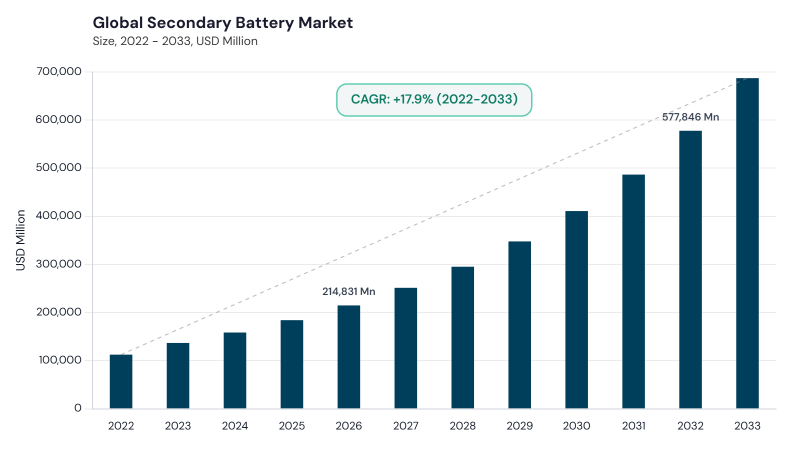
The Global Secondary Battery Market is expected to reach USD 687.2 billion by 2033, growing at a CAGR of 18.1% during (2026 - 2033).
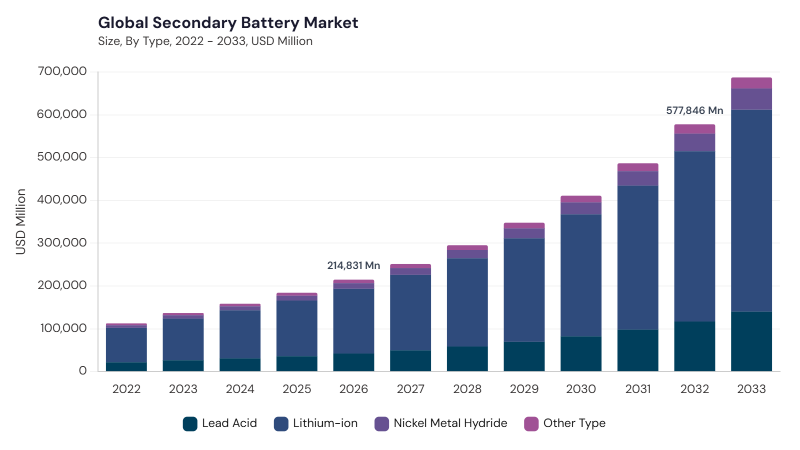
Growing demand for rechargeable energy storage across electric vehicles, renewable energy integration, consumer electronics, industrial equipment, telecom infrastructure, and backup power applications is driving the Secondary Battery Market. Users are prioritizing higher energy density, longer cycle life, fast charging, safety, recyclability, and lower total ownership cost. Growth is further strengthened by battery energy storage systems, portable electronics, industrial electrification, localized battery manufacturing, and recycling infrastructure.
Rapid electric vehicle adoption is the strongest structural growth factor for secondary batteries, as EVs require much larger rechargeable battery packs than conventional vehicles. Stationary energy storage is also becoming a major demand pillar as solar and wind power expansion increases the need for flexible electricity storage. Declining battery costs, chemistry improvements, cell-to-pack architectures, and manufacturing scale are improving economic viability across mobility, grid, industrial, and portable applications. Digital infrastructure, telecom networks, data centers, warehouses, industrial automation, and healthcare facilities are also increasing dependence on reliable backup and distributed energy storage. Together, these factors are broadening the market beyond vehicles into a wider rechargeable energy ecosystem.
Competition is intense and technology-driven, led by large battery manufacturers, automotive-linked suppliers, energy-storage specialists, and established lead-acid companies. Competitive positioning depends on manufacturing scale, chemistry expertise, energy density, cost per kilowatt-hour, fast charging, safety, cycle life, raw-material access, and customer relationships. Large suppliers are expanding gigafactories, localizing production, forming OEM partnerships, and investing in LFP, cylindrical formats, solid-state research, sodium-ion, recycling, and battery energy storage systems. The market is also becoming more regionalized as governments and customers prioritize domestic manufacturing, resilient supply chains, and traceable battery materials.
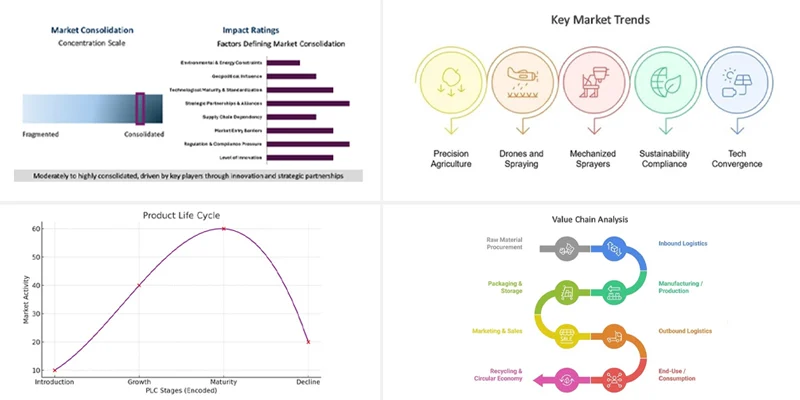

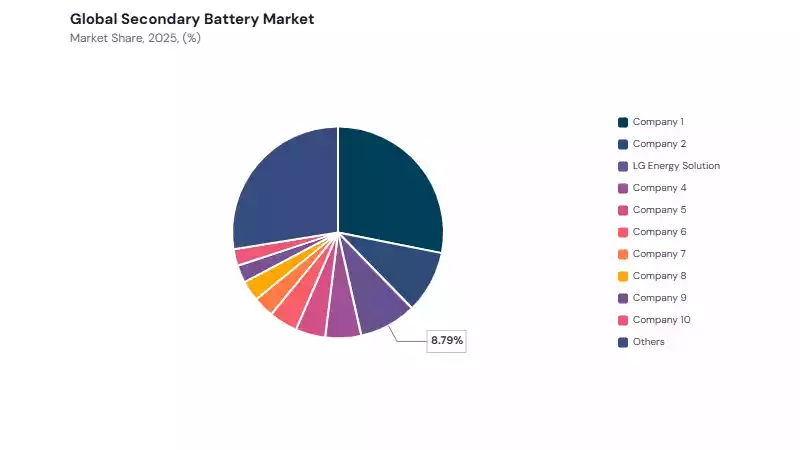
The Secondary Battery Market is relatively concentrated and technology-intensive, led by major lithium-ion battery manufacturers, automotive battery suppliers, energy-storage providers, and established lead-acid players. CATL leads through large-scale lithium-ion production, EV battery partnerships, LFP strength, and growing energy-storage exposure. FinDreams Battery, LG Energy Solution, Samsung SDI, EVE Energy, CALB, Gotion High-tech, Panasonic Energy, and SK On compete through EV batteries, ESS platforms, advanced cell formats, manufacturing scale, and global expansion. Clarios maintains a differentiated position in low-voltage automotive and lead-acid batteries. Future competition will depend on battery cost, chemistry diversification, supply security, recycling, safety, localization, and manufacturing quality.
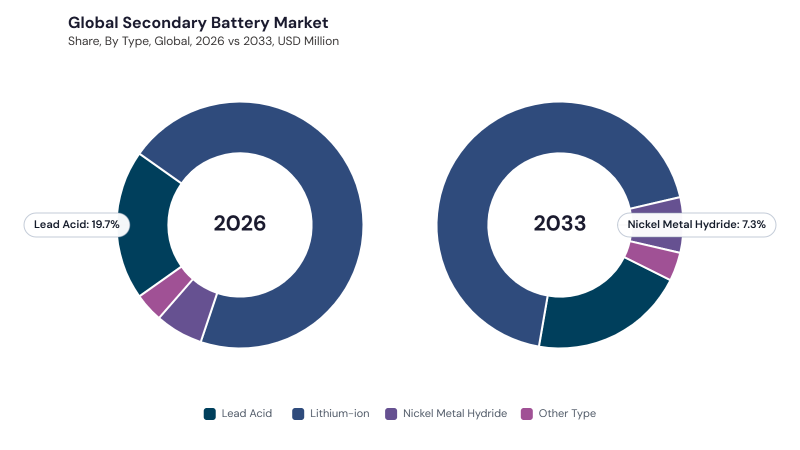
The Global Secondary Battery Market, by type, is segmented into Lithium-ion, Lead Acid, Nickel Metal Hydride, and Other Type. The Lithium-ion market dominated the Global Secondary Battery Market by Type in 2025, and would continue to be a dominant market till 2033; thereby, achieving a market value of USD 471.7 billion by 2033, growing at a CAGR of 17.7 % during the forecast period. The Lead Acid market is expected to witness a CAGR of 18.7% during (2026 - 2033). Additionally, The Nickel Metal Hydride market is expected to witness highest CAGR of 20.6% during (2026 - 2033).
Lithium-ion represents the dominant technology because of its high energy density, flexible cell formats, strong rechargeable performance, and broad use across electric mobility, electronics, stationary storage, and industrial applications. Lead Acid remains important in automotive SLI, backup power, telecommunications, UPS, and cost-sensitive industrial uses because of reliability, low upfront cost, and mature recycling infrastructure. Nickel Metal Hydride continues to serve selected hybrid vehicles and specialized industrial applications where proven durability remains valuable. Other Type includes alternative rechargeable chemistries designed for specialized requirements around safety, duration, materials availability, operating temperature, and lifecycle performance.
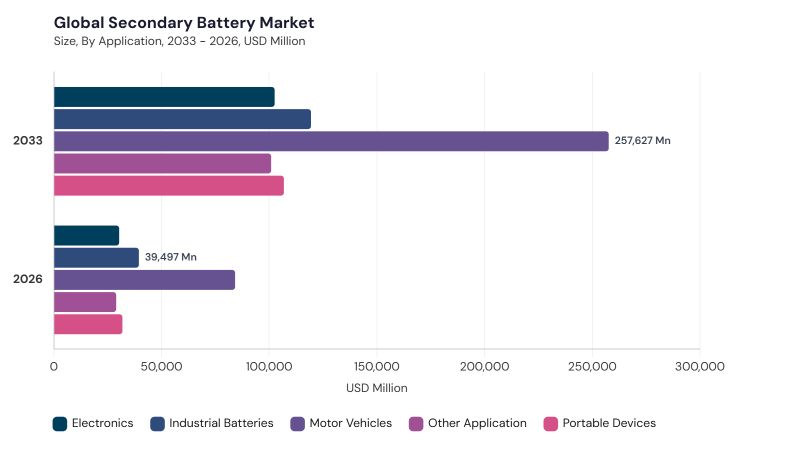
The Global Secondary Battery Market, by application, is segmented into Motor Vehicles, Industrial Batteries, Portable Devices, Electronics, and Other Application. The Motor Vehicles market dominated the Global Secondary Battery Market by Application in 2025, and would continue to be a dominant market till 2033; thereby, achieving a market value of USD 257.6 billion by 2033, growing at a CAGR of 17.3 % during the forecast period. The Industrial Batteries market is expected to witness a CAGR of 17.1% during (2026 - 2033). Additionally, The Portable Devices market is expected to witness highest CAGR of 18.9% during (2026 - 2033).
Motor Vehicles represent the leading application as rechargeable batteries are used across EVs, plug-in hybrids, hybrids, conventional vehicle electrical systems, buses, trucks, two-wheelers, and commercial fleets. Industrial Batteries support UPS systems, telecom infrastructure, data centers, renewable energy systems, material handling, warehouses, utilities, and emergency power. Portable Devices include mobile computing, wearables, power tools, cameras, medical devices, and other cordless products requiring compact rechargeable energy. Electronics cover consumer, professional, smart, connected, and computing devices, while Other Application includes residential storage, security systems, marine, recreational, defense, agricultural, medical, and specialized energy systems.
Free Valuable Insights: Secondary Battery Market Size to reach $687.2 Billion by 2033
Region-wise, the Secondary Battery Market is analyzed across North America, Europe, Asia Pacific, and LAMEA. The Asia Pacific market dominated the Global Secondary Battery Market by Region in 2025, and would continue to be a dominant market till 2033; thereby, achieving a market value of USD 402.6 billion by 2033, growing at a CAGR of 18.4 % during the forecast period. The North America market is expected to witness a CAGR of 17% during (2026 - 2033). Additionally, The Europe market is expected to witness a CAGR of 17.3% during (2026 - 2033).
Asia Pacific dominates due to extensive battery cell manufacturing, strong electronics and automotive industries, large-scale material and component ecosystems, and rapid EV and energy-storage deployment. North America is supported by localized battery manufacturing, EV production, stationary storage, renewable integration, data centers, telecom backup, and recycling investments. Europe benefits from vehicle electrification, energy transition programs, industrial decarbonization, battery sustainability rules, and recycling requirements. LAMEA remains smaller but is developing through renewable energy installations, telecom infrastructure, backup power needs, automotive applications, and gradual adoption of electric mobility and stationary energy storage.
| Report Attribute | Details |
|---|---|
| Market size value in 2026 | USD 214.8 billion |
| Market size forecast in 2033 | USD 687.2 billion |
| Base Year | 2025 |
| Historical Period | 2022 to 2024 |
| Forecast Period | 2026 to 2033 |
| Revenue Growth Rate | CAGR of 18.1% from 2026 to 2033 |
| Number of Pages | XX |
| Tables | XX |
| Report Coverage | Market Trends, Revenue Estimation and Forecast, Segmentation Analysis, Regional and Country Breakdown, Competitive Landscape, Market Share Analysis, Company Profiling, Companies Strategic Developments, SWOT Analysis, Product Life Cycle Analysis, Value Chain Analysis, Market Consolidation Analysis, Key Customer Criteria, Pandemic Impact Analysis, and Winning Imperatives |
| Segments Covered | Type, Application, and Geography |
| Country Scope |
|
| Companies Included | CATL; FinDreams Battery; LG Energy Solution; Clarios; Samsung SDI; EVE Energy; CALB; Gotion High-tech; Panasonic Energy; SK On |
By Type
By Application
By Geography
The market is projected to reach USD 687.2 billion by 2033, growing at 18.1% CAGR during 2026-2033.
Lithium-ion dominates, expected to achieve USD 471.7 billion by 2033 due to high energy density and versatility.
CATL, FinDreams Battery, LG Energy Solution, Clarios, Samsung SDI, EVE Energy, CALB, Gotion High-tech, Panasonic Energy, SK On.
Motor vehicles lead, projected to reach USD 257.6 billion by 2033 due to extensive use in electric vehicles.
Asia Pacific leads, expected to hit USD 402.6 billion by 2033, driven by strong manufacturing and EV deployment.
Rapid expansion of electric vehicles and declining battery costs are key growth drivers.
Our team of dedicated experts can provide you with attractive expansion opportunities for your business.






 Unique Offerings
