The sample copy of this report is available for access.
The Asia Pacific Secondary Battery Market is expected to reach USD 238.9 billion by 2030, growing at a CAGR of 18.4% during (2026 - 2033).
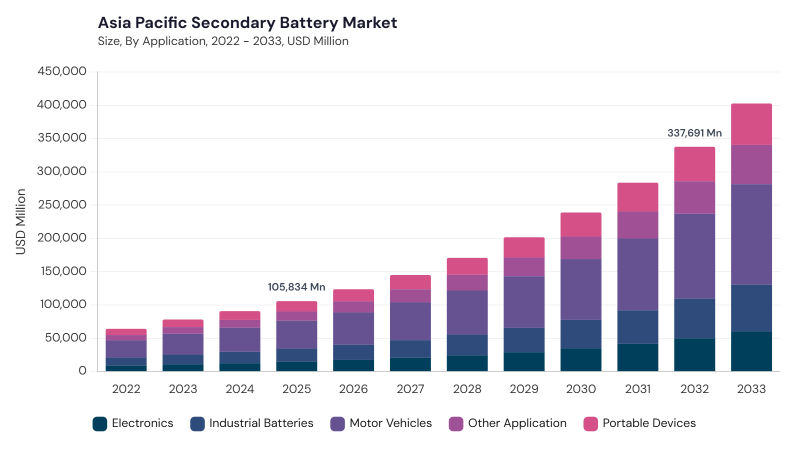
Asia Pacific Secondary Battery Market represents the largest and most strategically developed regional ecosystem for rechargeable batteries. The market combines extensive cell manufacturing, battery-material processing, consumer-electronics production, automotive manufacturing, electric-vehicle adoption, industrial applications, and rapidly expanding stationary energy storage. The regional industry initially developed around lead-acid automotive and industrial batteries, nickel-based rechargeable technologies, and consumer-electronics batteries. Lithium-ion commercialization transformed this structure, with China, Japan, South Korea, India, and Southeast Asian economies contributing across manufacturing, materials, EVs, storage, and recycling.
Electric mobility, renewable-energy storage, chemistry innovation, manufacturing scale, and supply-chain integration are shaping current market development. Lithium-ion is driving major growth across EVs, stationary storage, electronics, industrial equipment, and power tools, while lead acid remains relevant in vehicles, telecom, backup power, and industrial systems. Regional manufacturers compete through production scale, vertical integration, chemistry development, automation, customer relationships, and geographic expansion. However, raw-material volatility, overcapacity risk, price pressure, safety management, uneven market development, and rapid technology transitions continue to influence industry performance.
Based on Type, the market is segmented into Lithium-ion, Lead Acid, Nickel Metal Hydride, and Other Type. The Lithium-ion market dominated the Asia Pacific Secondary Battery Market by Type in 2025, and would continue to be a dominant market till 2033; thereby, achieving a market value of USD 165.8 billion by 2030, growing at a CAGR of 18 % during the forecast period. The Lead Acid market is expected to witness a CAGR of 19% during (2026 - 2033). Additionally, The Nickel Metal Hydride market is expected to witness highest CAGR of 20.9% during (2026 - 2033).
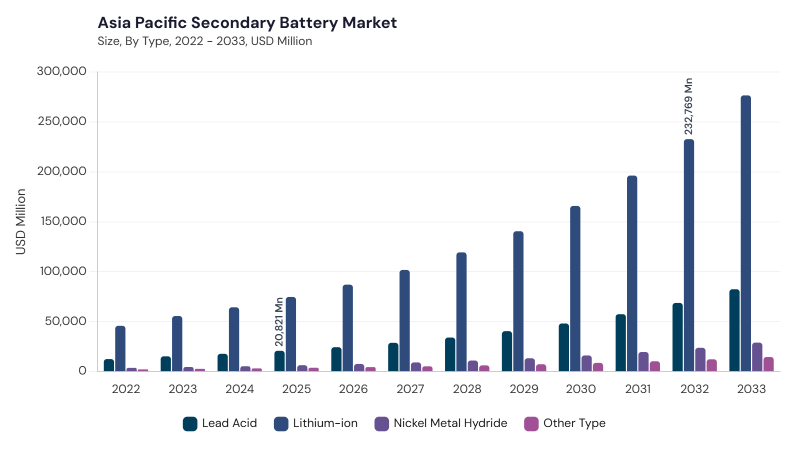
Lithium-ion represents the dominant and fastest-developing technology category, supported by EVs, stationary storage, consumer electronics, portable devices, telecom systems, power tools, and electrified applications. Lead Acid captured a substantial share through two-wheelers, passenger vehicles, commercial vehicles, telecommunications, UPS systems, industrial backup, and replacement demand. Nickel Metal Hydride established a considerable presence through hybrid vehicles and specialized rechargeable applications requiring proven reliability and stable operating performance. Other Type remained promising through emerging chemistries focused on cost optimization, resource availability, thermal stability, long duration, safety, and specialized industrial or stationary-storage requirements.
Based on Application, the market is segmented into Automotive Batteries, Industrial Batteries, Portable Batteries, Power Tool Batteries, SLI Batteries, and Other Application. Automotive Batteries include EV traction systems, plug-in hybrid batteries, hybrid platforms, two-wheeler batteries, three-wheeler batteries, commercial vehicle batteries, conventional vehicle batteries, and auxiliary rechargeable systems. Industrial Batteries garnered a significant share through telecom networks, data centers, manufacturing plants, warehouses, utilities, UPS systems, material handling, renewable-energy storage, and backup power.
Portable Batteries maintained a considerable presence through smartphones, computing devices, healthcare devices, recreational products, cameras, wearables, and compact rechargeable equipment. Power Tool Batteries achieved steady demand through cordless construction, maintenance, professional, and industrial equipment, while SLI Batteries retained a noteworthy role through the sizeable conventional vehicle fleet and aftermarket ecosystem. Other Application includes residential energy storage, medical equipment, agricultural machinery, marine uses, security systems, emergency equipment, specialized mobility, and other rechargeable products.
Free Valuable Insights: Secondary Battery Market is Predicted to reach USD 687.2 Billion billion by 2033, at a CAGR of 18.1%
Based on Country, the market is segmented into China, Japan, India, South Korea, Singapore, Malaysia, and Rest of Asia Pacific. The China market dominated the Asia Pacific Secondary Battery Market by Country in 2025, and would continue to be a dominant market till 2033; thereby, achieving a market value of USD 105.1 billion by 2030, growing at a CAGR of 17.1 % during the forecast period. The Japan market is expected to witness a CAGR of 17.2% during (2026 - 2033). Additionally, The India market is expected to witness a CAGR of 19.5% during (2026 - 2033).
Across Asia Pacific, Secondary Battery adoption varies with manufacturing depth, EV penetration, electronics production, renewable-energy deployment, industrialization, supply-chain maturity, and national policy support. China represents the largest integrated market, supported by materials, cells, packs, EVs, stationary storage, LFP adoption, cell-to-pack architecture, recycling, and large-scale production. Japan reflects mature battery expertise, advanced materials, consumer electronics, hybrid and EV platforms, residential storage, safety, durability, and precision manufacturing. India is transitioning from lead-acid automotive, inverter, telecom, and industrial batteries toward lithium-ion mobility, two- and three-wheeler electrification, renewable storage, and domestic manufacturing. South Korea is advanced through lithium-ion manufacturers, electronics, automotive production, materials, R&D, global supply relationships, and technology differentiation. Singapore is shaped by electronics, semiconductors, logistics, data centers, EV adoption, stationary storage, system integration, and regional service roles. Malaysia is developing through automotive manufacturing, electronics, telecom, data centers, renewable energy, EV adoption, battery-pack assembly, power electronics, and energy-storage integration. Rest of Asia Pacific remains diverse, with growth supported by electric mobility, battery manufacturing diversification, renewable-energy storage, industrial applications, electronics, mineral resources, and regional supply-chain expansion.

By Type
By Application
By Country
Set to reach $238.9 Billion by 2030, growing at 18.4% CAGR during 2026-2033.
China leads with a market value of $105.1 billion by 2030, growing at 17.1% CAGR during 2026-2033.
Rising demand for lithium-ion batteries, reaching $165.8 billion by 2030, is a key growth driver.
The lithium-ion segment will achieve $165.8 billion by 2030, growing at 18% CAGR during 2026-2033.
The India market is expected to witness a CAGR of 19.5% during 2026-2033.
The nickel metal hydride segment is expected to witness the highest CAGR of 20.9% during 2026-2033.
Our team of dedicated experts can provide you with attractive expansion opportunities for your business.




 Unique Offerings
