The sample copy of this report is available for access.
The LAMEA Secondary Battery Market is expected to reach USD 22.2 billion by 2029, growing at a CAGR of 20.6% during (2026 - 2033).
LAMEA Secondary Battery Market is developing through the convergence of transportation electrification, renewable-energy expansion, telecommunications infrastructure, industrial development, data-center investment, backup-power requirements, and adoption of rechargeable consumer and commercial equipment. Historically, demand has been strongly associated with lead-acid batteries used in conventional vehicles, UPS systems, telecom towers, industrial facilities, commercial buildings, and backup-power systems. Lithium-ion adoption is expanding through smartphones, portable electronics, EVs, renewable-energy storage, and specialized industrial applications. The pace of transition varies considerably across Latin America, the Middle East, and Africa because infrastructure, income, industrial development, and supply chains differ by country.
Renewable-energy storage, transportation electrification, telecom backup, distributed power, and advanced lithium-ion systems are shaping current market development. Lead acid remains important because of established automotive and backup-power demand, while lithium-ion accounts for an increasing share of incremental battery capacity. The region remains substantially dependent on imported lithium-ion cells and components, although opportunities exist in mineral resources, materials processing, pack assembly, system integration, and recycling. However, high initial cost, import dependence, infrastructure constraints, demanding climatic conditions, lifecycle economics, and collection or recycling gaps continue to influence adoption across LAMEA.
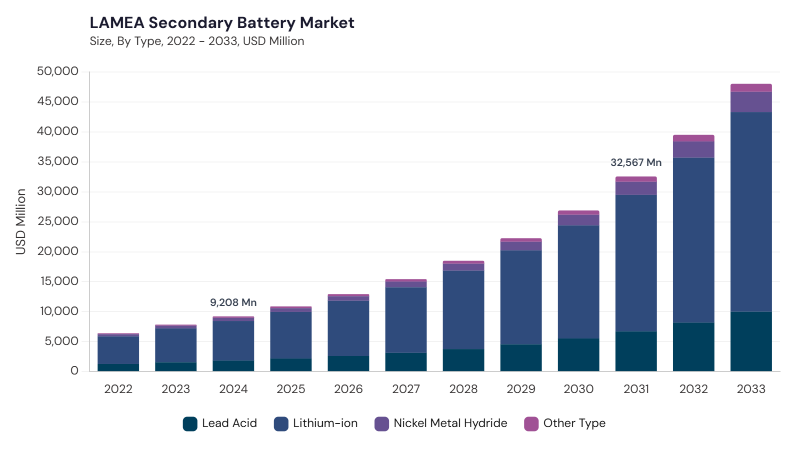
Based on Type, the market is segmented into Lithium-ion, Lead Acid, Nickel Metal Hydride, and Other Type. The Lithium-ion market dominated the LAMEA Secondary Battery Market by Type in 2025, and would continue to be a dominant market till 2033; thereby, achieving a market value of USD 15.6 billion by 2029, growing at a CAGR of 20.2 % during the forecast period. The Lead Acid market is expected to witness a CAGR of 21.2% during (2026 - 2033). Additionally, The Nickel Metal Hydride market is expected to witness highest CAGR of 23.3% during (2026 - 2033).
Lithium-ion represents the principal growth technology, supported by EVs, stationary storage, consumer electronics, telecom infrastructure, industrial equipment, distributed renewable systems, and rechargeable applications. Lead Acid garnered a significant share through conventional vehicles, telecom towers, UPS systems, off-grid power, industrial backup, and cost-sensitive applications. Nickel Metal Hydride maintained a noteworthy presence through selected hybrid transportation and specialized rechargeable equipment. Other Type remained promising through alternative battery technologies suited to challenging climates, decentralized energy systems, long-duration needs, durability, and specialized utility or industrial requirements.
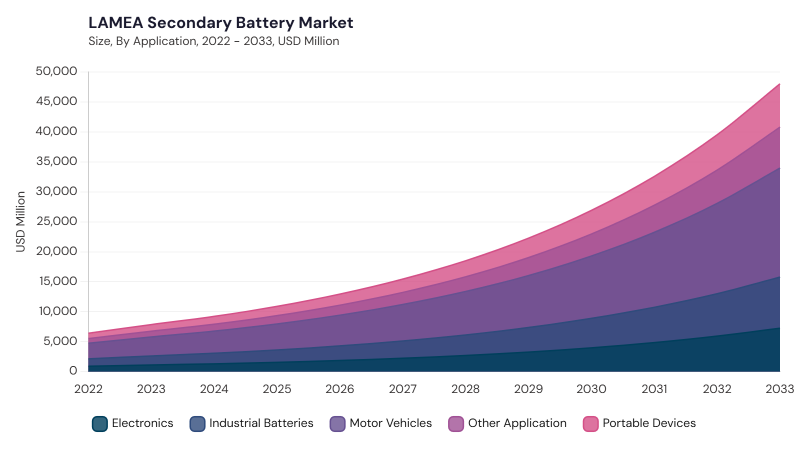
Based on Application, the market is segmented into Motor Vehicles, Industrial Batteries, Portable Devices, Electronics, and Other Application. Motor Vehicles include conventional passenger vehicles, motorcycles, buses, trucks, commercial vehicles, EVs, plug-in hybrids, electric buses, corporate fleets, and selected two- and three-wheeler applications. Industrial Batteries secured a substantial share across telecom networks, data centers, mining, oil and gas facilities, utilities, manufacturing plants, healthcare institutions, UPS systems, and backup power.
Portable Devices established a considerable presence through rechargeable tools, healthcare devices, cameras, personal equipment, wearables, and professional devices. Electronics recorded a noteworthy standing through smartphones, laptops, tablets, communication equipment, smart devices, accessories, and connected products. Other Application includes residential storage, distributed renewable systems, medical equipment, security installations, agricultural equipment, marine uses, emergency systems, specialized mobility, and off-grid power.
Free Valuable Insights: Secondary Battery Market Size Worth USD 687.2 Billion billion by 2033
Based on Country, the market is segmented into Brazil, Argentina, Saudi Arabia, UAE, South Africa, Nigeria, and Rest of LAMEA. The Brazil market dominated the LAMEA Secondary Battery Market by Country in 2025, and would continue to be a dominant market till 2033; thereby, achieving a market value of USD 6.3 billion by 2029, growing at a CAGR of 19.3 % during the forecast period. The Argentina market is expected to witness a CAGR of 21.2% during (2026 - 2033). Additionally, The UAE market is expected to witness a CAGR of 19.3% during (2026 - 2033).
Across LAMEA, Secondary Battery adoption varies with renewable resources, telecom infrastructure, automotive demand, electricity reliability, industrial activity, income levels, import dependence, and local service capability. Brazil is supported by automotive population, industrial activity, telecom, renewable resources, electric mobility, stationary storage, and distributed solar opportunities. Argentina reflects conventional automotive demand, industrial activity, telecom, consumer electronics, renewable energy, lithium resources, and emerging advanced-battery adoption. Saudi Arabia is advancing through renewable-energy storage, electric mobility, data infrastructure, industrial systems, telecom, smart-city development, and high-temperature battery requirements. The UAE is shaped by commercial infrastructure, EV adoption, charging networks, solar projects, data centers, smart buildings, logistics, and regional battery-service opportunities. South Africa is developing through automotive demand, mining, telecom, distributed solar, backup electricity, lithium-ion storage, and resilient power systems. Nigeria remains influenced by telecom infrastructure, unreliable electricity, conventional automotive demand, solar-energy applications, inverter batteries, and distributed power needs. Rest of LAMEA remains diverse, with growth shaped by renewable storage, telecom backup, electric mobility, industrial systems, distributed electricity, high-temperature conditions, and local integration or service partnerships.

By Type
By Application
By Country
Set to reach $22.2 Billion by 2029, growing at 20.6% CAGR during 2026-2033.
Brazil leads with a market value of USD 6.3 billion by 2029, growing at 19.3% CAGR during 2026-2033.
The Lithium-ion segment will reach USD 15.6 billion by 2029, growing at a 20.2% CAGR during 2026-2033.
The Lead Acid market is expected to grow at a 21.2% CAGR during 2026-2033.
The UAE market is expected to witness a CAGR of 19.3% during 2026-2033.
The Nickel Metal Hydride market is expected to witness the highest CAGR of 23.3% during 2026-2033.
Our team of dedicated experts can provide you with attractive expansion opportunities for your business.




 Unique Offerings
