The sample copy of this report is available for access.
The Europe Secondary Battery Market is expected to reach USD 77.2 billion by 2031, growing at a CAGR of 17.3% during (2026 - 2033).
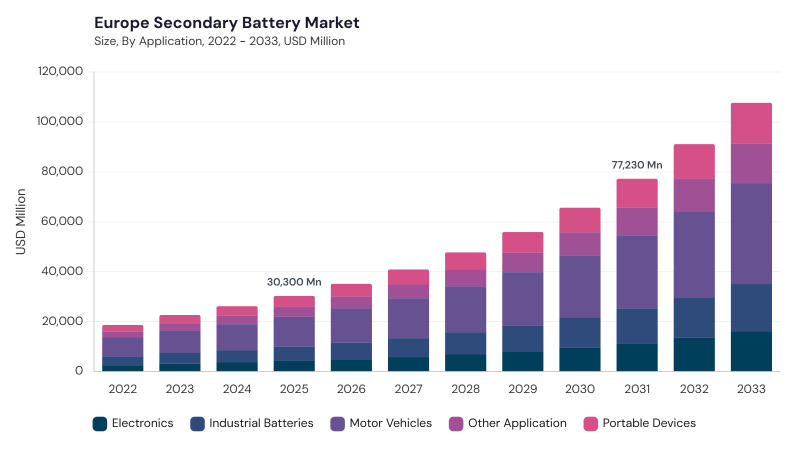
Europe Secondary Battery Market has evolved from an established rechargeable-battery industry serving conventional automobiles, industrial equipment, telecommunications infrastructure, UPS systems, portable devices, and electronics into a strategically important part of Europe’s electrification and energy-transition strategy. Lead-acid batteries historically formed a major portion of demand through automotive and industrial applications, while lithium-ion transformed the market through consumer electronics, electric vehicles, and stationary energy storage. European automotive manufacturers are progressively electrifying vehicle portfolios, increasing battery capacity per vehicle and encouraging investment in regional cells, modules, packs, materials, and recycling capabilities.
Vehicle electrification, renewable-energy storage, energy security, circularity, and regional battery manufacturing are shaping current market development. Battery demand is moving toward high-capacity lithium-ion traction systems while maintaining substantial replacement needs for established automotive and industrial batteries. Manufacturers are pursuing localized production, automotive partnerships, chemistry diversification, automation, materials sourcing, energy-efficient manufacturing, and recycling. However, high manufacturing costs, imported material dependence, strong international price competition, supply-chain resilience needs, and rapid technology and regulatory change continue to influence Europe’s secondary-battery ecosystem.
Based on Type, the market is segmented into Lithium-ion, Lead Acid, Nickel Metal Hydride, and Other Type. The Lithium-ion market dominated the Europe Secondary Battery Market by Type in 2025, and would continue to be a dominant market till 2033; thereby, achieving a market value of USD 53.4 billion by 2031, growing at a CAGR of 16.9 % during the forecast period. The Lead Acid market is expected to witness a CAGR of 18% during (2026 - 2033). Additionally, The Nickel Metal Hydride market is expected to witness highest CAGR of 19.9% during (2026 - 2033).
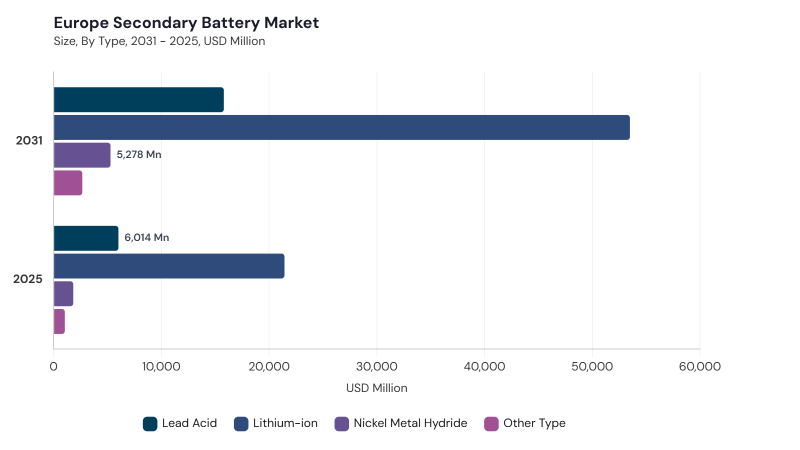
Lithium-ion represents the principal growth engine, supported by EV production, stationary storage, portable electronics, industrial electrification, power tools, and diversified rechargeable applications. Lead Acid attained a significant share through conventional automotive replacement, industrial backup, telecom infrastructure, UPS systems, emergency power, material handling, service networks, and mature recycling infrastructure. Nickel Metal Hydride demonstrated a considerable presence through hybrid mobility and selected rechargeable applications requiring dependable cycle performance. Other Type remained promising through emerging chemistries addressing material efficiency, recyclability, safety, storage duration, cost, and specialized operating requirements.
Based on Application, the market is segmented into Automotive Batteries, Industrial Batteries, Portable Batteries, Power Tool Batteries, SLI Batteries, and Other Application. Automotive Batteries include EV traction batteries, plug-in hybrid systems, hybrid platforms, conventional automotive batteries, and auxiliary rechargeable systems, with lithium-ion leading growth and lead acid remaining relevant in conventional and low-voltage applications. Industrial Batteries secured a substantial share across telecom networks, data centers, UPS systems, utilities, manufacturing facilities, material handling, renewable-energy systems, and backup power.
Portable Batteries retained a significant presence across consumer, healthcare, industrial, and professional portable equipment. Power Tool Batteries established a considerable standing through cordless construction, maintenance, industrial, and professional equipment use, while SLI Batteries retained a noteworthy role through Europe’s large conventional and start-stop vehicle base. Other Application includes specialized medical equipment, marine systems, security devices, emergency equipment, residential energy products, recreational systems, agricultural equipment, specialized mobility, and other rechargeable uses.
Free Valuable Insights: The Worldwide Secondary Battery Market is projected to reach USD 687.2 Billion billion by 2033, at a CAGR of 18.1%
Based on Country, the market is segmented into Germany, UK, France, Russia, Spain, Italy, and Rest of Europe. The Germany market dominated the Europe Secondary Battery Market by Country in 2025, and would continue to be a dominant market till 2033; thereby, achieving a market value of USD 18.7 billion by 2031, growing at a CAGR of 16 % during the forecast period. The UK market is expected to witness a CAGR of 16.1% during (2026 - 2033). Additionally, The France market is expected to witness a CAGR of 18.2% during (2026 - 2033).
Across Europe, Secondary Battery adoption varies with automotive electrification, industrial maturity, renewable-energy deployment, grid-storage demand, manufacturing capacity, supply-chain development, and sustainability requirements. Germany is supported by its automotive base, industrial economy, renewable infrastructure, EV batteries, stationary storage, engineering systems, and recycling. The UK is shaped by electric mobility, renewable electricity, grid-scale storage, digital infrastructure, backup power, and battery-system engineering. France advances through automotive manufacturing, electricity infrastructure, industrial activity, renewable energy, regional supply-chain investment, and lifecycle sustainability. Russia remains driven by conventional automotive demand, industrial infrastructure, telecom, energy facilities, backup power, durability needs, and specialized rechargeable applications. Spain benefits from automotive manufacturing, solar and wind resources, lithium-ion growth, stationary storage, industrial activity, and battery-related manufacturing opportunities. Italy reflects demand from automotive and industrial manufacturing, telecom, consumer electronics, solar-plus-storage, commercial facilities, logistics, backup power, and distributed energy systems. Rest of Europe remains diverse, with growth shaped by EV adoption, renewable storage, industrial modernization, telecom, data infrastructure, consumer electronics, battery collection, traceability, and recycling.

By Type
By Application
By Country
Set to reach $77.2 Billion by 2031, growing at 17.3% CAGR during 2026-2033.
Germany leads, achieving a market value of USD 18.7 billion by 2031, growing at a CAGR of 16% during the forecast period.
The Lithium-ion segment dominates, reaching USD 53.4 billion by 2031 at a 16.9% CAGR during 2026-2033.
Expected to witness the highest CAGR of 19.9% during 2026-2033.
France is expected to witness a CAGR of 18.2% during 2026-2033.
Our team of dedicated experts can provide you with attractive expansion opportunities for your business.




 Unique Offerings
