The sample copy of this report is available for access.
The North America Wrapping Machine Market is expected to reach USD 1014.8 million by 2032, growing at a CAGR of 3.8% during (2026 - 2033).
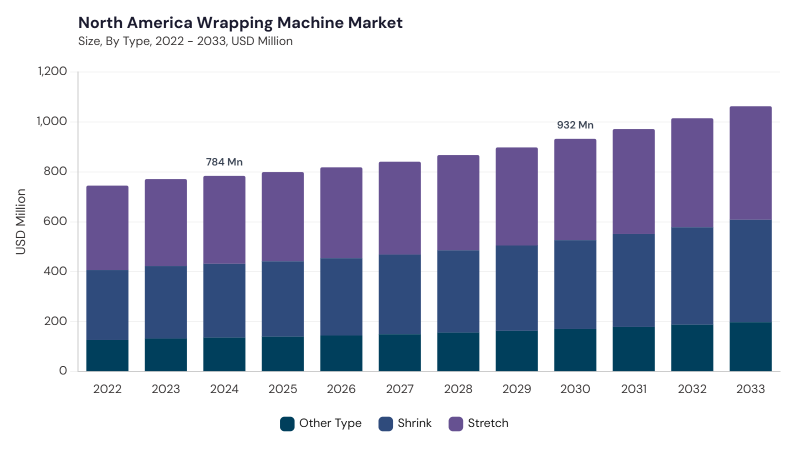
North America Wrapping Machine Market is shaped by a mature manufacturing base, strong packaging-equipment capacity, and rising transition toward flexible, automated, and digitally supported packaging operations. The US remains the largest regional machinery environment, supported by food, beverages, pharmaceuticals, chemicals, personal care, household products, industrial manufacturing, logistics, and warehousing. Canada contributes through food processing, beverages, pharmaceuticals, consumer products, and industrial manufacturing. Mexico is gaining importance as nearshoring and manufacturing investment expand regional production capacity.
Automation, SKU proliferation, sustainability, and end-of-line integration are shaping current market development. Manufacturers are adopting wrapping machines to reduce repetitive manual work, improve consistency, support rapid changeovers, and manage shorter production runs. Equipment suppliers are advancing servo controls, programmable recipes, automatic film management, remote diagnostics, condition monitoring, intuitive HMIs, and digital maintenance tools. However, high capital cost, sustainable-material transition complexity, skilled maintenance needs, integration requirements, and installed-base obsolescence continue to influence equipment selection across North America.
Based on Mode of Operation, the market is segmented into Automatic and Semi-automatic. The Automatic market dominated the North America Wrapping Machine Market by Mode of Operation in 2025, and would continue to be a dominant market till 2033; thereby, achieving a market value of USD 600.8 million by 2032, growing at a CAGR of 3.6 % during the forecast period. Additionally, The Semi-automatic market is expected to witness highest CAGR of 4.2% during (2026 - 2033).
Automatic wrapping systems are widely used in food and beverage plants, pharmaceutical manufacturing, consumer goods, logistics centers, and automated warehouses where throughput, labor reduction, and consistency are critical. These systems increasingly connect with conveyors, robotic palletizers, scanners, labeling, and warehouse automation. Semi-automatic maintained a promising presence among SMEs, regional processors, distribution facilities, and operations with moderate wrapping volumes. It offers better consistency than manual wrapping while requiring lower capital and infrastructure than fully automatic systems. As plants modernize, automatic systems gain momentum, while semi-automatic equipment remains relevant where flexibility and affordability are priorities.
Based on Type, the market is segmented into Stretch, Shrink, and Other Type. Stretch wrapping supports secure transportation of palletized goods across food, beverages, chemicals, personal care, industrial products, retail, and warehouse environments. Demand is strengthening for powered pre-stretch, programmable tension, automatic load-height detection, optimized wrap patterns, and integration with palletizers and warehouse systems.
Shrink garnered a significant share due to demand for compact, tamper-resistant, and visually appealing packaging across beverages, food, pharmaceuticals, and consumer goods. Other Type retained a promising presence in specialized applications requiring overwrapping, orbital wrapping, band wrapping, fold wrapping, sleeve wrapping, or customized product handling. E-commerce fulfillment and automated distribution centers are further supporting versatile wrapping technologies.
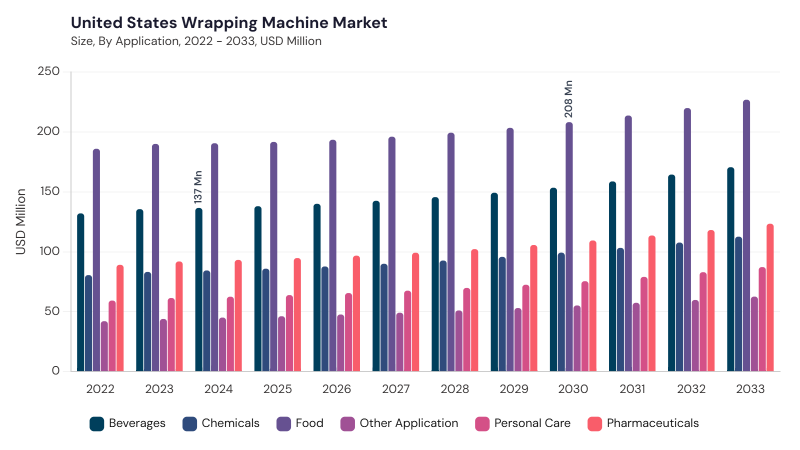
Based on Application, the market is segmented into Food, Beverages, Pharmaceuticals, Chemicals, Personal Care, and Other Application. Food applications require hygienic construction, reliable seals, flexible changeovers, broad material compatibility, and effective throughput across varied product formats. Beverages achieved a substantial share due to secondary packaging, shrink bundling, multipacks, and pallet stabilization requirements.
Pharmaceuticals established a significant presence as manufacturers prioritize packaging integrity, repeatability, traceability, and controlled production processes. Chemicals recorded considerable demand for secure transport and pallet containment, while Personal Care benefited from attractive and protective retail packaging needs. Other Application includes household goods, electronics, building products, paper, textiles, contract packaging, warehousing, and industrial products.
Free Valuable Insights: The Global Wrapping Machine Market will hit USD 3870.4 Million billion by 2033, at a CAGR of 4.5%
Based on Country, the market is segmented into US, Canada, Mexico, and Rest of North America. The US market dominated the North America Wrapping Machine Market by Country in 2025, and would continue to be a dominant market till 2033; thereby, achieving a market value of USD 752.8 million by 2032, growing at a CAGR of 3.1 % during the forecast period. The Canada market is expected to witness a CAGR of 6.1% during (2026 - 2033). Additionally, The Mexico market is expected to witness a CAGR of 5.1% during (2026 - 2033).
Across North America, wrapping machine adoption varies with manufacturing scale, automation maturity, labor costs, packaging volume, nearshoring, and service infrastructure. The US emphasizes high-speed automation, food and beverage packaging, pharmaceuticals, logistics, end-of-line integration, sustainability-ready films, remote diagnostics, and lifecycle modernization. Canada focuses on food processing, beverages, pharmaceuticals, industrial packaging, workforce productivity, film efficiency, sustainability, and reliable local technical service. Mexico is advancing through nearshoring, manufacturing expansion, packaging machinery imports, automation readiness, Spanish-language support, operator training, and local spare-parts access. Rest of North America remains more dependent on semi-automatic systems, imported machinery, affordability, distributor support, food and beverage modernization, export packaging, and scalable automation.

By Mode of Operation
By Type
By Application
By Country
Set to reach $1014.8 Million by 2032, growing at 3.8% CAGR during 2026-2033.
The US leads with $752.8 million by 2032, growing at a CAGR of 3.1% during 2026-2033.
The automatic segment dominates, reaching $600.8 million by 2032 at a CAGR of 3.6% during 2026-2033.
The semi-automatic segment is expected to witness the highest CAGR of 4.2% during 2026-2033.
Canada is expected to witness a CAGR of 6.1% during 2026-2033.
Our team of dedicated experts can provide you with attractive expansion opportunities for your business.




 Unique Offerings
