The sample copy of this report is available for access.
The LAMEA Wrapping Machine Market is expected to reach USD 255.0 million by 2029, growing at a CAGR of 6.3% during (2026 - 2033).
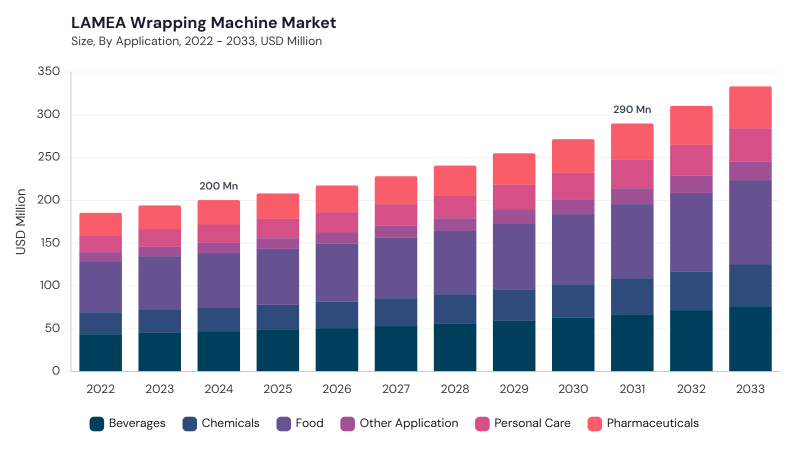
LAMEA Wrapping Machine Market is shaped by highly varied packaging machinery adoption across Latin America, the Middle East, and Africa. Brazil, UAE, Saudi Arabia, and South Africa have comparatively developed manufacturing bases, while several emerging markets are still moving from manual handling toward semi-automatic and automatic systems. Demand comes from food and beverages, pharmaceuticals, chemicals, personal care, household products, agricultural processing, consumer goods, petrochemicals, building materials, industrial manufacturing, logistics, and export industries. Stretch wrapping is important for pallet stabilization and transport packaging, while shrink machinery supports beverages, food, household products, and multipacks.
Industrial modernization, manufacturing localization, automation, logistics growth, and sustainability are shaping current market development. Brazil is upgrading packaging operations across food, beverages, pharmaceuticals, agribusiness, and consumer products, while Saudi Arabia and the UAE are expanding non-oil manufacturing. Manufacturers increasingly need wrapping machinery to improve throughput, reduce packaging variability, and manage workforce constraints. However, affordability, imported-equipment economics, currency fluctuations, import duties, financing availability, technical-service coverage, and spare-parts lead times continue to influence adoption across LAMEA.
Based on Mode of Operation, the market is segmented into Automatic and Semi-automatic. The Automatic market dominated the LAMEA Wrapping Machine Market by Mode of Operation in 2025, and would continue to be a dominant market till 2033; thereby, achieving a market value of USD 154.4 million by 2029, growing at a CAGR of 6 % during the forecast period. Additionally, The Semi-automatic market is expected to witness highest CAGR of 6.7% during (2026 - 2033).
Automatic wrapping machinery is gaining adoption among large food, beverage, pharmaceutical, chemical, personal-care, industrial, and logistics users seeking higher consistency and productivity. These systems increasingly connect with conveyors, robotic palletizers, labeling, inspection, and warehouse handling. Semi-automatic preserved a promising presence among SMEs, warehouses, food processors, distributors, and moderate-volume manufacturers requiring affordable equipment for variable schedules and diverse package formats. It remains an important first step from manual wrapping toward future automation.
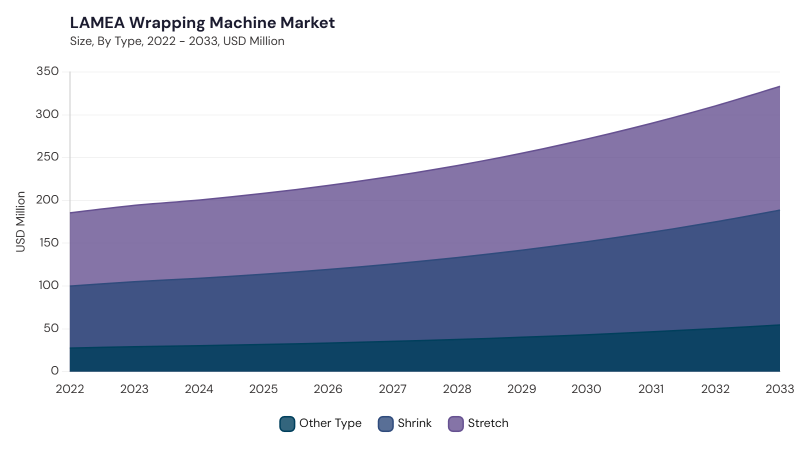
Based on Type, the market is segmented into Stretch, Shrink, and Other Type. Stretch wrapping supports food, beverages, chemicals, building materials, consumer products, pharmaceuticals, agriculture, and industrial goods where load stability is important. Demand is increasing for powered pre-stretch, programmable tension, reinforcement zones, automatic height sensing, optimized wrap patterns, and palletizer integration.
Shrink achieved a significant share due to its effectiveness in unitizing products, protective containment, beverage multipacks, food packaging, and retail handling. Other Type sustained a promising presence across orbital, overwrapping, sleeve, fold, band, and specialized industrial wrapping applications.
Based on Application, the market is segmented into Food, Beverages, Pharmaceuticals, Chemicals, Personal Care, and Other Application. Food applications cover bakery, confectionery, meat, dairy, frozen foods, processed fruits and vegetables, snacks, grains, ready-to-eat products, ingredients, trays, cases, multipacks, and finished pallets. Beverages garnered a substantial share through bottling, shrink multipacks, secondary packaging, and pallet stabilization.
Pharmaceuticals retained a significant presence as regional medicine production and healthcare supply chains develop, while Chemicals reflected demand across petrochemicals, fertilizers, and industrial materials. Personal Care expanded with beauty, hygiene, cosmetics, soaps, fragrances, and household products. Other Application covers building materials, paper, textiles, furniture, electronics, agriculture, logistics, and industrial products.
Free Valuable Insights: Wrapping Machine Market Size Worth USD 3870.4 Million billion by 2033
Based on Country, the market is segmented into Brazil, Argentina, UAE, Saudi Arabia, South Africa, Nigeria, and Rest of LAMEA. The Brazil market dominated the LAMEA Wrapping Machine Market by Country in 2025, and would continue to be a dominant market till 2033; thereby, achieving a market value of USD 80.6 million by 2029, growing at a CAGR of 5.2 % during the forecast period. The Argentina market is expected to witness a CAGR of 6.9% during (2026 - 2033). Additionally, The UAE market is expected to witness a CAGR of 4.9% during (2026 - 2033).
Across LAMEA, wrapping machine adoption varies with manufacturing maturity, automation readiness, import dependence, food-processing scale, logistics infrastructure, and local service strength. Brazil emphasizes packaging modernization, automation, food and beverage strength, agribusiness, pharmaceuticals, circularity, film efficiency, and lifecycle support, while Argentina focuses on food processing, beverages, wine, pharmaceuticals, imports, flexible machinery, and after-sales support. The UAE prioritizes advanced manufacturing, logistics, automatic wrapping, industrial zones, re-export activity, and integrated automation, whereas Saudi Arabia emphasizes Vision 2030, food manufacturing, pharmaceuticals, localization, SFDA-linked industrial growth, and 4IR technologies. South Africa focuses on established food, beverage, pharmaceuticals, chemicals, logistics, replacement demand, robust equipment, and regional distribution. Nigeria is advancing through food and beverage processing, imported machinery, semi-automatic adoption, affordability, and technical support. Rest of LAMEA remains highly diverse, with growth driven by food processing, exports, logistics modernization, manual-to-semi-automatic transition, and phased automation.

By Mode of Operation
By Type
By Application
By Country
Set to reach $255.0 Million by 2029, growing at 6.3% CAGR during 2026-2033.
Brazil leads with a market value of USD 80.6 million by 2029, growing at a CAGR of 5.2% during 2026-2033.
The automatic segment dominates, reaching USD 154.4 million by 2029, with a 6% CAGR during 2026-2033.
The semi-automatic segment is expected to witness the highest CAGR of 6.7% during 2026-2033.
The UAE market is expected to witness a CAGR of 4.9% during 2026-2033.
The Argentina market is expected to witness a CAGR of 6.9% during 2026-2033.
Our team of dedicated experts can provide you with attractive expansion opportunities for your business.




 Unique Offerings
