The sample copy of this report is available for access.
The Asia Pacific Wrapping Machine Market is expected to reach USD 1331.1 million by 2030, growing at a CAGR of 4.9% during (2026 - 2033).
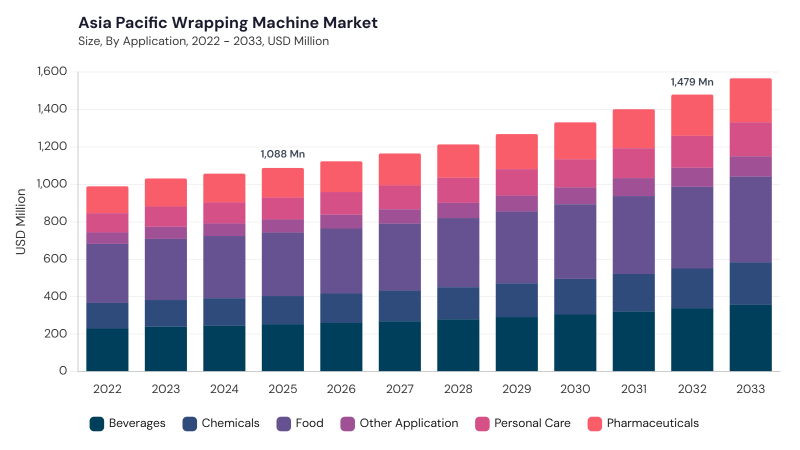
Asia Pacific Wrapping Machine Market is shaped by a highly diverse packaging-equipment environment covering advanced manufacturing economies such as Japan, South Korea, Singapore, and Australia, China’s large industrial and consumer-goods base, and rapidly modernizing markets including India and Southeast Asia. Demand comes from food and beverages, pharmaceuticals, chemicals, personal care, electronics, household products, industrial manufacturing, e-commerce, export production, and logistics. The region combines high-speed automatic packaging plants with a large base of SMEs moving from manual operations toward semi-automatic and automatic machinery.
Manufacturing automation, packaged-food growth, organized retail, e-commerce, logistics expansion, and material efficiency are shaping current market development. Rising wages, employee turnover, production growth, and technical workforce shortages are improving automation economics across the region. Wrapping machines are increasingly used for pallet stability, multipack protection, standardized secondary packaging, and transport packaging. However, capital sensitivity among SMEs, skilled technician shortages, strong price competition, service coverage challenges, affordability constraints, and diverse operating conditions continue to influence machinery adoption across Asia Pacific.
Based on Mode of Operation, the market is segmented into Automatic and Semi-automatic. The Automatic market dominated the Asia Pacific Wrapping Machine Market by Mode of Operation in 2025, and would continue to be a dominant market till 2033; thereby, achieving a market value of USD 797.0 million by 2030, growing at a CAGR of 4.6 % during the forecast period. Additionally, The Semi-automatic market is expected to witness highest CAGR of 5.2% during (2026 - 2033).
Automatic wrapping systems are gaining adoption among large manufacturers, export-oriented plants, food and beverage processors, pharmaceutical companies, e-commerce logistics facilities, and multinational production sites. These machines support automatic film handling, wrapping, sealing or cutting, product detection, discharge, and integration with conveyors, palletizers, inspection systems, and warehouse equipment. Semi-automatic retained a promising presence among SMEs and moderate-volume manufacturers needing affordable machinery for varied products and fluctuating output. It remains important as an entry point before companies migrate toward higher automation.
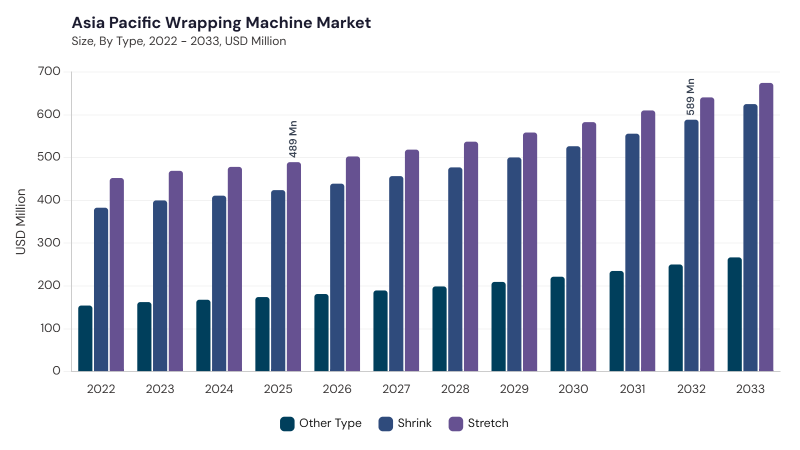
Based on Type, the market is segmented into Stretch, Shrink, and Other Type. Stretch wrapping supports food, beverages, chemicals, electronics, consumer goods, industrial products, building materials, textiles, export manufacturing, and e-commerce logistics. Demand is increasing for powered pre-stretch, programmable tension, reinforcement patterns, automatic load-height detection, optimized film application, and integration with robotic palletizers.
Shrink captured a substantial share due to bundling, product protection, tray packs, multipacks, and retail presentation across food, beverages, personal care, pharmaceuticals, and consumer goods. Other Type maintained a promising presence in orbital wrapping, overwrapping, banding, fold wrapping, sleeve wrapping, and customized applications.
Based on Application, the market is segmented into Food, Beverages, Pharmaceuticals, Chemicals, Personal Care, and Other Application. Food applications require wrapping across bakery, snacks, dairy, meat, frozen products, ready meals, noodles, processed foods, ingredients, fresh products, and local food categories. Beverages attained a substantial share through bottled water, juices, dairy drinks, cans, cartons, multipacks, shrink wrapping, and pallet stabilization.
Pharmaceuticals maintained a significant presence due to medicine production and stricter packaging consistency, while Chemicals relied on secure shipment preparation. Personal Care benefited from beauty, hygiene, skincare, cosmetics, and grooming products. Other Application covers electronics, household goods, textiles, paper, building materials, agriculture, e-commerce, contract packaging, and logistics.
Free Valuable Insights: Wrapping Machine Market is Predicted to reach USD 3870.4 Million billion by 2033, at a CAGR of 4.5%
Based on Country, the market is segmented into China, Japan, India, South Korea, Australia, Malaysia, and Rest of Asia Pacific. The China market dominated the Asia Pacific Wrapping Machine Market by Country in 2025, and would continue to be a dominant market till 2033; thereby, achieving a market value of USD 480.4 million by 2030, growing at a CAGR of 3.5 % during the forecast period. The Japan market is expected to witness a CAGR of 4.1% during (2026 - 2033). Additionally, The India market is expected to witness a CAGR of 5.6% during (2026 - 2033).
Across Asia Pacific, wrapping machine adoption varies with manufacturing scale, automation maturity, packaging volume, labor economics, service infrastructure, and export orientation. China combines large domestic machinery production, automated packaging lines, e-commerce logistics, film efficiency, and strong demand across premium and economical equipment. Japan emphasizes mature automation, compact design, precision, robotics, labor-saving systems, and machine-material collaboration. India is advancing through packaged consumption, food processing, pharmaceuticals, e-commerce, organized retail, localization, and scalable automation. South Korea focuses on smart factories, electronics, cosmetics, robotics integration, digital controls, and flexible high-speed machinery. Malaysia is moving toward Industry 4.0, smart manufacturing, food-processing automation, IIoT, predictive maintenance, and digitally connected wrapping lines. Rest of Asia Pacific reflects growth across Indonesia, Vietnam, Thailand, the Philippines, New Zealand, and other markets where manufacturing expansion, workforce pressure, logistics modernization, and after-sales support shape machinery demand.

By Mode of Operation
By Type
By Application
By Country
Set to reach $1331.1 Million by 2030, growing at 4.9% CAGR during 2026-2033.
China leads with $480.4 million by 2030, growing at a CAGR of 3.5% during 2026-2033.
The automatic segment will dominate, reaching $797.0 million by 2030 at a CAGR of 4.6% during 2026-2033.
The semi-automatic segment is expected to witness the highest CAGR of 5.2% during 2026-2033.
Japan is expected to witness a CAGR of 4.1% during 2026-2033.
India is expected to witness a CAGR of 5.6% during 2026-2033.
Our team of dedicated experts can provide you with attractive expansion opportunities for your business.




 Unique Offerings
