The sample copy of this report is available for access.
The Europe Wrapping Machine Market is expected to reach USD 825.4 million by 2031, growing at a CAGR of 4.1% during (2026 - 2033).
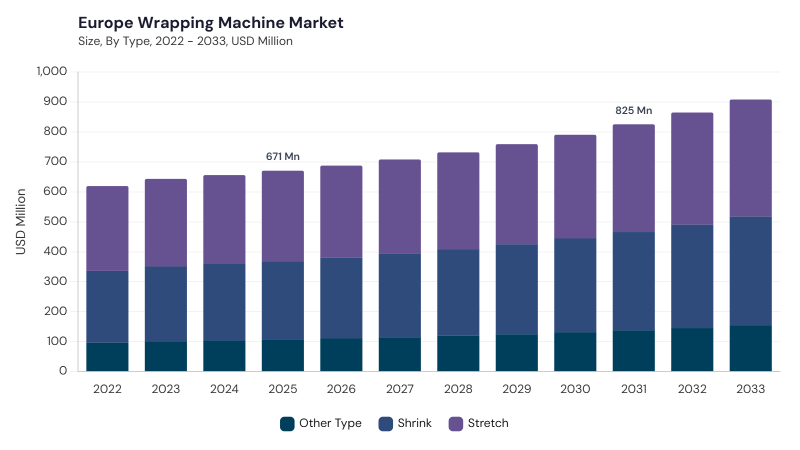
Europe Wrapping Machine Market is shaped by a mature packaging machinery ecosystem, strong engineering capabilities, and extensive demand from food, beverages, pharmaceuticals, chemicals, personal care, industrial manufacturing, retail distribution, and logistics. Germany and Italy remain important machinery manufacturing centers, while France, the UK, Spain, Benelux, Central Europe, and other markets contribute sizable end-user demand. Wrapping operations range from semi-automatic pallet wrappers in smaller factories and warehouses to advanced automatic stretch and shrink systems integrated into highly automated production lines.
Automation, flexibility, sustainability, and digital integration are shaping current market development. European manufacturers are adopting automatic wrappers connected with conveyors, robotic palletizers, inspection systems, labeling equipment, and warehouse automation. Product variety, retailer-specific formats, and shorter production runs are increasing demand for servo controls, recipe-based settings, modular architectures, and automatic format adjustments. PPWR, circular-economy objectives, sustainable films, energy efficiency, lifecycle economics, and modernization of mature installed machinery are further influencing equipment selection across Europe.
Based on Mode of Operation, the market is segmented into Automatic and Semi-automatic. The Automatic market dominated the Europe Wrapping Machine Market by Mode of Operation in 2025, and would continue to be a dominant market till 2033; thereby, achieving a market value of USD 493.2 million by 2031, growing at a CAGR of 3.8 % during the forecast period. Additionally, The Semi-automatic market is expected to witness highest CAGR of 4.4% during (2026 - 2033).
Automatic wrapping machines are used across food processing, beverages, pharmaceuticals, chemicals, personal care, and industrial manufacturing where efficiency, safety, throughput, and reduced manual work are critical. These systems increasingly support film dispensing, wrapping, sealing or cutting, product detection, discharge, and communication with adjacent equipment. Semi-automatic sustained a promising presence among smaller manufacturers, specialty producers, warehouses, and mixed-product operations requiring lower capital investment. Its role remains important where frequent format changes, moderate volumes, flexibility, and affordability outweigh the need for complete automation.
Based on Type, the market is segmented into Stretch, Shrink, and Other Type. Stretch wrapping supports food, beverages, chemicals, personal care, industrial goods, building materials, and export-oriented supply chains where pallet stability and transport protection are essential. Demand is increasing for powered pre-stretch, programmable tension, reinforcement zones, automatic height detection, optimized wrap patterns, and compatibility with recycled-content films.
Shrink attained a substantial share due to product bundling, protective enclosure, multipacks, and shelf-ready presentation across packaged goods. Other Type maintained a promising presence in overwrapping, orbital wrapping, fold wrapping, band wrapping, sleeve systems, and customized applications requiring specialized protection or presentation.
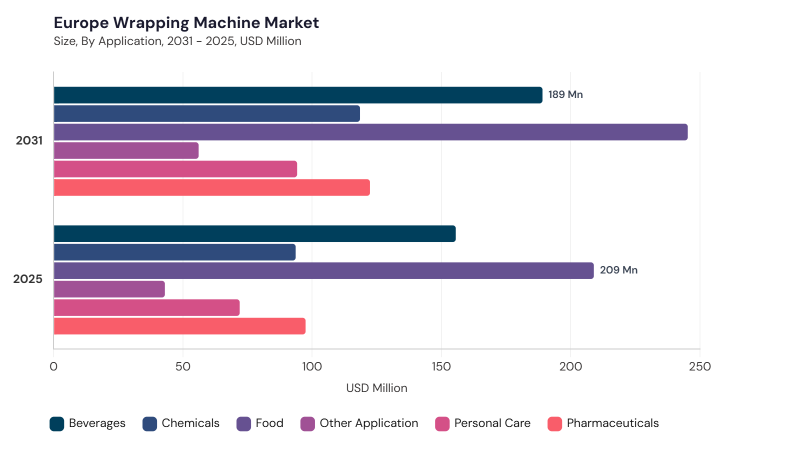
Based on Application, the market is segmented into Food, Beverages, Pharmaceuticals, Chemicals, Personal Care, and Other Application. Food applications require hygienic construction, reliable throughput, rapid changeovers, broad material compatibility, and package integrity across bakery, meat, dairy, frozen foods, prepared meals, produce, and specialty categories. Beverages garnered a significant share through shrink multipacks, bottles, cans, trays, cartons, and pallet containment.
Pharmaceuticals developed a considerable presence through controlled, traceable, and repeatable packaging needs, while Chemicals required robust wrapping for safe storage and transportation. Personal Care achieved a noteworthy role through premium presentation, promotional formats, and retail packaging quality. Other Application covers industrial products, household goods, paper, textiles, electronics, logistics, contract packaging, and specialized manufacturing.
Free Valuable Insights: The Worldwide Wrapping Machine Market is projected to reach USD 3870.4 Million billion by 2033, at a CAGR of 4.5%
Based on Country, the market is segmented into Germany, UK, France, Russia, Spain, Italy, and Rest of Europe. The Germany market dominated the Europe Wrapping Machine Market by Country in 2025, and would continue to be a dominant market till 2033; thereby, achieving a market value of USD 188.6 million by 2031, growing at a CAGR of 2.8 % during the forecast period. The UK market is expected to witness a CAGR of 2.8% during (2026 - 2033). Additionally, The France market is expected to witness a CAGR of 4.8% during (2026 - 2033).
Across Europe, wrapping machine adoption varies with engineering depth, packaging automation, food and beverage scale, sustainability pressure, labor costs, and service infrastructure. Germany emphasizes advanced engineering, automation, robotics integration, PPWR-ready materials, digitalization, and lifecycle modernization, while the UK focuses on food processing, private-label production, labor-saving automation, flexible machinery, and sustainable material compliance. France prioritizes food, beverages, cosmetics, pharmaceuticals, package quality, automation, and material compatibility. Russia emphasizes robust machinery, local maintainability, component availability, food and beverage production, and reliable pallet containment. Spain focuses on food exports, beverages, seasonal flexibility, automatic wrapping, and sustainability-driven upgrades. Italy combines strong domestic demand with packaging-machinery manufacturing, customized engineering, format flexibility, and connected equipment. Rest of Europe blends advanced Benelux, Nordic, Swiss, and Austrian automation with Central and Eastern European manufacturing investment and cost-effective modular machinery demand.

By Mode of Operation
By Type
By Application
By Country
Set to reach $825.4 Million by 2031, growing at 4.1% CAGR during 2026-2033.
Germany leads with $188.6 million by 2031, growing at 2.8% CAGR during 2026-2033.
Automatic segment dominates, reaching $493.2 million by 2031 at 3.8% CAGR during 2026-2033.
Semi-automatic segment to witness highest growth at 4.4% CAGR during 2026-2033.
The UK market is expected to witness a CAGR of 2.8% during 2026-2033.
France market to grow at 4.8% CAGR during 2026-2033.
Our team of dedicated experts can provide you with attractive expansion opportunities for your business.




 Unique Offerings
