The sample copy of this report is available for access.
The North America Supply Chain ERP Market would reach a market value of USD 8.01 billion by 2032, witnessing a market growth of 6.6% CAGR during the forecast period (2026-2033).
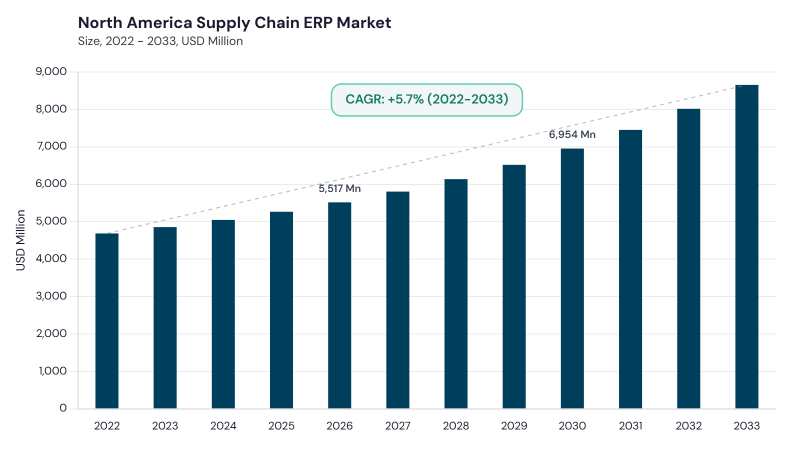
The U.S. market dominated the North America Supply Chain ERP Market by Country in 2025 and would continue to be a dominant market till 2033; thereby, achieving a market value of USD 6.25 billion by 2033, growing at a CAGR of 5.9% during the forecast period. The Canada market is expected to witness a CAGR of 9.2% during (2026-2033). Additionally, the Mexico market is expected to witness a CAGR of 7.9% during (2026-2033). The U.S. and Canada led the North America Supply Chain ERP Market by Country with market shares of 76.1% and 10.8% respectively in 2025.
The North America Supply Chain ERP Market has evolved significantly due to rising enterprise demand for digital transformation, operational efficiency, and intelligent supply chain management solutions. Initially, ERP systems across the region primarily focused on inventory management, procurement tracking, and financial operations. However, rapid advancements in cloud computing, artificial intelligence, machine learning, IoT integration, and predictive analytics have transformed ERP platforms into highly intelligent business management ecosystems capable of delivering real-time operational visibility and automated decision-making capabilities. Enterprises across manufacturing, retail, healthcare, automotive, and logistics sectors are increasingly deploying advanced ERP systems to optimize supply chain workflows, improve demand forecasting, reduce operational risks, and strengthen business continuity strategies.
A major trend shaping the market is the growing adoption of cloud-based ERP platforms. Enterprises are increasingly migrating away from legacy on-premise infrastructure toward scalable cloud-native ERP environments that offer lower infrastructure costs, improved flexibility, and remote accessibility. Hybrid deployment models are also gaining traction as organizations seek to balance scalability, security, and operational control. In addition, AI-powered analytics and predictive supply chain intelligence are becoming critical differentiators across ERP ecosystems, enabling organizations to proactively respond to disruptions, optimize inventory planning, and improve customer fulfillment efficiency.
The competitive landscape remains highly dynamic and innovation-driven. Vendors are increasingly integrating generative AI, intelligent automation, digital twins, advanced analytics, and ESG-focused reporting functionalities into ERP ecosystems to strengthen enterprise supply chain resilience and operational agility. Rising enterprise investments in cybersecurity, data governance, and intelligent workflow automation are expected to continue driving strong market expansion throughout the forecast period.
Based on Organization Size, the market is segmented into Large Enterprises and Small & Medium Enterprises (SMEs). The Large Enterprises segment dominated the North America Supply Chain ERP Market by Organization Size in 2025 and would continue to be a dominant market till 2033; thereby, achieving a market value of USD 5.7 billion by 2033, growing at a CAGR of 6.4% during the forecast period. The Small & Medium Enterprises (SMEs) market is expected to witness a CAGR of 7.2% during (2026-2033).
Large enterprises continue to dominate the market due to their complex operational structures, multi-location supply chains, and significant investments in digital transformation initiatives. These organizations increasingly deploy integrated ERP platforms to improve enterprise-wide visibility, automate workflows, optimize procurement processes, and strengthen operational resilience.
The SME segment is witnessing strong growth due to increasing affordability and accessibility of subscription-based cloud ERP solutions. SMEs are increasingly adopting ERP systems to improve inventory management, automate supply chain processes, reduce operational inefficiencies, and enhance decision-making capabilities.
Based on Component, the market is segmented into Software and Services. The Software segment dominated the North America Supply Chain ERP Market by Component in 2025 and would continue to be a dominant market till 2033; thereby, achieving a market value of USD 5.26 billion by 2033, growing at a CAGR of 6.2% during the forecast period. The Services market is expected to witness a CAGR of 7.3% during (2026-2033).
Software solutions continue to dominate due to increasing enterprise demand for integrated supply chain planning, procurement management, inventory optimization, warehouse automation, and predictive analytics capabilities. AI-powered ERP software platforms are increasingly helping organizations improve forecasting accuracy, operational visibility, and supply chain coordination.
Based on Deployment Mode, the market is segmented into Cloud-Based, On-Premise, and Hybrid. The Cloud-Based segment dominated the North America Supply Chain ERP Market by Deployment Mode in 2025 and would continue to be a dominant market till 2033; thereby, achieving a market value of USD 4.87 billion by 2033, growing at a CAGR of 6.3% during the forecast period. The On-Premise market is expected to witness a CAGR of 6.9% during (2026-2033). The Hybrid market is expected to witness a CAGR of 7.4% during (2026-2033).
Cloud-based ERP deployment dominates the market due to its scalability, flexibility, lower upfront infrastructure requirements, and improved remote accessibility. Enterprises are increasingly adopting cloud-native ERP platforms to support distributed operations, hybrid work environments, and digitally connected supply chain ecosystems.
On-premise deployment remains important for organizations requiring higher levels of data security, regulatory compliance, and operational control. Industries such as healthcare, BFSI, and government continue to prefer localized ERP infrastructure for sensitive business operations.
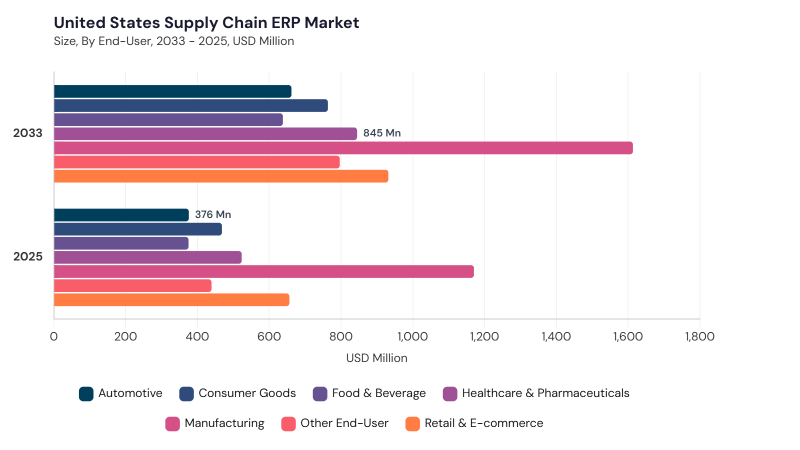
Based on End-User, the market is segmented into Manufacturing, Retail & E-commerce, Healthcare & Pharmaceuticals, Consumer Goods, Food & Beverage, Automotive, and Other End-User. The Manufacturing segment dominated the North America Supply Chain ERP Market by End-User in 2025 and would continue to be a dominant market till 2033; thereby, achieving a market value of USD 2.23 billion by 2033, growing at a CAGR of 5.0% during the forecast period. The Retail & E-commerce market is expected to witness a CAGR of 5.4% during (2026-2033). Additionally, the Healthcare & Pharmaceuticals market is expected to witness the highest CAGR of 7.1% during (2026-2033).
Manufacturing organizations continue to lead ERP adoption due to increasing demand for production planning optimization, inventory control, procurement automation, supplier management, and real-time operational visibility. ERP systems are increasingly supporting smart manufacturing initiatives and industrial automation strategies across North America.
Healthcare & pharmaceutical companies are witnessing rapid ERP adoption due to increasing regulatory compliance requirements, inventory traceability demands, supply chain transparency needs, and pharmaceutical distribution optimization initiatives. AI-enabled ERP systems are helping healthcare organizations improve operational efficiency and strengthen supply chain resilience.

By Organization Size
By Component
By Deployment Mode
By End-User
By Country
Market will reach USD 8.01 billion by 2032, growing at 6.6% CAGR during 2026-2033.
The U.S. dominates with 76.1% market share in 2025. Canada holds second position with 10.8% share.
Canada shows strongest growth at 9.2% CAGR during 2026-2033. Mexico follows at 7.9% CAGR during the same period.
Cloud-Based deployment leads the market across all segments in 2025.
Large Enterprises dominate the market by organization size in 2025.
Our team of dedicated experts can provide you with attractive expansion opportunities for your business.




 Unique Offerings