The sample copy of this report is available for access.
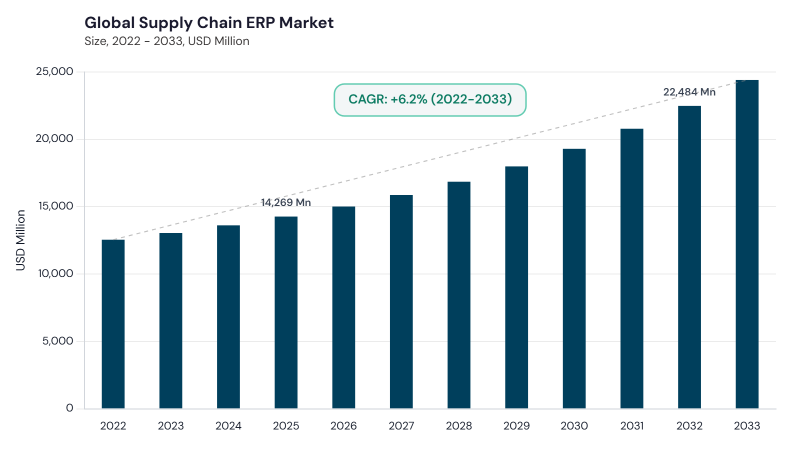
“Global Supply Chain ERP Market to reach a market value of USD 24.40 Billion by 2033 growing at a CAGR of 6.9%”
The Global Supply Chain ERP Market size is expected to reach USD 24.40 billion by 2033, rising at a market growth of 7.2% CAGR during the forecast period.
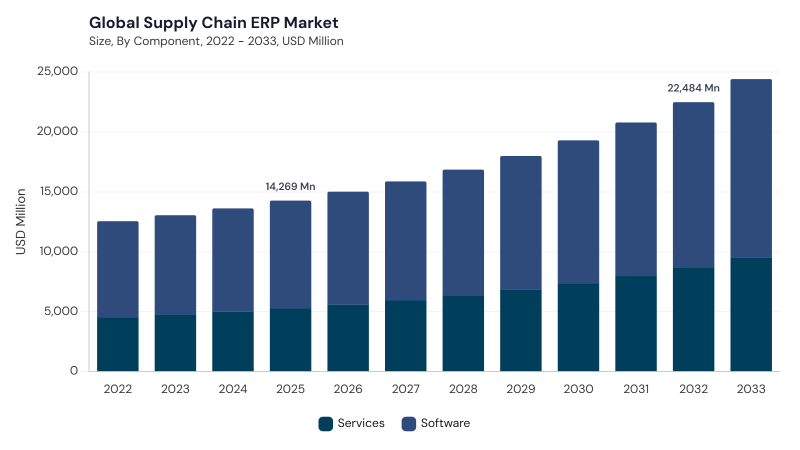
The market growth is driven by increasing demand for integrated supply chain management solutions, rising adoption of cloud-based ERP platforms, and growing focus on operational efficiency across industries. Businesses are increasingly deploying AI-enabled ERP systems to improve supply chain visibility, automate workflows, and enhance real-time decision-making capabilities across global operations.
The major strategies followed by the market participants are Partnerships, Product Innovation, and Cloud Expansion as organizations focus on improving interoperability, automation, and supply chain intelligence capabilities. For instance, in February 2025, SAP SE expanded its AI-driven supply chain planning capabilities within SAP Integrated Business Planning to improve predictive forecasting and operational visibility. Additionally, in January 2025, Oracle Corporation enhanced Oracle Fusion Cloud SCM with generative AI-powered workflow automation and procurement intelligence features.
The Supply Chain ERP Market has evolved significantly from traditional enterprise planning systems into integrated digital platforms capable of managing procurement, logistics, inventory, warehousing, and supplier collaboration within a unified ecosystem. Earlier ERP systems primarily focused on transactional management, while modern solutions incorporate cloud computing, AI, analytics, and automation technologies to support agile and resilient supply chain operations.
Growing digital transformation initiatives across manufacturing, retail, healthcare, food & beverage, and automotive sectors continue to accelerate adoption of advanced supply chain ERP platforms. Organizations are increasingly investing in scalable ERP solutions to improve operational efficiency, reduce costs, optimize inventory levels, and strengthen supply chain resilience amid evolving market conditions and global trade complexities.
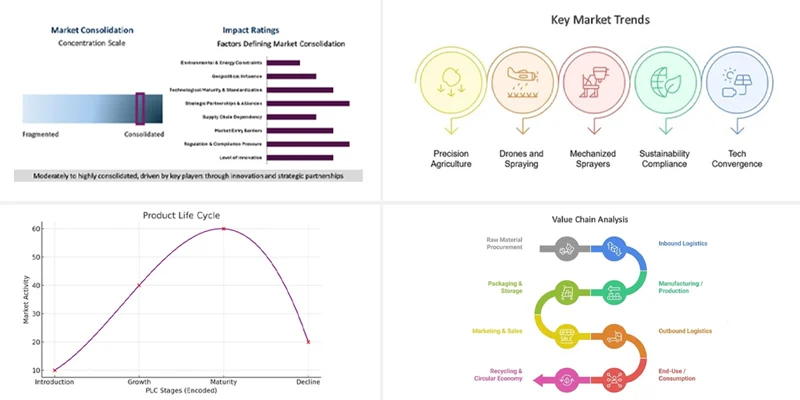
The Supply Chain ERP Market demonstrates a moderately fragmented competitive structure with the top market participants accounting for a significant share of global revenue. SAP SE held the leading market position with approximately 12.65% share, supported by its strong enterprise ERP ecosystem and extensive adoption across manufacturing and logistics-intensive industries.
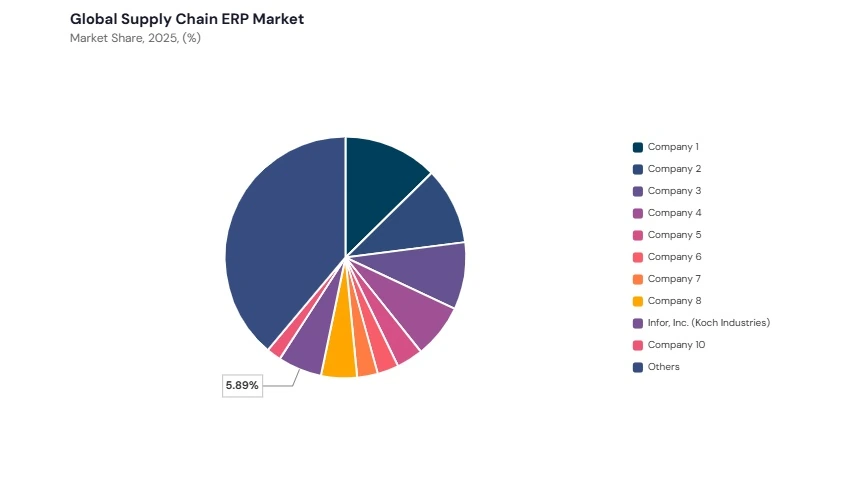
Oracle Corporation and Microsoft Corporation continue to strengthen their positions through cloud-native ERP platforms, AI-driven analytics, and integrated supply chain management capabilities. Specialized providers including Blue Yonder, Infor, Manhattan Associates, and Kinaxis are gaining traction by offering advanced supply chain planning, warehouse management, and logistics optimization solutions. Mid-tier and niche vendors are also expanding through industry-specific ERP capabilities and faster deployment models.
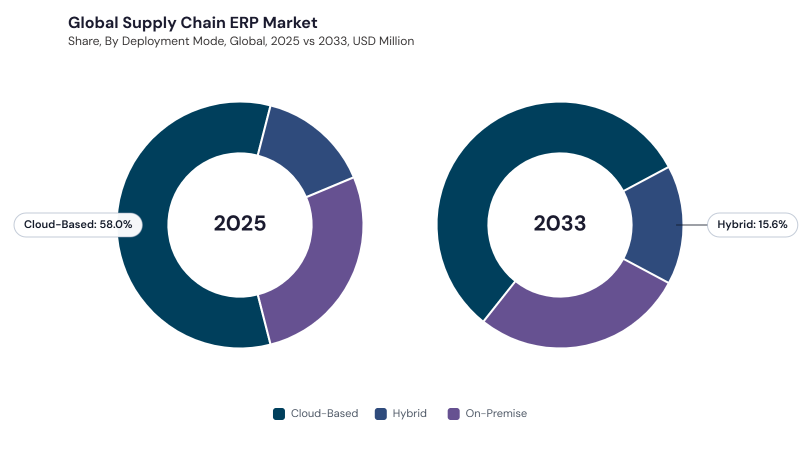
Based on deployment mode, the market is segmented into Cloud-Based, On-Premise, and Hybrid. The Cloud-Based segment dominated the market in 2025 accounting for a 57.97% share owing to increasing demand for scalable, flexible, and remotely accessible ERP platforms. Organizations are increasingly adopting cloud ERP solutions to reduce infrastructure costs, improve operational agility, and enable real-time collaboration across global supply chain networks. The Hybrid segment is also witnessing steady growth as enterprises seek a balance between on-premise security and cloud scalability.
Based on component, the market is segmented into Software and Services. The Software segment dominated the market in 2025 with a 63.08% revenue share driven by rising demand for integrated ERP platforms capable of automating procurement, inventory management, logistics, and forecasting operations. Organizations continue to invest in AI-enabled ERP software solutions to improve operational visibility, optimize workflows, and support data-driven supply chain management. The Services segment is also growing steadily due to increasing demand for implementation, consulting, training, and system integration services.
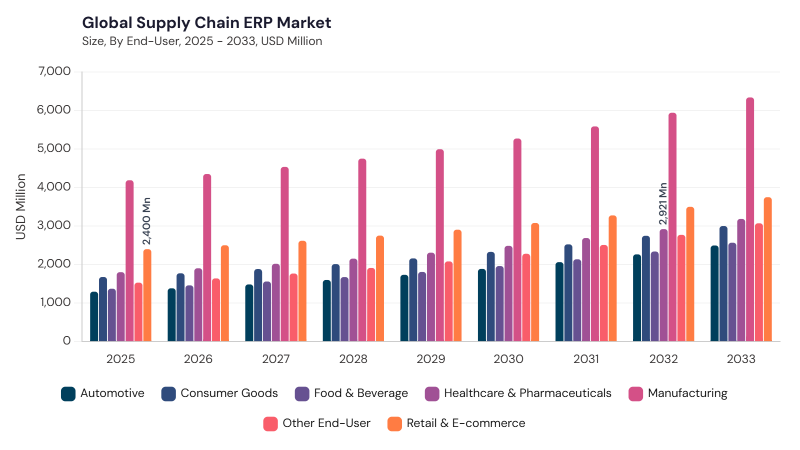
Based on end-use industry, the market is segmented into Manufacturing, Retail & E-commerce, Healthcare & Pharmaceuticals, Food & Beverage, Consumer Goods, Automotive, and Other End-User industries. The Manufacturing segment dominated the market in 2025 accounting for a 29.37% revenue share due to increasing demand for production planning, inventory optimization, and supply chain coordination solutions. Retail & E-commerce organizations are also significantly adopting supply chain ERP systems to improve order management and inventory visibility, while healthcare and pharmaceutical companies are deploying ERP platforms to strengthen regulatory compliance and supply chain traceability.
The Supply Chain ERP Market is highly competitive with companies focusing on AI-enabled analytics, cloud-native ERP platforms, automation, and integrated supply chain visibility solutions. Vendors are increasingly prioritizing interoperability, modular deployment capabilities, and real-time analytics to support complex and globalized supply chain operations across industries.
Strategic partnerships between ERP vendors, cloud service providers, logistics technology firms, and analytics companies continue to strengthen the competitive landscape. Companies are investing in AI, machine learning, IoT integration, and digital twin technologies to enhance predictive capabilities, improve inventory management, and streamline logistics operations.
Regional expansion strategies and flexible pricing models are also influencing competition as organizations seek scalable ERP deployments that align with operational requirements and budget considerations. Cloud migration services, cybersecurity capabilities, and regulatory compliance support remain important competitive differentiators among leading market participants.
| Report Attribute | Details |
|---|---|
| Market size value in 2026 | USD 15.01 Billion |
| Market size forecast in 2033 | USD 24.40 Billion |
| Base Year | 2025 |
| Historical period | 2022 to 2024 |
| Forecast Period | 2026 to 2033 |
| Revenue Growth Rate | CAGR of 6.9% from 2026 to 2033 |
| Number of Pages | 700+ |
| Tables | 750+ |
| Report Coverage | Market Trends, Revenue Estimation and Forecast, Segmentation Analysis, Regional and Country Breakdown, Competitive Landscape, Market Share Analysis, Porter’s Five Forces Analysis, Company Profiling, Company Strategic Developments, SWOT Analysis, Winning Imperatives |
| Segments Covered | Component, Deployment Mode, End-User, Organization Size, Region |
| Country Scope |
|
| Companies Included | SAP SE, Oracle Corporation, Microsoft Corporation, Blue Yonder Group, Inc., Kinaxis, Inc., Epicor Software Corporation, The Sage Group plc, Manhattan Associates, Inc., Infor, Inc., Workday, Inc. |
By Component
By Deployment Mode
By End-User
By Organization Size
By Geography

The Supply Chain ERP Market is highly competitive with companies focusing on AI-enabled analytics, cloud-native ERP platforms, automation, and integrated supply chain visibility solutions. Vendors are increasingly prioritizing interoperability, modular deployment capabilities, and real-time analytics to support complex and globalized supply chain operations across industries.
Strategic partnerships between ERP vendors, cloud service providers, logistics technology firms, and analytics companies continue to strengthen the competitive landscape. Companies are investing in AI, machine learning, IoT integration, and digital twin technologies to enhance predictive capabilities, improve inventory management, and streamline logistics operations.
Regional expansion strategies and flexible pricing models are also influencing competition as organizations seek scalable ERP deployments that align with operational requirements and budget considerations. Cloud migration services, cybersecurity capabilities, and regulatory compliance support remain important competitive differentiators among leading market participants.
| Report Attribute | Details |
|---|---|
| Market size value in 2026 | USD 15.01 Billion |
| Market size forecast in 2033 | USD 24.40 Billion |
| Base Year | 2025 |
| Historical period | 2022 to 2024 |
| Forecast Period | 2026 to 2033 |
| Revenue Growth Rate | CAGR of 6.9% from 2026 to 2033 |
| Number of Pages | 650 |
| Tables | 750 |
| Report Coverage | Market Trends, Revenue Estimation and Forecast, Segmentation Analysis, Regional and Country Breakdown, Competitive Landscape, Market Share Analysis, Porter’s Five Forces Analysis, Company Profiling, Company Strategic Developments, SWOT Analysis, Winning Imperatives |
| Segments Covered | Component, Deployment Mode, End-User, Organization Size, Region |
| Country Scope |
|
| Companies Included | SAP SE, Oracle Corporation, Microsoft Corporation, Blue Yonder Group, Inc., Kinaxis, Inc., Epicor Software Corporation, The Sage Group plc, Manhattan Associates, Inc., Infor, Inc., Workday, Inc. |
By Component
By Deployment Mode
By End-User
By Organization Size
By Geography
Valued at USD 15.01 billion in 2026, reaching USD 24.40 billion by 2033 at 6.9% CAGR during 2026-2033.
Software captures 63.08% market share in 2025, projected to hit USD 14.92 billion by 2033.
SAP SE, Oracle Corporation, Microsoft Corporation, and Blue Yonder Group Inc. hold dominant positions.
North America leads the market, projected to reach USD 8.66 billion by 2033.
Cloud-based solutions command 57.97% market share in 2025 due to scalability and lower costs.
Large enterprises account for 67.77% market share in 2025 due to complex operations.
Our team of dedicated experts can provide you with attractive expansion opportunities for your business.








 Unique Offerings