The sample copy of this report is available for access.
The LAMEA Supply Chain ERP Market is expected to reach a market size of USD 1,525.70 million by 2029 and would witness market growth of 8.9% CAGR during the forecast period (2026-2033).
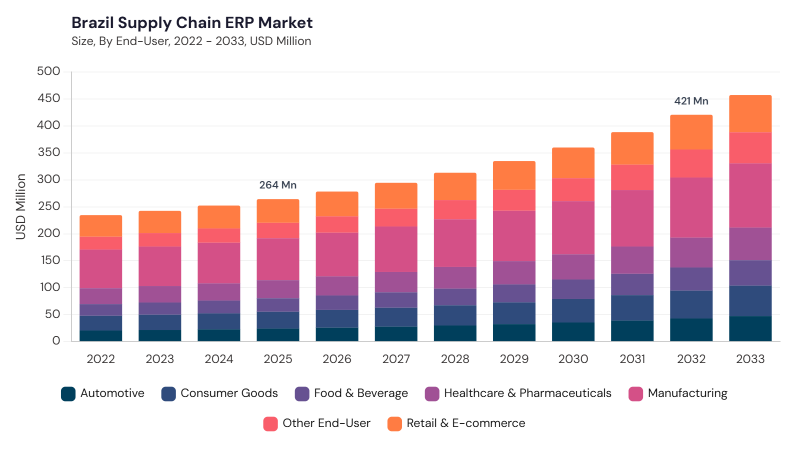
The Brazil market dominated the LAMEA Supply Chain ERP Market by Country in 2025, and would continue to be a dominant market till 2033; thereby, achieving a market value of USD 457.3 million by 2033. The Argentina market is expected to witness a CAGR of 10.5% during (2026 - 2033). Additionally, the UAE market is expected to witness a CAGR of 7.6% during (2026 - 2033). The Brazil and UAE markets led the LAMEA Supply Chain ERP Market by Country with market shares of 23.2% and 11.1% respectively in 2025. The South Africa market is expected to witness a CAGR of 10.1% throughout the forecast period.
The LAMEA Supply Chain ERP Market has experienced notable growth due to increasing enterprise digitalization, growing industrial modernization initiatives, and expanding adoption of cloud-based business management solutions across Latin America, the Middle East, and Africa. Enterprises across manufacturing, retail, healthcare, automotive, food & beverage, and consumer goods sectors are increasingly deploying supply chain ERP platforms to improve inventory visibility, streamline procurement processes, optimize logistics operations, and enhance operational efficiency. The growing need for supply chain resilience and real-time decision-making capabilities has accelerated ERP implementation among both large enterprises and SMEs throughout the region.
Countries such as Brazil, Saudi Arabia, the UAE, South Africa, and Argentina are witnessing increasing investments in enterprise automation and smart supply chain infrastructure. Brazil continues to dominate the regional market due to its strong industrial and retail sectors, rising cloud adoption, and expanding digital transformation initiatives among enterprises. Saudi Arabia and the UAE are increasingly integrating advanced ERP solutions into logistics, manufacturing, retail, and energy sectors as part of broader economic diversification and smart city development programs. South Africa and Nigeria are also emerging as high-growth markets due to increasing SME digitization and rising enterprise focus on operational efficiency and supply chain optimization.
Cloud-based deployment models are gaining significant traction across the LAMEA region due to flexibility, scalability, and lower implementation costs. Organizations are increasingly adopting AI-enabled analytics, IoT connectivity, predictive demand forecasting, warehouse automation, and blockchain-enabled supply chain visibility solutions integrated within ERP platforms. Growing e-commerce penetration and expanding omnichannel retail ecosystems are further driving the demand for intelligent ERP systems capable of supporting real-time inventory and logistics management.
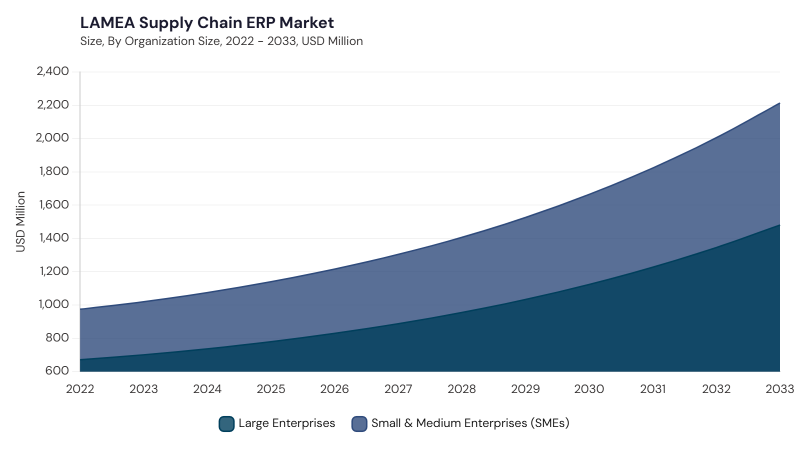
Based on Organization Size, the market is segmented into Large Enterprises and Small & Medium Enterprises (SMEs). The Large Enterprises market dominated the LAMEA Supply Chain ERP Market by Organization Size in 2025 and would continue to be a dominant market till 2033; thereby, achieving a market value of USD 1,480.6 million by 2033. The Small & Medium Enterprises (SMEs) market is expected to witness a CAGR of 9.6% during (2026 - 2033).
Based on Component, the market is segmented into Software and Services. The Software market dominated the LAMEA Supply Chain ERP Market by Component in 2025 and would continue to maintain its dominance till 2033 owing to increasing demand for integrated inventory management, procurement optimization, demand planning, and logistics monitoring solutions. The Services market is expected to witness strong growth due to rising demand for ERP implementation, consulting, customization, support, and managed services across enterprises.
Based on Deployment Mode, the market is segmented into Cloud-Based, On-Premise, and Hybrid. The Cloud-Based market dominated the LAMEA Supply Chain ERP Market by Deployment Mode in 2025 and would continue to be a dominant market till 2033; thereby, achieving a market value of USD 1,261.8 million by 2033. The On-Premise market is expected to witness a CAGR of 9.2% during (2026 - 2033). Additionally, the Hybrid market is expected to witness a CAGR of 10.0% during (2026 - 2033).
Based on End-User, the market is segmented into Manufacturing, Retail & E-commerce, Healthcare & Pharmaceuticals, Consumer Goods, Food & Beverage, Automotive, and Other End-User. The Manufacturing market dominated the LAMEA Supply Chain ERP Market by End-User in 2025 and would continue to be a dominant market till 2033; thereby, achieving a market value of USD 579.8 million by 2033. The Retail & E-commerce market is expected to witness a CAGR of 7.6% during (2026 - 2033). Additionally, the Healthcare & Pharmaceuticals market is expected to witness the highest CAGR of 9.4% during (2026 - 2033).
Free Valuable Insights: Supply Chain ERP Market Size Worth USD 24.40 Billion billion by 2033
The Brazil Supply Chain ERP Market remains the leading market across LAMEA due to increasing enterprise digitization, strong manufacturing activities, and expanding cloud ERP adoption among large enterprises and SMEs. Organizations across retail, automotive, healthcare, and manufacturing sectors are increasingly integrating intelligent ERP platforms to improve supply chain visibility and operational efficiency.
The Saudi Arabia Supply Chain ERP Market is witnessing strong growth due to rapid digital transformation initiatives, increasing investments in industrial automation, and the growing adoption of smart manufacturing technologies aligned with Vision 2030 programs. Enterprises are increasingly implementing AI-enabled ERP systems to optimize procurement, warehouse operations, and logistics management.
The UAE Supply Chain ERP Market continues to grow steadily owing to rising investments in logistics infrastructure, smart city initiatives, and increasing adoption of cloud-native enterprise applications across retail, transportation, and industrial sectors. Businesses are increasingly focusing on real-time supply chain analytics and predictive operational management capabilities.

By Organization Size
By Component
By Deployment Mode
By End-User
By Country
Market will reach USD 1,525.70 million by 2029, growing at 8.9% CAGR during 2026-2033.
Brazil dominates with USD 457.3 million by 2033 and holds 23.2% market share in 2025.
Cloud-based deployment preferences and large enterprise digital transformation initiatives fuel regional growth.
UAE captures 11.1% market share in 2025 and grows at 7.6% CAGR during 2026-2033.
Large enterprises lead the market, outpacing small and medium enterprises in deployment rates.
Our team of dedicated experts can provide you with attractive expansion opportunities for your business.




 Unique Offerings