The sample copy of this report is available for access.
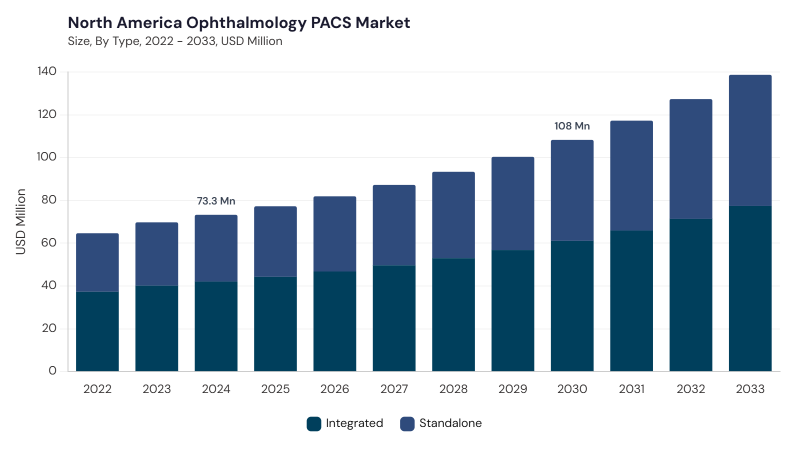
The North America Ophthalmology PACS Market is expected to reach USD 127.3 million by 2032, growing at a CAGR of 7.8% during (2026 - 2033).
North America Ophthalmology PACS Market originated with the integration of digital imaging technologies in ophthalmic care, initially driven by the shift from film-based captured images toward accessible and durable digital formats. Early standalone imaging devices gradually evolved into interconnected systems capable of storing and managing OCT scans, fundus photography, visual field data, and other ophthalmic diagnostic images. The market advanced further as enterprise imaging platforms enabled ophthalmology-specific PACS to integrate with hospital-wide EHR systems and health information exchanges, supporting more interoperable and comprehensive image-management workflows.
Cloud-based PACS, AI-enabled image analysis, teleophthalmology, interoperability, data security, and workflow optimization are shaping current market development. PACS platforms are moving beyond image storage and retrieval toward clinical decision support, automated image analysis, remote consultation, and collaborative ophthalmic care. Vendors compete through AI integration, cloud deployment, device connectivity, EHR partnerships, security, compliance, and cost-flexible models. However, high implementation cost, interoperability gaps, complex privacy requirements, cybersecurity needs, and integration with fragmented healthcare IT systems continue to influence adoption across North America.
Based on Type, the market is segmented into Integrated and Standalone. The Integrated market dominated the North America Ophthalmology PACS Market by Type in 2025, and would continue to be a dominant market till 2033; thereby, achieving a market value of USD 71.3 million by 2032, growing at a CAGR of 7.5 % during the forecast period. The Standalone market is expected to witness a CAGR of 8.3% during (2026 - 2033).
Integrated PACS solutions combine ophthalmic image management with broader EHR and hospital information systems, supporting hospitals and large ophthalmology centers that require coordinated patient data, multimodal image access, and clinician collaboration. These systems help reduce data silos, improve workflow efficiency, support teleophthalmology, and enable AI-enabled image analysis. Standalone PACS maintained a promising presence among small to mid-sized ophthalmology clinics, specialty eye-care centers, and ambulatory facilities that prioritize dedicated image management, simpler implementation, flexible operation, cost efficiency, and selective interoperability with EMR systems or diagnostic devices.
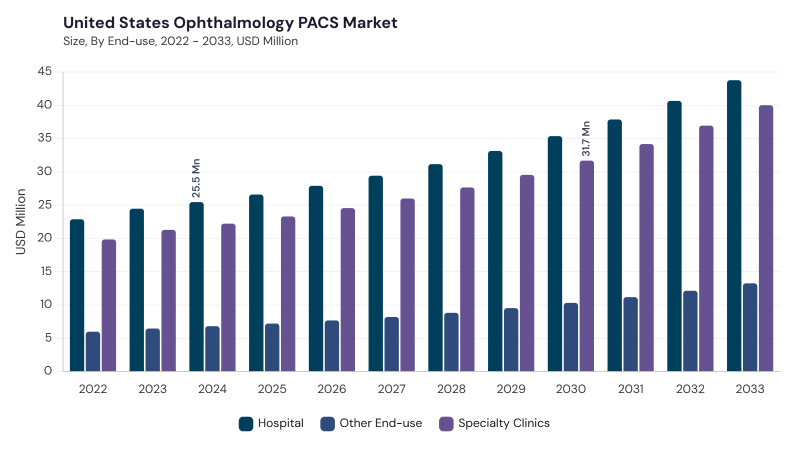
Based on End-use, the market is segmented into Hospital, Specialty Clinics, and Other End-use. Hospital settings use PACS to manage extensive ophthalmic imaging workflows involving OCT, fundus photography, angiography, and other modalities, while supporting large-scale archival, fast retrieval, EHR integration, collaboration, and telemedicine.
Specialty Clinics garnered a significant share through outpatient ophthalmic care centers, retina and glaucoma clinics, optometry practices, high-resolution imaging workflows, patient follow-up, and subspecialty-focused imaging requirements. Other End-use represented an emerging segment across teleophthalmology providers, academic research institutions, mobile eye-care units, standalone diagnostic centers, and remote screening environments requiring adaptable image access, analytics, and secure data sharing.
Based on Mode of Action, the market is segmented into Cloud-based and On-premises. Cloud-based PACS supports remote storage, management, and sharing of ophthalmic images through internet-connected platforms, allowing practices and diagnostic centers to expand imaging capacity without heavy on-site hardware investment.
It supports OCT storage, fundus photography, teleophthalmology, real-time collaboration, multi-location access, cybersecurity-enabled archives, and cost-flexible deployment. On-premises retained a noteworthy share among large hospitals and academic medical centers prioritizing direct data control, local infrastructure, customized workflows, high-speed access, institutional cybersecurity policies, and integration with established enterprise IT systems.
Free Valuable Insights: The Global Ophthalmology PACS Market will hit USD 329.1 Million billion by 2033, at a CAGR of 8.4%
Based on Country, the market is segmented into US, Canada, Mexico, and Rest of North America. The US market dominated the North America Ophthalmology PACS Market by Country in 2025, and would continue to be a dominant market till 2033; thereby, achieving a market value of USD 89.7 million by 2032, growing at a CAGR of 7.1 % during the forecast period. The Canada market is expected to witness a CAGR of 9.9% during (2026 - 2033). Additionally, The Mexico market is expected to witness a CAGR of 9.1% during (2026 - 2033).
Across North America, Ophthalmology PACS adoption varies with healthcare IT maturity, ophthalmic imaging volumes, EHR integration, teleophthalmology adoption, regulatory requirements, and provider infrastructure. The US is shaped by advanced digital imaging, OCT data growth, AI-enabled disease detection, cloud-native PACS, HIPAA-driven security, multi-site collaboration, and strong demand for scalable ophthalmology workflows. Canada reflects cloud-enabled PACS architecture, teleophthalmology expansion, AI and machine-learning analytics, data security, patient privacy, provincial and federal information governance, and localized healthcare protocols. Mexico is developing through digital ophthalmic imaging, AI tools, teleophthalmology, interoperable systems, OCT and fundus imaging, Spanish-language support, cloud infrastructure, and cost-sensitive deployment across public and private healthcare settings. Rest of North America remains influenced by AI-enabled PACS, cloud-based systems, interoperability with health IT infrastructure, regulatory alignment, remote image access, cost-effective deployment, and localized service models.

By Type
By End-use
By Mode of Action
By Country
Set to reach $127.3 Million by 2032, growing at 7.8% CAGR during 2026-2033.
The US leads with $89.7 million by 2032, growing at a CAGR of 7.1% during 2026-2033.
The Integrated segment dominates, reaching $71.3 million by 2032 at a 7.5% CAGR during 2026-2033.
The Standalone segment is expected to grow at an 8.3% CAGR during 2026-2033.
The Canada market is expected to witness a CAGR of 9.9% during 2026-2033.
The Mexico market is expected to witness a CAGR of 9.1% during 2026-2033.
Our team of dedicated experts can provide you with attractive expansion opportunities for your business.




 Unique Offerings
