The sample copy of this report is available for access.
The Asia Pacific Ophthalmology PACS Market is expected to reach USD 59.4 million by 2030, growing at a CAGR of 9.4% during (2026 - 2033).
Asia Pacific Ophthalmology PACS Market originated from the growing need to manage, store, and share ophthalmic imaging data across clinical settings. Earlier ophthalmology departments relied on film-based imaging and manual records, which limited diagnostic speed and collaboration. The market evolved with digital imaging, OCT, fundus photography, hospital information system integration, and teleophthalmology adoption. Healthcare digitization policies further expanded PACS use beyond advanced urban centers into emerging markets, making these systems important for clinical decision-making and remote patient monitoring.
AI-enabled image interpretation, cloud-based PACS, cybersecurity, interoperability, and teleophthalmology are shaping current market development. Providers increasingly require real-time image access, automated image analysis, secure storage, EHR connectivity, and scalable platforms that support dispersed care locations. Vendors compete through AI tools, cloud infrastructure, local workflow customization, language support, cybersecurity, regulatory alignment, and cost-effective deployment. However, high adoption cost, fragmented regulations, weak IT infrastructure, interoperability gaps, and limited technical expertise continue to influence adoption across Asia Pacific.
Based on Type, the market is segmented into Integrated and Standalone. The Integrated market dominated the Asia Pacific Ophthalmology PACS Market by Type in 2025, and would continue to be a dominant market till 2033; thereby, achieving a market value of USD 33.7 million by 2030, growing at a CAGR of 9 % during the forecast period. The Standalone market is expected to witness a CAGR of 9.8% during (2026 - 2033).
Integrated PACS solutions connect ophthalmic imaging systems with HIS, EMR, diagnostic platforms, scheduling, reporting, and analytics capabilities. They are mainly used by large hospitals and eye-care networks requiring centralized image management, cross-department coordination, teleophthalmology support, and AI-assisted analysis. Standalone demonstrated a promising foothold among smaller ophthalmology centers, diagnostic centers, and specialized clinics that need focused image acquisition, storage, viewing, ease of installation, user-friendly workflows, affordability, and operational independence.
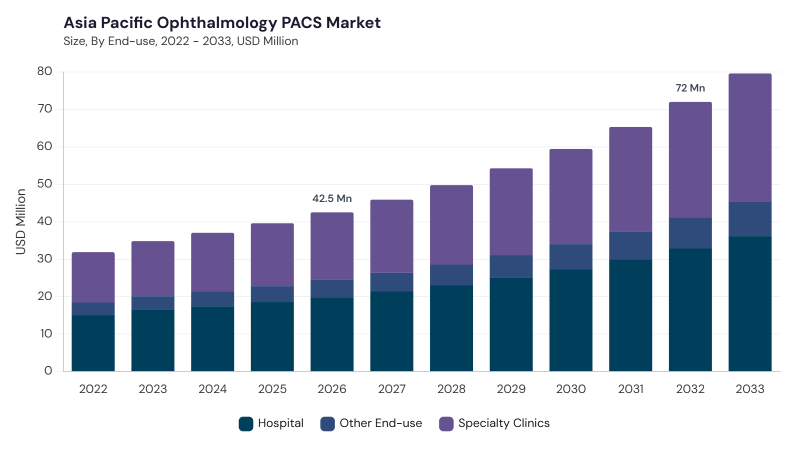
Based on End-use, the market is segmented into Hospital, Specialty Clinics, and Other End-use. Hospitals use PACS to manage OCT, fundus photography, visual field testing, high-volume image storage, rapid retrieval, AI-enabled image analysis, EHR integration, and multi-department collaboration. Specialty Clinics represented a substantial market presence through retina, cornea, glaucoma, outpatient eye-care, customized reporting, patient follow-up, and teleophthalmology workflows.
Other End-use formed an emerging role across diagnostic imaging centers, academic research institutions, ambulatory facilities, telemedicine platforms, and research-oriented environments requiring modular image management and secure data sharing.
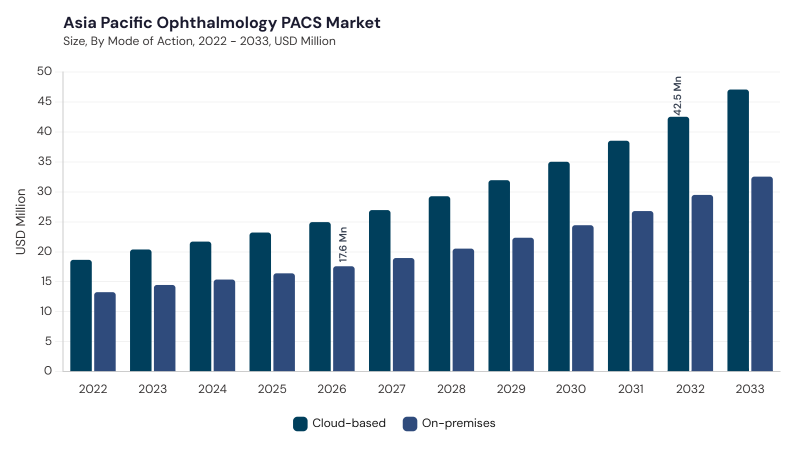
Based on Mode of Action, the market is segmented into Cloud-based and On-premises. Cloud-based PACS enables remote image storage, real-time collaboration, scalable capacity, teleophthalmology, OCT and fundus image access, AI-enabled analysis, disaster recovery, and subscription-based deployment. It is useful for geographically dispersed markets and mid-sized ophthalmology centers seeking lower upfront IT investment.
On-premises registered a noteworthy position among hospitals and ophthalmology centers requiring locally managed data, direct institutional control, legacy integration, fast image retrieval, data-residency compliance, and customized configurations.
Free Valuable Insights: Ophthalmology PACS Market is Predicted to reach USD 329.1 Million billion by 2033, at a CAGR of 8.4%
Based on Country, the market is segmented into China, Japan, India, South Korea, Singapore, Malaysia, and Rest of Asia Pacific. The China market dominated the Asia Pacific Ophthalmology PACS Market by Country in 2025, and would continue to be a dominant market till 2033; thereby, achieving a market value of USD 15.7 million by 2030, growing at a CAGR of 7.4 % during the forecast period. The Japan market is expected to witness a CAGR of 8.8% during (2026 - 2033). Additionally, The India market is expected to witness a CAGR of 10.3% during (2026 - 2033).
Across Asia Pacific, Ophthalmology PACS adoption is shaped by healthcare digitization, eye-disease burden, cloud readiness, AI adoption, teleophthalmology, and regulatory maturity. China is driven by smart hospitals, AI diagnostics, cloud PACS, and remote consultation; Japan reflects mature PACS adoption, secure platforms, AI support, and EHR integration; India is supported by teleophthalmology, government healthcare IT adoption, and scalable cloud tools; South Korea emphasizes AI analytics, cloud connectivity, and multimodal imaging; Singapore reflects advanced interoperability, cybersecurity, and smart-health infrastructure; Malaysia is developing through digital health standardization, cloud adoption, and AI-enabled image analysis; Rest of Asia Pacific remains diverse, with demand supported by rural access, teleophthalmology, secure cloud storage, and affordable PACS deployment.

By Type
By End-use
By Mode of Action
By Country
Set to reach $59.4 Million by 2030, growing at 9.4% CAGR during 2026-2033.
China leads with a market value of $15.7 million by 2030, growing at a 7.4% CAGR during 2026-2033.
The Integrated segment dominates, projected to reach $33.7 million by 2030, with a 9% CAGR during 2026-2033.
The Standalone market is expected to grow at a 9.8% CAGR during 2026-2033.
The Japan market is expected to witness a CAGR of 8.8% during 2026-2033.
The India market is expected to witness a CAGR of 10.3% during 2026-2033.
Our team of dedicated experts can provide you with attractive expansion opportunities for your business.




 Unique Offerings
