The sample copy of this report is available for access.
The LAMEA Ophthalmology PACS Market is expected to reach USD 18.7 million by 2029, growing at a CAGR of 9.6% during (2026 - 2033).
LAMEA Ophthalmology PACS Market originated as a response to the need for efficient image management and diagnostic solutions across Latin America, the Middle East, and Africa. Early adoption lagged behind radiology PACS because ophthalmology required specialized handling of fundus photography, OCT, fluorescein angiography, and other ocular imaging formats. Over time, better image resolution, digital storage, integrated diagnostic tools, and regulatory encouragement for patient-record digitization supported wider clinical acceptance. The market has moved toward interoperable platforms that connect imaging devices, data repositories, clinicians, and diagnostic workflows.
AI-enhanced image analytics, cloud-based PACS, teleophthalmology, data security, and regional customization are shaping current market development. Cloud platforms help improve remote access and collaborative care in underserved or geographically dispersed areas, while AI tools support retinal-disease detection, workflow automation, and diagnostic support. Vendors compete through innovation, flexible deployment models, localization, training, support, cybersecurity, and integration with healthcare IT systems. However, high capital cost, legacy-system integration challenges, data-privacy complexity, uneven infrastructure, and limited technical capacity continue to affect adoption across LAMEA.
Based on Type, the market is segmented into Integrated and Standalone. The Integrated market dominated the LAMEA Ophthalmology PACS Market by Type in 2025, and would continue to be a dominant market till 2033; thereby, achieving a market value of USD 10.7 million by 2029, growing at a CAGR of 9.3 % during the forecast period. The Standalone market is expected to witness a CAGR of 10.1% during (2026 - 2033).
Integrated PACS embeds ophthalmic image management within broader healthcare IT ecosystems, supporting hospitals and multispecialty centers that need EHR connectivity, diagnostic-device integration, centralized repositories, consolidated patient information, and streamlined clinical coordination. These systems are supported by healthcare modernization programs, interoperability mandates, cloud-based integration, AI-enabled image analysis, and teleophthalmology workflows. Standalone preserved a promising presence among independent eye-care practices, smaller clinics, and facilities needing specialized image archiving, lower upfront investment, simpler installation, operational flexibility, and focused ophthalmic imaging management.
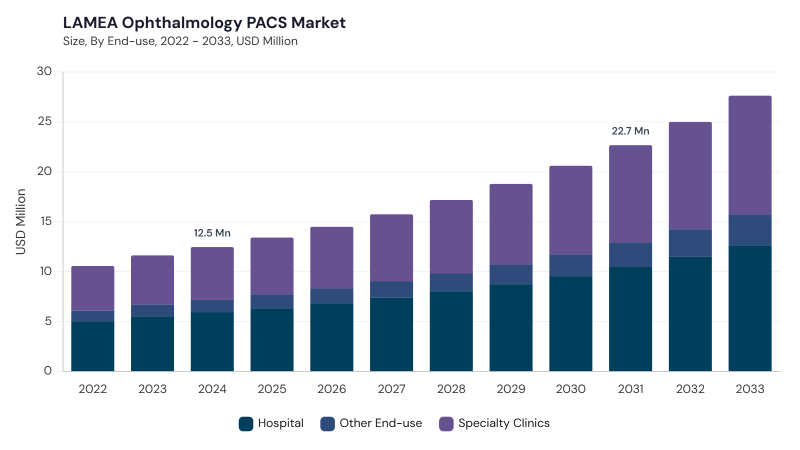
Based on End-use, the market is segmented into Hospital, Specialty Clinics, and Other End-use. Hospitals use PACS to manage OCT, fundus photography, fluorescein angiography, large imaging volumes, EHR integration, RIS connectivity, multidisciplinary workflows, remote consultations, and AI-assisted diagnostic tools.
Specialty Clinics achieved a significant presence through outpatient eye-care centers focused on retina, glaucoma, cataract assessment, rapid image retrieval, patient follow-up, and cost-efficient scalable PACS. Other End-use developed a promising footprint across diagnostic centers, academic centers, ambulatory settings, outpatient departments, smaller healthcare facilities, and research environments needing flexible image storage, sharing, and remote expert access.
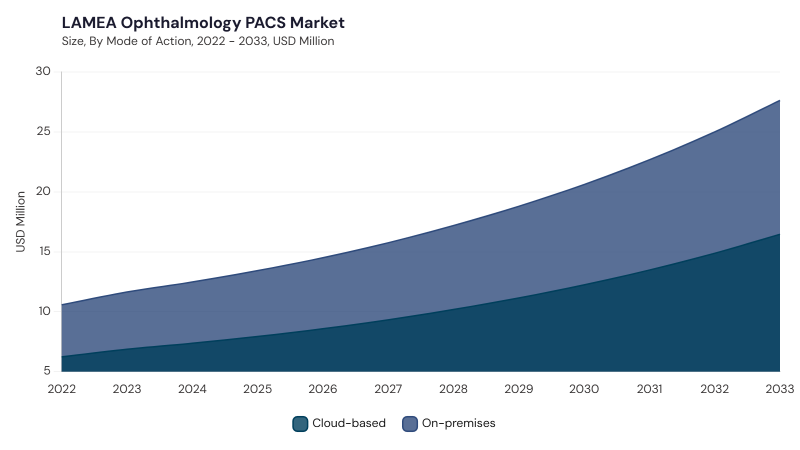
Based on Mode of Action, the market is segmented into Cloud-based and On-premises. Cloud-based PACS enables remotely hosted storage, retrieval, processing, and management of OCT images, fundus photography, visual-field data, retinal imaging, corneal scans, and other ophthalmic datasets. It supports teleophthalmology, multi-site care, cloud access, AI analytics, subscription-based deployment, and reduced local IT burden.
On-premises retained a noteworthy market position among providers preferring direct control over image repositories, local device integration, institutional governance, predictable access, cybersecurity oversight, and compatibility with legacy hospital systems.
Free Valuable Insights: Ophthalmology PACS Market Size Worth USD 329.1 Million billion by 2033
Based on Country, the market is segmented into Brazil, Argentina, UAE, Saudi Arabia, South Africa, Nigeria, and Rest of LAMEA. The Brazil market dominated the LAMEA Ophthalmology PACS Market by Country in 2025, and would continue to be a dominant market till 2033; thereby, achieving a market value of USD 4.0 million by 2029, growing at a CAGR of 8 % during the forecast period. The Argentina market is expected to witness a CAGR of 11.3% during (2026 - 2033). Additionally, The UAE market is expected to witness a CAGR of 8.4% during (2026 - 2033).
Across LAMEA, Ophthalmology PACS adoption varies by healthcare digitization, eye-care infrastructure, cloud readiness, specialist availability, affordability, and data-security requirements. Brazil is shaped by teleophthalmology, AI diagnostics, EHR integration, and cloud-based image access; Argentina reflects cloud PACS, AI-assisted analysis, Spanish-language localization, and national data-security needs; the UAE is driven by integrated healthcare IT, AI analytics, cloud PACS, and EHR interoperability; Saudi Arabia is supported by Vision 2030-linked healthcare digitization, teleophthalmology, Arabic localization, and cloud-native PACS; South Africa reflects AI tools, cloud deployment, data-security compliance, and remote-care needs; Nigeria is developing through cloud access, hybrid PACS, AI support, and localized deployment; Rest of LAMEA remains diverse, with demand supported by teleophthalmology, secure cloud storage, interoperability, and affordable PACS models.

By Type
By End-use
By Mode of Action
By Country
Set to reach $18.7 Million by 2029, growing at 9.6% CAGR during 2026-2033.
Brazil leads with $4.0 million by 2029, growing at 8% CAGR during 2026-2033.
The Integrated segment dominates, reaching $10.7 million by 2029 at 9.3% CAGR during 2026-2033.
The Standalone segment is expected to grow at a 10.1% CAGR during 2026-2033.
The UAE market is expected to witness a CAGR of 8.4% during 2026-2033.
Our team of dedicated experts can provide you with attractive expansion opportunities for your business.




 Unique Offerings
