The sample copy of this report is available for access.
The North America Machine Identity Management Market is expected to reach USD 3.7 billion by 2032, growing at a CAGR of 13.9% during (2026 - 2033).
North America Machine Identity Management Market represents one of the most advanced environments for securing machine and non-human identities. Demand is supported by enterprise digitalization, cloud adoption, cybersecurity maturity, software development, APIs, containers, microservices, automation, and connected infrastructure. Organizations increasingly manage certificates, cryptographic keys, secrets, service accounts, workload identities, API credentials, and other authentication mechanisms across cloud platforms, data centers, applications, networks, DevOps pipelines, and connected devices.
The market is progressing beyond conventional certificate administration toward enterprise-wide machine identity security and cryptographic governance. Organizations increasingly require automated certificate discovery, issuance, renewal, rotation, revocation, secrets management, workload authentication, policy enforcement, identity ownership, cryptographic inventory, and risk analytics. Cloud-native environments, containers, workloads, DevSecOps, zero-trust programs, AI-related identities, and crypto-agility are shaping current market development. However, legacy complexity, fragmented ownership, specialized skill shortages, and enterprise-wide transformation costs continue to influence adoption.
Based on Offering, the market is segmented into Software and Services. The Software market dominated the North America Machine Identity Management Market by Offering in 2025, and would continue to be a dominant market till 2033; thereby, achieving a market value of USD 2.6 billion by 2032, growing at a CAGR of 13.5 % during the forecast period. The Services market is expected to witness a CAGR of 14.9% during (2026 - 2033).
Software platforms support certificate lifecycle management, credential protection, secrets governance, workload authentication, cryptographic-key governance, policy enforcement, discovery, inventory, renewal, rotation, risk monitoring, and automation across non-human identities. Services maintained a promising presence as organizations require implementation, PKI modernization, security assessments, integration, managed identity operations, compliance support, and cryptographic expertise. Services are becoming important as enterprises address complex hybrid infrastructure, fragmented identity ownership, legacy dependencies, and shortages of specialized machine identity professionals.
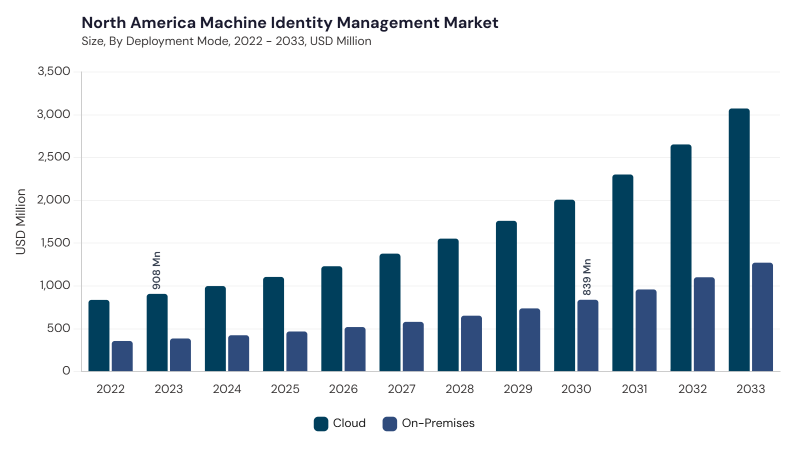
Based on Deployment Mode, the market is segmented into Cloud and On-Premises. The Cloud market dominated the North America Machine Identity Management Market by Deployment Mode in 2025, and would continue to be a dominant market till 2033; thereby, achieving a market value of USD 2.6 billion by 2032, growing at a CAGR of 14 % during the forecast period. The On-Premises market is expected to witness a CAGR of 13.6% during (2026 - 2033).
Cloud deployment supports certificate discovery, lifecycle automation, secrets protection, workload authentication, cryptographic inventory, policy management, analytics, risk monitoring, and rapid platform upgrades across distributed environments. It is especially relevant for dynamic infrastructure where workloads are created and removed continuously. On-Premises represented a promising segment among government, defense, financial services, critical infrastructure, healthcare, manufacturing, and organizations needing direct control over certificate authorities, keys, security policies, machine credentials, legacy systems, private PKI, and sensitive cryptographic assets.
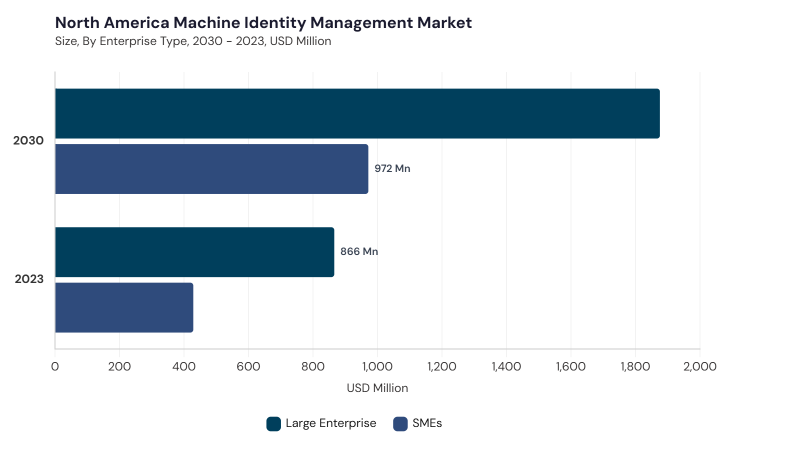
Based on Enterprise Type, the market is segmented into Large Enterprise and SMEs. Large enterprises operate broad technology estates across clouds, data centers, Kubernetes clusters, APIs, connected devices, DevOps pipelines, business applications, and distributed teams. They require high-scale discovery, governance, policy control, automation, auditability, availability, integration, crypto-agility, and AI-agent identity readiness.
SMEs maintained a promising presence as cloud services, SaaS platforms, managed infrastructure, subscription-based tools, automated certificate renewal, simplified policy configuration, managed services, and rising cybersecurity awareness make machine identity management more accessible beyond large enterprises.
Based on End-user Industry, the market is segmented into BFSI, IT and Telecommunications, Healthcare and Life Sciences, Manufacturing, Government and Defense, Retail and E-commerce, Energy and Utilities, and Other End-user Industry. BFSI uses machine identity management to secure online banking, APIs, payment systems, cloud workloads, partner connections, and sensitive financial infrastructure. IT and Telecommunications garnered a substantial share through servers, APIs, networks, cloud workloads, microservices, data centers, and virtualized infrastructure. Healthcare and Life Sciences established a significant presence as clinical systems, patient portals, connected medical devices, research platforms, and laboratory systems expand.
Manufacturing reflected smart factories, industrial IoT, robotics, sensors, gateways, and OT-IT connectivity. Government and Defense relied on secure networks, digital services, PKI, zero-trust, and controlled deployment architectures. Retail and E-commerce used platforms to protect storefronts, checkout systems, mobile apps, payment services, inventory systems, and APIs, while Energy and Utilities required identity protection across smart grids, sensors, critical infrastructure, renewable assets, and operational technology. Other End-user Industry includes transportation, logistics, education, aerospace, professional services, media, hospitality, and other digitally connected sectors.
Free Valuable Insights: The Global Machine Identity Management Market will hit USD 12.0 Billion billion by 2033, at a CAGR of 14.6%
Based on Country, the market is segmented into US, Canada, Mexico, and Rest of North America. The US market dominated the North America Machine Identity Management Market by Country in 2025, and would continue to be a dominant market till 2033; thereby, achieving a market value of USD 2.8 billion by 2032, growing at a CAGR of 13.1 % during the forecast period. The Canada market is expected to witness a CAGR of 16.4% during (2026 - 2033). Additionally, The Mexico market is expected to witness a CAGR of 15.7% during (2026 - 2033).
Across North America, Machine Identity Management adoption varies with cloud maturity, cybersecurity spending, digital infrastructure, regulatory needs, enterprise complexity, and managed-service availability. The US emphasizes cloud-native automation, non-human identity security, certificates, secrets, service accounts, workloads, APIs, containers, AI-related identities, cryptographic agility, and platform consolidation. Canada focuses on hybrid and multi-cloud environments, regulated industries, identity-centric cybersecurity, DevSecOps integration, PKI modernization, managed services, and crypto-agility. Mexico is advancing through financial-services digitalization, cloud adoption, e-commerce, manufacturing connectivity, certificate discovery, expiration monitoring, managed security, and broader lifecycle automation. Rest of North America remains smaller but developing, supported by Caribbean digital-government modernization, cloud adoption, financial services, telecommunications, data sovereignty, cybersecurity resilience, sovereign-cloud infrastructure, and automated certificate lifecycle management.

By Offering
By Deployment Mode
By Enterprise Type
By End-user Industry
By Country
Set to reach $3.7 Billion by 2032, growing at 13.9% CAGR during 2026-2033.
The US leads with $2.8 billion by 2032, growing at 13.1% CAGR during 2026-2033.
Rising demand for cloud deployment is a main catalyst, reaching $2.6 billion by 2032 at 14% CAGR during 2026-2033.
Software segment hits $2.6 billion by 2032, growing at 13.5% CAGR during 2026-2033.
Canada's market is expected to grow at a 16.4% CAGR during 2026-2033.
The services segment is expected to witness a CAGR of 14.9% during 2026-2033.
Our team of dedicated experts can provide you with attractive expansion opportunities for your business.




 Unique Offerings
