The sample copy of this report is available for access.
The Asia Pacific Machine Identity Management Market is expected to reach USD 2201.2 million by 2030, growing at a CAGR of 15.4% during (2026 - 2033).
Asia Pacific Machine Identity Management Market is emerging as one of the most dynamic regional markets, supported by cloud adoption, digital transformation, data-center expansion, telecommunications development, digital banking, e-commerce, smart manufacturing, connected devices, and government digitalization. Enterprises increasingly operate applications, APIs, containers, microservices, cloud workloads, network infrastructure, industrial systems, and automated processes that require secure machine-to-machine authentication. Digital certificates, cryptographic keys, secrets, service accounts, workload identities, API credentials, and other non-human identities are becoming widely distributed across enterprise environments.
The market is evolving from conventional PKI and certificate management toward automated machine identity lifecycle management and broader non-human identity security. Enterprises increasingly require certificate discovery, centralized inventory, automated issuance and renewal, credential rotation, policy enforcement, secrets governance, workload authentication, cryptographic visibility, and contextual risk assessment. Cloud security, DevSecOps, connected-device security, AI infrastructure, and crypto-agility are shaping current development. However, uneven cybersecurity maturity, integration complexity, legacy infrastructure, and shortage of specialized machine identity expertise continue to influence adoption.
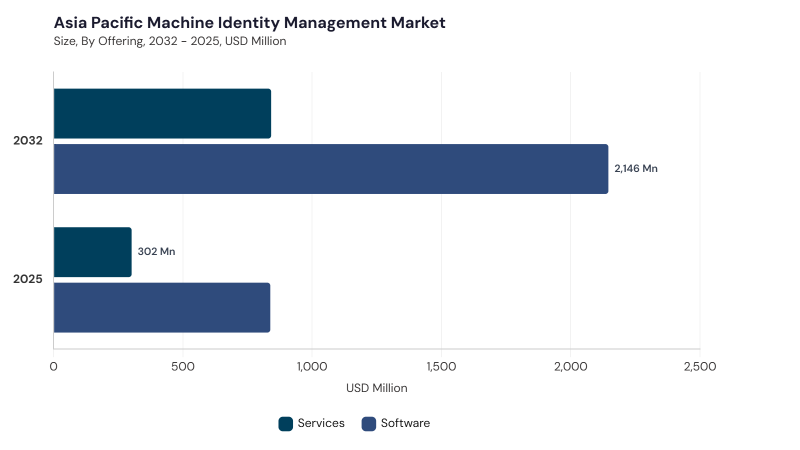
Based on Offering, the market is segmented into Software and Services. The Software market dominated the Asia Pacific Machine Identity Management Market by Offering in 2025, and would continue to be a dominant market till 2033; thereby, achieving a market value of USD 1591.8 million by 2030, growing at a CAGR of 15.1 % during the forecast period. The Services market is expected to witness a CAGR of 16.5% during (2026 - 2033).
Software platforms support certificate lifecycle automation, secrets governance, workload authentication, service-account visibility, cryptographic inventory, contextual risk assessment, policy enforcement, and broader non-human identity security. Services formed a promising presence as enterprises seek support for certificate discovery, PKI integration, credential governance, security modernization, architecture design, platform implementation, cloud migration, managed operations, and cryptographic transformation. Services are especially important where organizations lack dedicated PKI, cryptographic, identity-security, and cloud-security expertise.
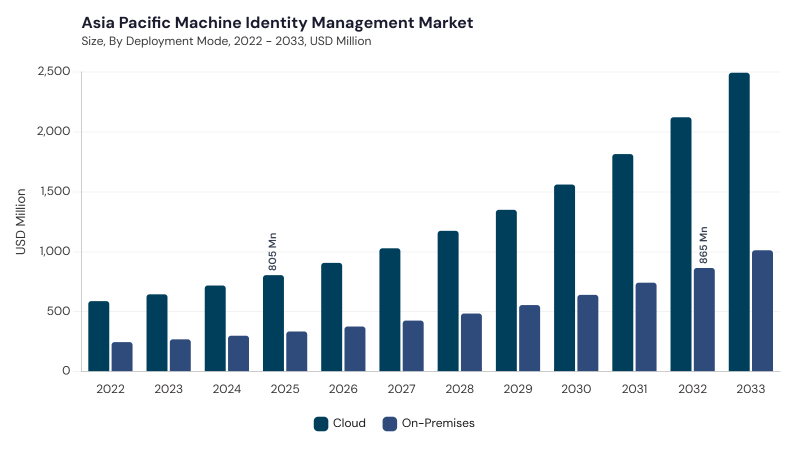
Based on Deployment Mode, the market is segmented into Cloud and On-Premises. The Cloud market dominated the Asia Pacific Machine Identity Management Market by Deployment Mode in 2025, and would continue to be a dominant market till 2033; thereby, achieving a market value of USD 1560.9 million by 2030, growing at a CAGR of 15.5 % during the forecast period. The On-Premises market is expected to witness a CAGR of 15.2% during (2026 - 2033).
Cloud deployment supports certificate discovery, lifecycle automation, cryptographic inventory, policy management, secrets governance, risk visibility, DevOps integration, Kubernetes connectivity, CI/CD workflows, and multi-cloud governance. It is especially useful for dynamic environments where containers, microservices, serverless workloads, and automated infrastructure create identities continuously. On-Premises retained a promising segment among governments, defense organizations, financial institutions, telecom providers, manufacturers, energy companies, and critical-infrastructure operators requiring control over PKI, cryptographic assets, legacy systems, internal networks, and sensitive credentials.
Based on Enterprise Type, the market is segmented into Large Enterprise and SMEs. Large enterprises operate complex identity environments across public clouds, private data centers, APIs, network infrastructure, containers, development platforms, connected devices, industrial systems, countries, and business units. They require continuous discovery, policy structures, organizational segregation, high availability, broad integrations, lifecycle automation, auditability, crypto-agility, and AI-agent identity readiness.
SMEs represented a promising presence as affordable cloud-delivered security tools, SaaS applications, digital commerce, automated business processes, subscription models, managed services, and simplified platforms make machine identity management more accessible.
Based on End-user Industry, the market is segmented into BFSI, IT and Telecommunications, Healthcare and Life Sciences, Manufacturing, Government and Defense, Retail and E-commerce, Energy and Utilities, and Other End-user Industry. BFSI uses machine identity management to secure banking platforms, payment gateways, financial APIs, trading infrastructure, cloud services, and machine-to-machine financial communication. IT and Telecommunications garnered a substantial share through cloud infrastructure, telecom networks, data centers, APIs, microservices, software platforms, and digital ecosystems. Healthcare and Life Sciences established a significant presence through telehealth, diagnostics, laboratories, medical devices, research systems, and pharmaceutical environments.
Manufacturing achieved a considerable standing through smart factories, industrial IoT, sensors, robotics, semiconductor, electronics, automotive, and connected production systems. Government and Defense retained a steady role through digital public services, cloud infrastructure, secure networks, defense systems, and cybersecurity modernization. Retail and E-commerce reflected demand from mobile commerce, online marketplaces, digital payments, logistics platforms, and customer applications, while Energy and Utilities expanded through smart grids, renewable infrastructure, smart meters, sensors, and operational technology. Other End-user Industry includes transportation, logistics, education, hospitality, media, professional services, aerospace, automotive services, and other digitally connected sectors.
Free Valuable Insights: Machine Identity Management Market is Predicted to reach USD 12.0 Billion billion by 2033, at a CAGR of 14.6%
Based on Country, the market is segmented into China, Japan, India, South Korea, Singapore, Malaysia, and Rest of Asia Pacific. The China market dominated the Asia Pacific Machine Identity Management Market by Country in 2025, and would continue to be a dominant market till 2033; thereby, achieving a market value of USD 566.0 million by 2030, growing at a CAGR of 13.3 % during the forecast period. The Japan market is expected to witness a CAGR of 14.7% during (2026 - 2033). Additionally, The India market is expected to witness a CAGR of 16.2% during (2026 - 2033).
Across Asia Pacific, Machine Identity Management adoption varies by cloud maturity, cybersecurity readiness, digital infrastructure, industrial automation, telecom development, and managed-service availability. China focuses on cloud automation, AI infrastructure, e-commerce, telecom networks, connected devices, and large-scale machine trust, while Japan emphasizes mature infrastructure modernization, robotics, automotive technology, lifecycle automation, and crypto-agility. India is advancing through cloud-native development, fintech, telecom, IT services, data centers, and non-human identity security. South Korea and Singapore show strong demand through connected devices, financial services, DevSecOps, workload identity, and AI-related identities. Malaysia and Rest of Asia Pacific are growing through cloud migration, digital banking, e-commerce, manufacturing modernization, certificate automation, and managed security.

By Offering
By Deployment Mode
By Enterprise Type
By End-user Industry
By Country
Set to reach $2201.2 Million by 2030, growing at 15.4% CAGR during 2026-2033.
China leads with $566.0 million by 2030, growing at a CAGR of 13.3% during 2026-2033.
Rising enterprise cloud adoption is a major catalyst for market growth.
The software segment is projected to reach $1591.8 million by 2030, growing at a CAGR of 15.1% during 2026-2033.
The India market is expected to witness a CAGR of 16.2% during 2026-2033.
Cloud deployment mode will reach $1560.9 million by 2030, with a CAGR of 15.5% during 2026-2033.
Our team of dedicated experts can provide you with attractive expansion opportunities for your business.




 Unique Offerings
