The sample copy of this report is available for access.
“Global Machine Identity Management Market to reach a market value of USD 12020.85 Million by 2033 growing at a CAGR of %”
The Global Machine Identity Management Market is expected to reach USD 12.0 billion by 2033, growing at a CAGR of 14.6% during (2026 - 2033).
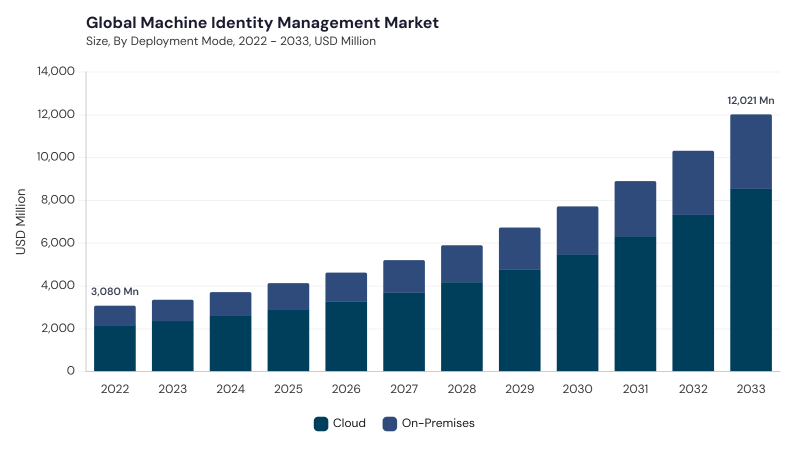
Growing dependence on cloud workloads, APIs, containers, microservices, connected devices, automation platforms, AI systems, and other non-human entities is driving the Machine Identity Management Market. Enterprises are increasingly using centralized platforms to manage certificates, cryptographic keys, secrets, tokens, service accounts, and workload identities for secure machine-to-machine authentication. Growth is further strengthened by zero-trust adoption, DevOps integration, certificate lifecycle automation, and cryptographic governance.
Increasing use of automated digital infrastructure is making machine identity management a core requirement for enterprise cybersecurity. Applications, workloads, containers, APIs, connected devices, service accounts, bots, and AI agents increasingly require trusted authentication and controlled access. Expired certificates, unmanaged credentials, compromised keys, and weak secrets governance can disrupt digital services or expose organizations to unauthorized access. This is increasing demand for automated certificate lifecycle management, secrets protection, cryptographic inventories, and policy-based credential governance. Expansion of cloud-native architecture and DevSecOps workflows is also shifting machine identity controls closer to application development and infrastructure automation.
Competition is intensifying as machine identity management expands beyond certificate lifecycle management into broader non-human identity security. Specialist certificate and PKI vendors compete with identity-security platforms, privileged access providers, secrets-management companies, cloud-security vendors, and large enterprise technology suppliers. Differentiation increasingly depends on discovery coverage, automation depth, scalability, interoperability, cloud-native integration, cryptographic visibility, DevSecOps support, and operational reliability. Vendors are also expanding through acquisitions, partnerships, and platform integration to cover certificates, secrets, service accounts, workload identities, API credentials, and AI-agent identities. Enterprise buyers are prioritizing platforms that can reduce certificate outages, simplify credential governance, support crypto-agility, and operate across heterogeneous hybrid and multi-cloud environments.

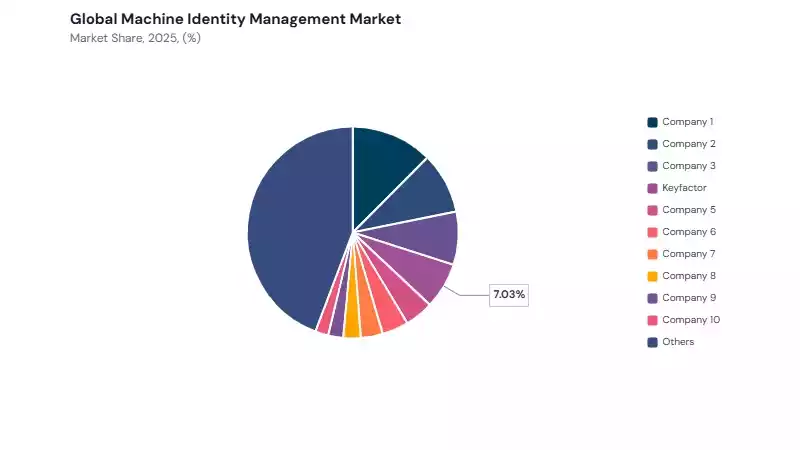
The global Machine Identity Management market is moderately fragmented, with competition led by machine identity specialists, PKI providers, privileged access vendors, secrets-management platforms, and large cybersecurity companies. CyberArk, including Venafi, holds a strong position through machine identity, certificate lifecycle, workload identity, and broader identity-security capabilities. DigiCert, Sectigo, Keyfactor, and AppViewX form a strong certificate and PKI automation tier, while IBM, Microsoft, BeyondTrust, Delinea, and Entrust strengthen competition through secrets management, privileged access, cloud identity, and cryptographic trust infrastructure. Market share is shaped by automation reliability, certificate lifecycle depth, cloud-native integration, crypto-agility, DevSecOps support, and the ability to govern expanding non-human identity populations.
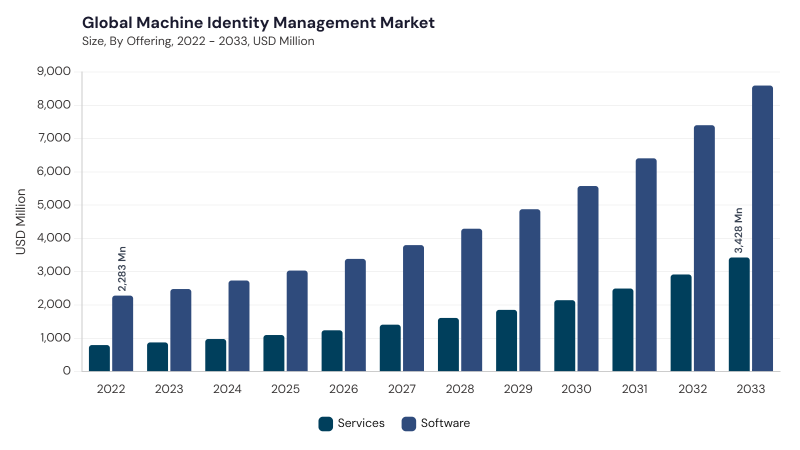
The Global Machine Identity Management Market, by offering, is segmented into Software and Services. The Software market dominated the Global Machine Identity Management Market by Offering in 2025, and would continue to be a dominant market till 2033; thereby, achieving a market value of USD 8.5 billion by 2033, growing at a CAGR of 14.2 % during the forecast period. The Services market is expected to witness a CAGR of 15.6% during (2026 - 2033).
Software represents the leading offering as enterprises require centralized platforms for discovering machine identities, managing certificates and cryptographic keys, rotating credentials, securing workload identities, enforcing access policies, and maintaining visibility across cloud, application, device, API, and automation environments. Services support adoption through consulting, implementation, PKI modernization, managed operations, compliance support, migration assistance, and technical advisory. As machine identity environments become more complex, organizations increasingly rely on service providers to configure governance frameworks, integrate security tools, and maintain reliable lifecycle operations.
The Global Machine Identity Management Market, by deployment mode, is segmented into Cloud and On-Premises. The Cloud market dominated the Global Machine Identity Management Market by Deployment Mode in 2025, and would continue to be a dominant market till 2033; thereby, achieving a market value of USD 8.5 billion by 2033, growing at a CAGR of 14.7 % during the forecast period. The On-Premises market is expected to witness a CAGR of 14.4% during (2026 - 2033).
Cloud represents the leading deployment model as enterprises operate applications, APIs, containers, microservices, virtual machines, and automated workloads across distributed environments. Cloud deployment offers scalable administration, faster implementation, centralized visibility, automatic updates, and easier integration with cloud-native infrastructure. On-Premises remains important for organizations requiring direct control over cryptographic keys, internal certificate authorities, sensitive credentials, and critical security infrastructure. Regulated industries and legacy environments continue to support local deployments, while hybrid architectures increase the need for consistent governance across both models.
The Global Machine Identity Management Market, by enterprise type, is segmented into Large Enterprises and Small & Medium Enterprises (SMEs). The Large Enterprise market dominated the Global Machine Identity Management Market by Enterprise Type in 2025, and would continue to be a dominant market till 2033; thereby, achieving a market value of USD 7.8 billion by 2033, growing at a CAGR of 14.3 % during the forecast period. The SMEs market is expected to witness a CAGR of 15.2% during (2026 - 2033).
Large Enterprises represent the leading segment because they operate complex hybrid and multi-cloud environments, large PKI systems, extensive application portfolios, and substantial populations of certificates, keys, APIs, containers, service accounts, and workload identities. These organizations require automated discovery, lifecycle management, credential rotation, policy enforcement, and integration with cybersecurity platforms. SMEs are increasingly adopting machine identity management as cloud usage, SaaS applications, digital services, and DevOps practices expand. Simpler cloud-based tools, subscription models, and managed services are helping smaller organizations reduce administrative burden and improve credential governance.
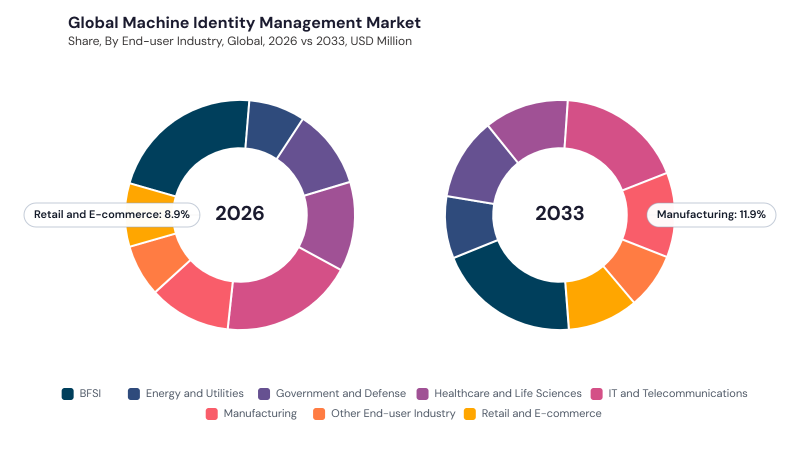
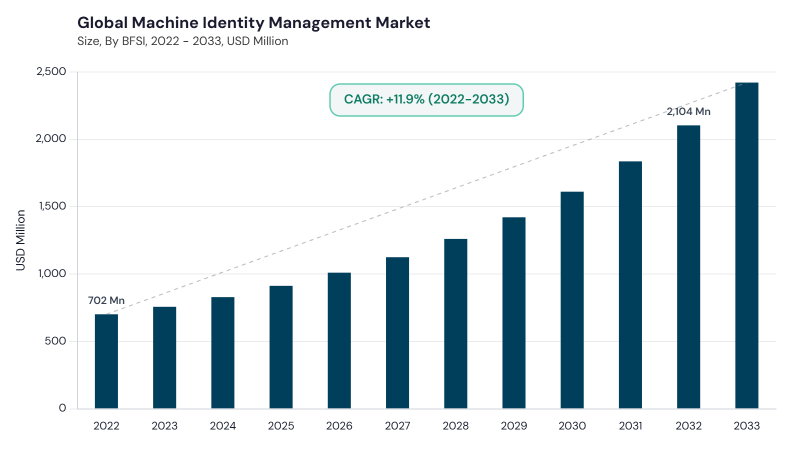
The Global Machine Identity Management Market, by end-user industry, is segmented into BFSI, IT & Telecommunications, Healthcare & Life Sciences, Manufacturing, Government & Defense, Retail & E-commerce, Energy & Utilities, and Others. The BFSI market dominated the Global Machine Identity Management Market by End-user Industry in 2025, and would continue to be a dominant market till 2033; thereby, achieving a market value of USD 2.4 billion by 2033, growing at a CAGR of 13.3 % during the forecast period. The IT and Telecommunications market is expected to witness a CAGR of 13.9% during (2026 - 2033). Additionally, The Healthcare and Life Sciences market is expected to witness highest CAGR of 13.7% during (2026 - 2033).
BFSI leads demand because financial institutions depend on certificates, cryptographic keys, APIs, automated systems, and secure digital transaction infrastructure. IT & Telecommunications is expanding strongly as cloud services, 5G networks, data centers, APIs, virtualized networks, and software-defined services increase non-human identity volumes. Healthcare, manufacturing, government, retail, and energy organizations are also adopting machine identity controls as connected medical systems, industrial automation, public-sector networks, digital commerce platforms, smart-grid infrastructure, and operational technology become more interconnected.
Free Valuable Insights: Machine Identity Management Market Size to reach $12.0 Billion by 2033
Region-wise, the Machine Identity Management Market is analyzed across North America, Europe, Asia Pacific, and LAMEA. The North America market dominated the Global Machine Identity Management Market by Region in 2025, and would continue to be a dominant market till 2033; thereby, achieving a market value of USD 4.3 billion by 2033, growing at a CAGR of 13.9 % during the forecast period. The Asia Pacific market is expected to witness a CAGR of 15.4% during (2026 - 2033). Additionally, The Europe market is expected to witness a CAGR of 14.4% during (2026 - 2033).
North America leads the market due to mature cybersecurity investment, extensive cloud adoption, DevOps maturity, zero-trust programs, and widespread use of digital applications, APIs, containers, and connected infrastructure. Asia Pacific is witnessing strong demand as cloud migration, data center expansion, digital financial services, mobile applications, and enterprise digitalization increase machine credential volumes. Europe is supported by cybersecurity resilience, data protection, hybrid infrastructure, and stronger governance of cryptographic assets. LAMEA adoption is expanding through cloud infrastructure growth, financial technology, telecommunications modernization, managed services, and rising awareness of identity-related cyber risks.
| Report Attribute | Details |
|---|---|
| Market size value in 2026 | USD 4.6 billion |
| Market size forecast in 2033 | USD 12.0 billion |
| Base Year | 2025 |
| Historical Period | 2022 to 2024 |
| Forecast Period | 2026 to 2033 |
| Revenue Growth Rate | CAGR of 14.6% from 2026 to 2033 |
| Number of Pages | XX |
| Tables | XX |
| Report Coverage | Market Trends, Revenue Estimation and Forecast, Segmentation Analysis, Regional and Country Breakdown, Competitive Landscape, Market Share Analysis, Company Profiling, Companies Strategic Developments, SWOT Analysis, Product Life Cycle Analysis, Value Chain Analysis, Market Consolidation Analysis, Key Customer Criteria, Pandemic Impact Analysis, and Winning Imperatives |
| Segments Covered | Offering, Deployment Mode, Enterprise Type, End-user Industry, and Geography |
| Country Scope |
|
| Companies Included | CyberArk; DigiCert; Sectigo; Keyfactor; AppViewX; IBM; Microsoft; BeyondTrust; Delinea; Entrust |
By Offering
By Deployment Mode
By Enterprise Type
By End-user Industry
By Geography
Expected to reach USD 12.0 billion by 2033, growing at 14.6% CAGR during 2026-2033.
Software leads, projected to reach USD 8.5 billion by 2033.
CyberArk, DigiCert, Sectigo, Keyfactor, AppViewX, IBM, Microsoft, BeyondTrust, Delinea, Entrust are key players.
Cloud deployment leads, reaching USD 8.5 billion by 2033.
North America leads, projected to reach USD 4.3 billion by 2033.
Rapid growth of machine identities and zero-trust security adoption drive market growth.
Our team of dedicated experts can provide you with attractive expansion opportunities for your business.






 Unique Offerings
