The sample copy of this report is available for access.
The LAMEA Machine Identity Management Market is expected to reach USD 548.1 million by 2029, growing at a CAGR of 15.9% during (2026 - 2033).
LAMEA Machine Identity Management Market is developing as organizations across Latin America, the Middle East, and Africa accelerate cloud adoption, digital banking, telecom modernization, government digitalization, e-commerce, industrial automation, and cybersecurity investment. Enterprises increasingly depend on applications, APIs, cloud workloads, networks, connected devices, payment systems, and automated services that communicate without direct human involvement. These environments generate digital certificates, cryptographic keys, secrets, service accounts, workload identities, API credentials, and other non-human identities requiring secure lifecycle governance.
The market is gradually evolving from conventional PKI and certificate administration toward automated certificate lifecycle management and broader machine identity security. Large financial institutions, telecom operators, governments, energy companies, technology providers, and multinational enterprises are positioned at the more advanced end of adoption. Cloud-native machine identity, automated certificate lifecycle management, connected-device security, non-human identity governance, AI-related identities, and crypto-agility are shaping current development. However, uneven cybersecurity maturity, legacy infrastructure complexity, limited awareness, implementation burden, and shortage of specialized machine identity expertise continue to influence adoption.
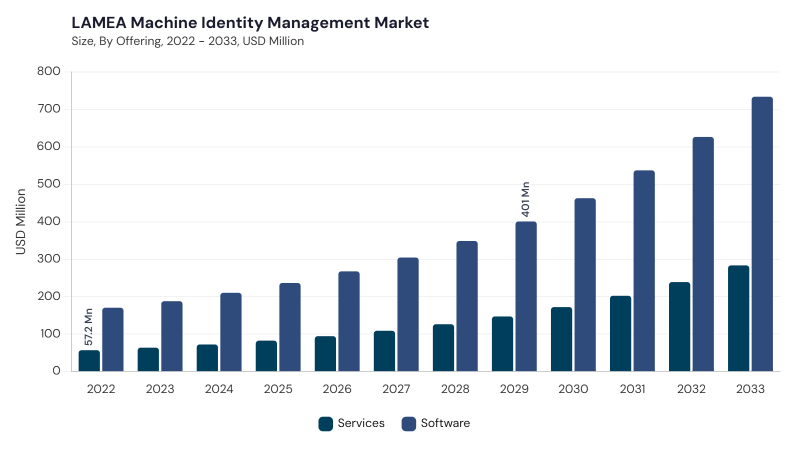
Based on Offering, the market is segmented into Software and Services. The Software market dominated the LAMEA Machine Identity Management Market by Offering in 2025, and would continue to be a dominant market till 2033; thereby, achieving a market value of USD 400.9 million by 2029, growing at a CAGR of 15.5 % during the forecast period. The Services market is expected to witness a CAGR of 17% during (2026 - 2033).
Software platforms support continuous discovery, certificate lifecycle automation, centralized inventory, credential rotation, policy enforcement, cryptographic visibility, non-human identity governance, DevOps integration, and cloud infrastructure connectivity. Services represented a promising presence through cybersecurity consulting, implementation support, PKI configuration, platform integration, training, managed security expertise, cryptographic reporting, and ongoing lifecycle operations. Services are especially important where internal PKI, cryptographic, cloud-security, and identity-security expertise remains limited.
Based on Deployment Mode, the market is segmented into Cloud and On-Premises. The Cloud market dominated the LAMEA Machine Identity Management Market by Deployment Mode in 2025, and would continue to be a dominant market till 2033; thereby, achieving a market value of USD 391.5 million by 2029, growing at a CAGR of 16 % during the forecast period. The On-Premises market is expected to witness a CAGR of 15.7% during (2026 - 2033).
Cloud deployment supports certificate discovery, lifecycle automation, policy administration, credential monitoring, cryptographic inventory, cloud-native development, API-driven issuance, DevSecOps integration, Kubernetes connectivity, CI/CD workflows, and multi-cloud governance. It is especially relevant for organizations seeking scalability, faster deployment, automation, and simplified administration. On-Premises maintained a promising segment among governments, defense organizations, financial institutions, telecom operators, energy companies, industrial enterprises, and critical-infrastructure providers requiring direct control over cryptographic assets, private certificate authorities, internal trust environments, sensitive applications, and hybrid architecture.
Based on Enterprise Type, the market is segmented into Large Enterprise and SMEs. Large enterprises operate extensive identity estates across applications, servers, network devices, APIs, cloud workloads, containers, databases, connected systems, cryptographic keys, secrets, service accounts, and workload identities. They require continuous discovery, enterprise-scale automation, policy segmentation, reporting, cryptographic visibility, high availability, governance, non-human identity security, AI-agent identity readiness, and crypto-agility.
SMEs formed a promising presence as cloud applications, digital payments, subscription cybersecurity tools, e-commerce, SaaS platforms, simplified deployment, managed services, and predictable pricing make machine identity automation more accessible.
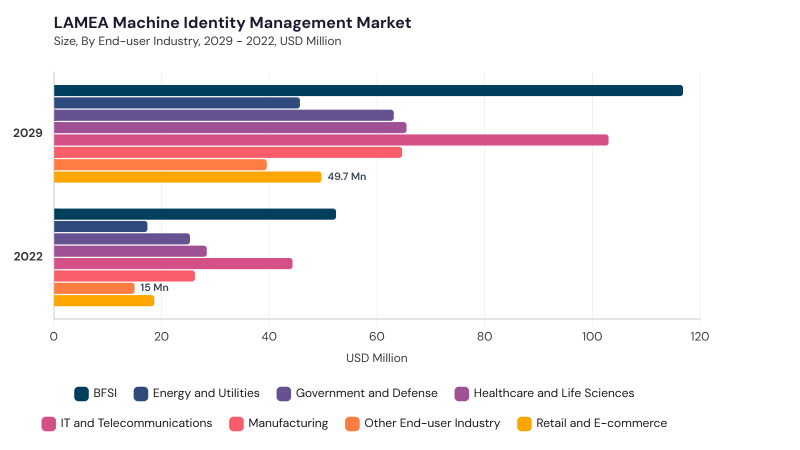
Based on End-user Industry, the market is segmented into BFSI, IT and Telecommunications, Healthcare and Life Sciences, Manufacturing, Government and Defense, Retail and E-commerce, Energy and Utilities, and Other End-user Industry. BFSI uses machine identity management to secure digital banking, mobile finance, payment platforms, fintech applications, online insurance, wallets, API-based financial ecosystems, and transaction infrastructure. IT and Telecommunications captured a substantial share through network expansion, cloud services, data centers, software-defined infrastructure, connected endpoints, and telecom modernization. Healthcare and Life Sciences established a significant presence as hospitals, laboratories, digital health platforms, pharmaceutical firms, and connected medical environments expand.
Manufacturing reflected industrial automation, smart production, robotics, industrial IoT, mining technology, and connected supply chains. Government and Defense retained a steady role through digital government, secure networks, cloud infrastructure, defense systems, and public-sector cybersecurity modernization. Retail and E-commerce developed demand through online marketplaces, payment gateways, mobile commerce, APIs, and customer applications, while Energy and Utilities expanded through oil and gas facilities, renewable projects, smart meters, power networks, sensors, and operational technologies. Other End-user Industry includes transportation, logistics, education, tourism, hospitality, media, construction, aerospace, and other digitized activities.
Free Valuable Insights: Machine Identity Management Market Size Worth USD 12.0 Billion billion by 2033
Based on Country, the market is segmented into Brazil, Argentina, UAE, Saudi Arabia, South Africa, Nigeria, and Rest of LAMEA. The Brazil market dominated the LAMEA Machine Identity Management Market by Country in 2025, and would continue to be a dominant market till 2033; thereby, achieving a market value of USD 145.8 million by 2029, growing at a CAGR of 14.5 % during the forecast period. The Argentina market is expected to witness a CAGR of 16.5% during (2026 - 2033). Additionally, The UAE market is expected to witness a CAGR of 14.8% during (2026 - 2033).
Across LAMEA, Machine Identity Management adoption varies by digital maturity, cloud adoption, fintech growth, cybersecurity investment, enterprise infrastructure, and managed-service availability. Brazil is progressing through cloud modernization, financial digitalization, telecom, e-commerce, DevSecOps, and cryptographic visibility, while Argentina focuses on software modernization, digital finance, certificate lifecycle automation, and accessible managed services. The UAE and Saudi Arabia show stronger demand through cloud infrastructure, digital government, fintech, smart systems, AI adoption, energy infrastructure, and cybersecurity modernization. South Africa and Nigeria are growing through hybrid cloud, financial services, telecom, mining, energy, fintech, digital payments, and e-commerce, managed cybersecurity, secrets management, and secure application credentials.

By Offering
By Deployment Mode
By Enterprise Type
By End-user Industry
By Country
Set to reach $548.1 Million by 2029, growing at 15.9% CAGR during 2026-2033.
Brazil leads with a market value of USD 145.8 million by 2029, growing at 14.5% CAGR during the forecast period.
The Software segment is projected to achieve USD 400.9 million by 2029, growing at a 15.5% CAGR during 2026-2033.
Cloud deployment mode will reach USD 391.5 million by 2029, growing at a 16% CAGR during 2026-2033.
The UAE market is expected to witness a CAGR of 14.8% during 2026-2033.
The Services segment is expected to witness a CAGR of 17% during 2026-2033.
Our team of dedicated experts can provide you with attractive expansion opportunities for your business.




 Unique Offerings
