The sample copy of this report is available for access.
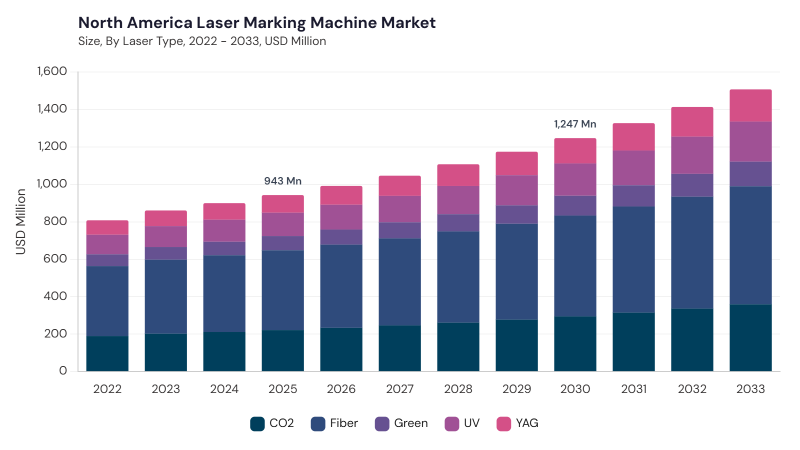
The North America Laser Marking Machine Market is expected to reach USD 1413.3 million by 2032, growing at a CAGR of 6.2% during (2026 - 2033).
The North America Laser Marking Machine Market evolved from conventional industrial engraving and micromachining systems into advanced, automated laser platforms supporting permanent identification and traceability. Early systems were comparatively bulky and concentrated on metal marking, while the development of fiber lasers, compact beam-delivery systems, UV technologies, and improved controls expanded material compatibility and precision. The transition from CO2 and Nd:YAG systems toward fiber-based solutions improved speed, energy efficiency, maintenance requirements, and production integration. Laser marking has consequently become embedded in automotive, aerospace, electronics, medical devices, packaging, machine tools, and other manufacturing environments requiring durable identification.
Fiber laser adoption, Industry 4.0 integration, customization, AI-enabled process control, and sustainability are shaping current market development. Manufacturers increasingly integrate laser systems with robotics, MES platforms, IoT monitoring, automated inspection, and real-time traceability systems to improve throughput and reduce errors. Growing regulatory emphasis on permanent identification, serialization, anti-counterfeiting, and audit-ready product tracking is reinforcing demand across regulated industries. Portable and modular systems are widening adoption among smaller manufacturers, while UV, green, and advanced pulsed lasers are supporting heat-sensitive, reflective, and complex substrates. Energy-efficient, ink-free marking processes are also strengthening laser technology’s position within environmentally conscious manufacturing.
Based on Laser Type, the market is segmented into Fiber, CO2, UV, YAG, and Green. The Fiber market dominated the North America Laser Marking Machine Market by Laser Type in 2025, and would continue to be a dominant market till 2033; thereby, achieving a market value of USD 597.7 million by 2032, growing at a CAGR of 5.1 % during the forecast period. The CO2 market is expected to witness a CAGR of 6.4% during (2026 - 2033). Additionally, The UV market is expected to witness highest CAGR of 7.1% during (2026 - 2033).
Fiber lasers provide high-speed, precise, and durable marking across metals and selected plastics, supporting automotive, aerospace, electronics, and industrial traceability applications. CO2 lasers remain important for plastics, paper, wood, leather, glass, and other non-metallic substrates across packaging and general manufacturing. UV lasers enable cold marking with minimal thermal impact, making them suitable for sensitive polymers, electronics, medical devices, and semiconductor-related components. YAG lasers support controlled-depth and high-precision marking on metals and hard industrial parts, while Green lasers address reflective materials such as copper, gold, and silver where shorter wavelengths improve absorption, contrast, and marking precision.
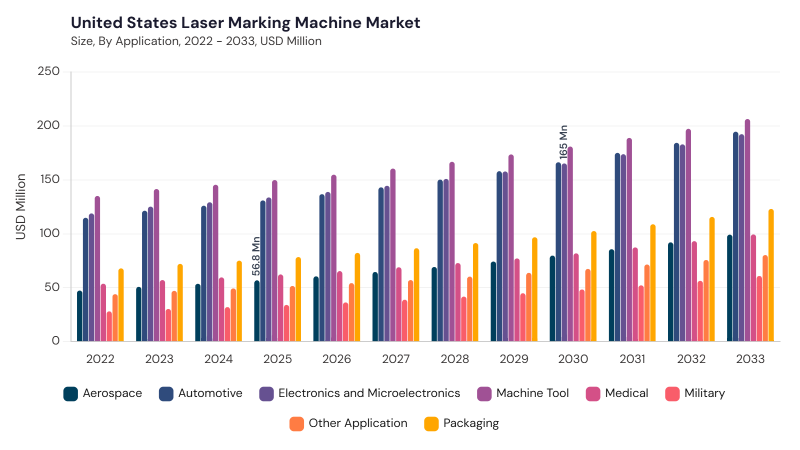
Based on Application, the market is segmented into Machine Tool, Electronics and Microelectronics, Automotive, Packaging, Medical, Aerospace, Military, and Other Application. Machine Tool applications use laser marking for component identification, calibration, serialization, tooling traceability, and integration with digitally controlled manufacturing systems. Electronics and Microelectronics requires high-resolution, low-thermal-impact marking for circuit boards, semiconductors, and miniature components, while Automotive relies on durable codes, serial numbers, VIN-related identification, battery marking, and lifecycle tracking.
Packaging uses contactless marking for date codes, batch information, barcodes, and variable data, whereas Medical applies permanent, sterilization-resistant markings to instruments, implants, and diagnostic equipment. Aerospace requires durable identification able to withstand long service cycles and harsh operating conditions, while Military uses secure and resilient markings for components and mission-critical equipment. Other Application includes jewelry, consumer products, promotional goods, general fabrication, and customized manufacturing.
Free Valuable Insights: The Global Laser Marking Machine Market will hit USD 7039.9 Million billion by 2033, at a CAGR of
Based on Country, the market is segmented into US, Canada, Mexico, and Rest of North America. The US market dominated the North America Laser Marking Machine Market by Country in 2025, and would continue to be a dominant market till 2033; thereby, achieving a market value of USD 997.3 million by 2032, growing at a CAGR of 5.4 % during the forecast period. The Canada market is expected to witness a CAGR of 9.1% during (2026 - 2033). Additionally, The Mexico market is expected to witness a CAGR of 6.9% during (2026 - 2033).
Across North America, laser marking adoption is being shaped by automation, regulatory traceability, material versatility, customization, sustainability, and Industry 4.0 integration. The US emphasizes fiber lasers, 3D marking, integrated inspection, smart manufacturing, anti-counterfeiting, and high-precision industrial applications, while Canada focuses on Industry 4.0 connectivity, environmentally efficient marking, UV and fiber technologies, flexible production, and localized technical support. Mexico is advancing AI-enabled automation, versatile multi-material marking, compliance-driven traceability, modular systems, ERP integration, and localized service infrastructure, whereas Rest of North America continues to develop connected fiber-laser systems, eco-efficient marking, AI-assisted process optimization, portable platforms, predictive maintenance, and smart-factory integration.

By Laser Type
By Application
By Country
Set to reach $1413.3 Million by 2032, growing at 6.2% CAGR during 2026-2033.
The US leads with $997.3 million by 2032, growing at 5.4% CAGR during 2026-2033.
Fiber segment reaches $597.7 million by 2032, growing at 5.1% CAGR during 2026-2033.
Canada is expected to witness a CAGR of 9.1% during 2026-2033.
The UV segment is expected to witness the highest CAGR of 7.1% during 2026-2033.
Our team of dedicated experts can provide you with attractive expansion opportunities for your business.




 Unique Offerings