The sample copy of this report is available for access.
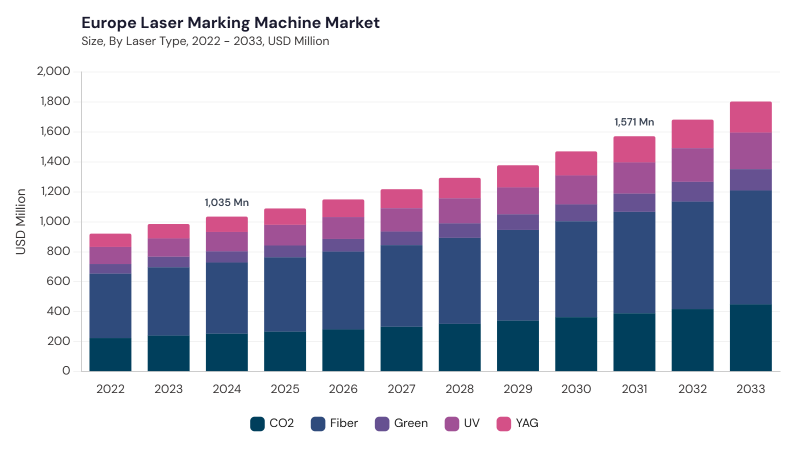
The Europe Laser Marking Machine Market is expected to reach USD 1571.2 million by 2031, growing at a CAGR of 6.6% during (2026 - 2033).
The Europe Laser Marking Machine Market evolved from early laser-based industrial identification used primarily in automotive and aerospace into advanced, digitally integrated marking systems serving a broad manufacturing base. The transition from CO2 and Nd:YAG technologies toward fiber lasers improved marking speed, resolution, efficiency, and material flexibility, while CNC integration enabled programmable precision. Increasing traceability requirements further expanded use across electronics, medical devices, packaging, and industrial components. More recently, Industry 4.0 adoption has transformed laser marking into an integrated manufacturing function supported by connectivity, real-time process control, automation, and data-driven quality management.
Fiber laser adoption, smart manufacturing, sustainability, micro-marking, and regulatory traceability are shaping current market development. Manufacturers increasingly integrate laser systems with IoT connectivity, AI-enabled optimization, robotic handling, machine vision, and real-time inspection to improve productivity and compliance. Growing demand for permanent and tamper-resistant identification supports adoption across medical devices, aerospace, automotive, electronics, and packaging. Environmental priorities are also encouraging ink-free, low-waste, energy-efficient marking technologies, while portable systems, ultrafast lasers, UV sources, and customizable configurations are expanding application flexibility across both large manufacturers and specialized industrial users.
Based on Laser Type, the market is segmented into Fiber, CO2, UV, YAG, and Green. The Fiber market dominated the Europe Laser Marking Machine Market by Laser Type in 2025, and would continue to be a dominant market till 2033; thereby, achieving a market value of USD 677.0 million by 2031, growing at a CAGR of 5.6 % during the forecast period. The CO2 market is expected to witness a CAGR of 6.9% during (2026 - 2033). Additionally, The UV market is expected to witness highest CAGR of 7.6% during (2026 - 2033).
Fiber lasers provide high precision, strong beam quality, energy efficiency, long service life, and effective marking of metals and selected plastics across automotive, electronics, machinery, and aerospace applications. CO2 lasers remain important for plastics, paper, wood, leather, glass, labels, and other non-metallic substrates used in packaging and consumer-oriented production. UV lasers support cold marking with minimal thermal impact, making them suitable for sensitive electronics, medical materials, polymers, glass, and micro-components. YAG lasers maintain relevance in metal engraving, tooling, engineered parts, and established industrial installations requiring controlled marking depth, while Green lasers address reflective metals, transparent materials, luxury goods, and heat-sensitive substrates requiring precise energy absorption.
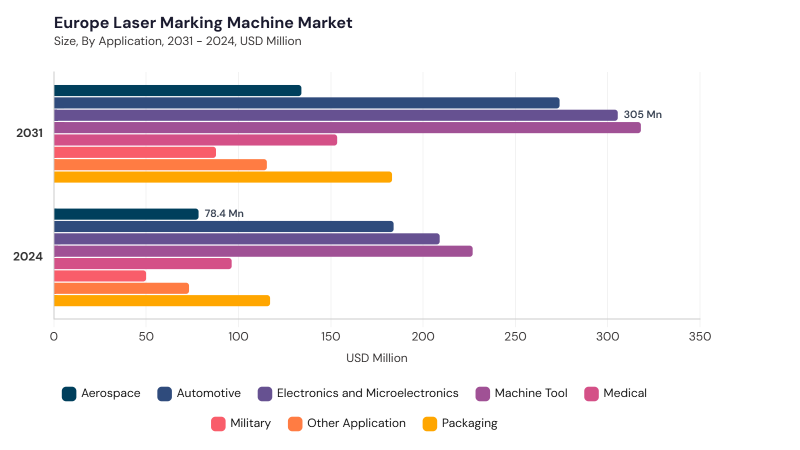
Based on Application, the market is segmented into Machine Tool, Electronics and Microelectronics, Automotive, Packaging, Medical, Aerospace, Military, and Other Application. Machine Tool applications use laser marking for tool identification, calibration labels, serial numbers, production codes, and component traceability within automated manufacturing systems. Electronics and Microelectronics requires fine, low-thermal-impact marking for sensors, circuit assemblies, semiconductors, and compact electronic components, while Automotive relies on durable identification across powertrain parts, EV systems, batteries, safety components, and supplier networks.
Packaging uses laser systems for batch coding, serialization, recycling information, and product identification, whereas Medical requires permanent, sterilization-resistant markings on instruments, implants, and diagnostic devices. Aerospace applies laser marking for component traceability and maintenance records across long operating cycles, while Military uses durable identification for specialized equipment and critical components. Other Application includes luxury goods, jewelry, customized manufacturing, research activities, textiles, and general fabrication.
Free Valuable Insights: The Worldwide Laser Marking Machine Market is projected to reach USD 7039.9 Million billion by 2033, at a CAGR of
Based on Country, the market is segmented into Germany, UK, France, Russia, Spain, Italy, and Rest of Europe. The Germany market dominated the Europe Laser Marking Machine Market by Country in 2025, and would continue to be a dominant market till 2033; thereby, achieving a market value of USD 402.3 million by 2031, growing at a CAGR of 5.5 % during the forecast period. The UK market is expected to witness a CAGR of 5.2% during (2026 - 2033). Additionally, The France market is expected to witness a CAGR of 7.5% during (2026 - 2033).
Across Europe, laser marking adoption is being influenced by precision manufacturing, fiber-laser expansion, Industry 4.0 integration, regulatory traceability, sustainability, and increasing demand for customized systems. Germany emphasizes ultra-precise fiber and ultrafast lasers, portable systems, smart monitoring, and automated production integration, while the UK focuses on machine vision, portable marking, traceability, hybrid laser technologies, and AI-enabled diagnostics. France is advancing micro-marking, ultrafast fiber lasers, sustainable processes, IoT connectivity, and Industry 4.0 integration, whereas Russia emphasizes localized production, fiber technologies, high-precision marking, import substitution, and connected manufacturing systems. Spain focuses on micro-marking, automated production lines, MES connectivity, energy efficiency, and portable solutions, while Italy emphasizes fiber lasers, robotics, smart sensors, traceability software, and sustainable marking processes. Rest of Europe continues to develop micro-marking, eco-efficient laser systems, IoT-enabled monitoring, predictive maintenance, portable equipment, and automation-oriented marking technologies.

By Laser Type
By Application
By Country
Set to reach $1571.2 Million by 2031, growing at a 6.6% CAGR during 2026-2033.
Germany leads with $402.3 million by 2031, growing at a 5.5% CAGR during the forecast period.
Fiber segment to reach $677.0 million by 2031, growing at a 5.6% CAGR during the forecast period.
The France market is expected to witness a 7.5% CAGR during 2026-2033.
The UV market is expected to witness the highest CAGR of 7.6% during 2026-2033.
Our team of dedicated experts can provide you with attractive expansion opportunities for your business.




 Unique Offerings