The sample copy of this report is available for access.
The Asia Pacific Laser Marking Machine Market is expected to reach USD 2.5 billion by 2030, growing at a CAGR of 7.4% during (2026 - 2033).
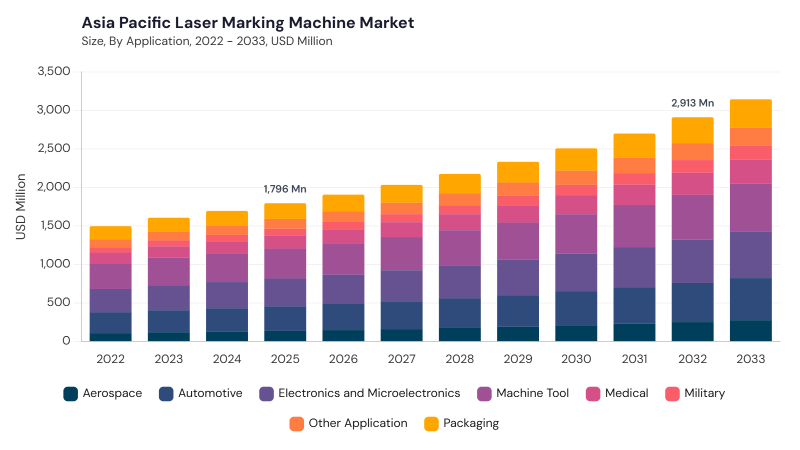
The Asia Pacific Laser Marking Machine Market evolved from early CO2 and YAG-based engraving systems into advanced fiber, UV, green, and digitally integrated marking platforms. Initial applications focused on metal engraving and component identification, while improvements in optics, beam delivery, automation, and laser-source efficiency expanded adoption across electronics, automotive, medical devices, packaging, and machinery. Rapid industrialization and high-precision manufacturing development in China, Japan, South Korea, India, and Southeast Asia accelerated deployment. The market now includes portable, high-power, automated, and smart marking systems aligned with traceability, anti-counterfeiting, customization, and Industry 4.0 requirements.
Fiber laser adoption, portable systems, smart manufacturing, regulatory traceability, and sustainability are shaping current market development. Manufacturers increasingly integrate laser marking with IoT connectivity, AI analytics, machine vision, robotic systems, real-time monitoring, and predictive maintenance to improve production accuracy and reduce defects. Growing demand for customized and mobile marking solutions is widening adoption among SMEs and specialized manufacturers, while UV and green technologies support heat-sensitive and reflective materials. Regulatory emphasis on permanent identification and anti-counterfeiting is strengthening demand, while energy-efficient, consumable-free laser systems are increasingly aligned with environmental and operational-efficiency priorities.
Based on Laser Type, the market is segmented into Fiber, CO2, UV, YAG, and Green. The Fiber market dominated the Asia Pacific Laser Marking Machine Market by Laser Type in 2025, and would continue to be a dominant market till 2033; thereby, achieving a market value of USD 1.0 billion by 2030, growing at a CAGR of 6.3 % during the forecast period. The CO2 market is expected to witness a CAGR of 7.6% during (2026 - 2033). Additionally, The UV market is expected to witness highest CAGR of 8.3% during (2026 - 2033).
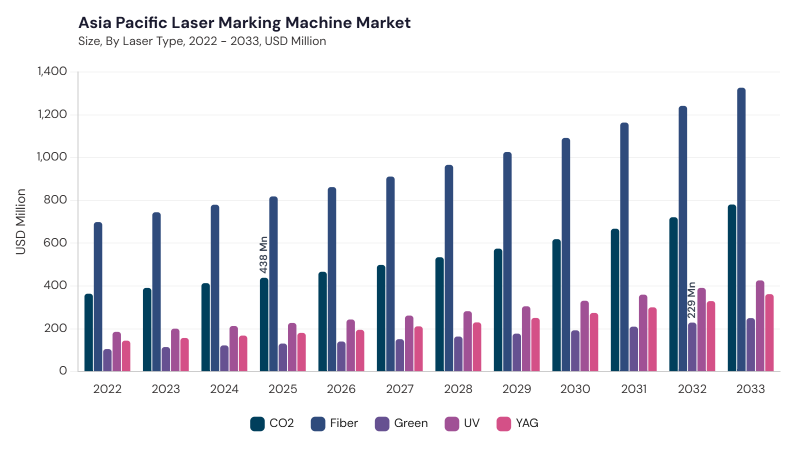
Fiber lasers provide high beam quality, rapid marking, low maintenance, long operating life, and strong performance across metals, alloys, and selected plastics, supporting automotive, electronics, machinery, and industrial traceability applications. CO2 lasers remain important for packaging materials, textiles, plastics, wood, glass, leather, and other non-metal substrates requiring economical high-speed marking. UV lasers enable precise cold marking with minimal thermal damage, supporting semiconductor, display, PCB, medical, and sensitive polymer applications. YAG lasers retain relevance in tooling, engineered components, metals, ceramics, and deep engraving, while Green lasers serve reflective and transparent materials, photovoltaics, electronics, luxury products, and precision applications requiring controlled energy absorption.
Based on Application, the market is segmented into Machine Tool, Electronics and Microelectronics, Automotive, Packaging, Medical, Aerospace, Military, and Other Application. Machine Tool applications use laser marking for serial numbers, tool coding, asset identification, production tracking, and integration with automated manufacturing systems. Electronics and Microelectronics requires microscopic, high-resolution marking on semiconductors, circuit boards, batteries, displays, and compact components, while Automotive relies on permanent identification across vehicle parts, EV batteries, electronic modules, and complex supplier chains.
Packaging applies laser systems to batch codes, dates, variable data, and product identification, whereas Medical uses permanent marking on diagnostic products, surgical equipment, disposables, implants, and medical electronics. Aerospace requires durable traceability across aircraft parts, maintenance components, and high-value assemblies, while Military uses marking for equipment identification, inventory control, and defense-related assets. Other Application includes jewelry, gifts, consumer products, contract manufacturing, research facilities, and customized fabrication.
Free Valuable Insights: Laser Marking Machine Market is Predicted to reach USD 7039.9 Million billion by 2033, at a CAGR of
Based on Country, the market is segmented into China, Japan, India, South Korea, Singapore, Malaysia, and Rest of Asia Pacific. The China market dominated the Asia Pacific Laser Marking Machine Market by Country in 2025, and would continue to be a dominant market till 2033; thereby, achieving a market value of USD 1.0 billion by 2030, growing at a CAGR of 6.1 % during the forecast period. The Japan market is expected to witness a CAGR of 6.6% during (2026 - 2033). Additionally, The India market is expected to witness a CAGR of 8.5% during (2026 - 2033).
Across Asia Pacific, laser marking adoption is being influenced by fiber-laser expansion, industrial automation, traceability requirements, AI integration, localization, and sustainability. China emphasizes fiber lasers, Industry 4.0 connectivity, automation, AI-enabled optimization, and environmentally efficient marking, while Japan focuses on fiber and UV technologies, smart manufacturing, traceability, advanced optics, and multifunctional systems. India is advancing AI-integrated marking, ultrafast lasers, automation, machine vision, localization, and compliance-driven applications, whereas South Korea emphasizes robotic integration, fiber technologies, AI vision systems, semiconductor marking, and smart manufacturing. Singapore focuses on Industry 4.0 connectivity, sustainable operation, precision engineering, AI-based defect detection, and flexible high-mix marking, while Malaysia emphasizes automation, fiber systems, sustainability, machine vision, and miniaturized precision applications. Rest of Asia Pacific continues to develop fiber laser adoption, portable marking, localized service networks, AI-assisted systems, smart manufacturing, and customized solutions across emerging industrial hubs.

By Laser Type
By Application
By Country
Set to reach $2.5 Billion by 2030, growing at 7.4% CAGR during 2026-2033.
China leads with a market value of USD 1.0 billion by 2030, growing at a CAGR of 6.1% during the forecast period.
Fiber laser type dominates, achieving USD 1.0 billion by 2030, with a CAGR of 6.3% during 2026-2033.
The UV market is expected to witness the highest CAGR of 8.3% during 2026-2033.
The India market is expected to witness a CAGR of 8.5% during 2026-2033.
Our team of dedicated experts can provide you with attractive expansion opportunities for your business.




 Unique Offerings