The sample copy of this report is available for access.
The North America Inventory Tags Market is expected to reach USD 2769.1 million by 2032, growing at a CAGR of 4.4% during (2026 - 2033).
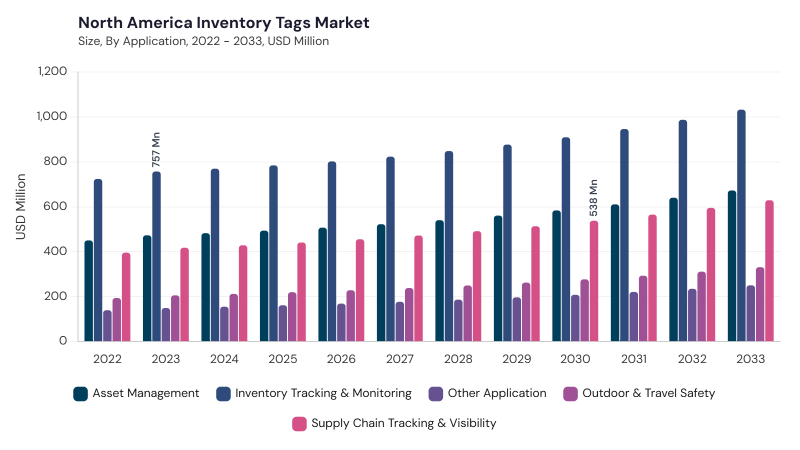
The North America Inventory Tags Market evolved from the early use of basic tagging systems designed to improve stock visibility across retail and warehousing operations. Initial adoption relied mainly on barcode labels for simple stock tracking, while later advancements in RFID technology enabled faster data capture, improved accuracy, and automated inventory visibility. The market matured further as tagging systems became integrated with ERP platforms, IoT-enabled sensors, and cloud-based analytics, transforming inventory tags from basic identification tools into connected inventory control solutions.
Current market growth is shaped by IoT integration, sustainability-focused materials, e-commerce expansion, and omnichannel retailing. Smart tags are increasingly enabling real-time inventory visibility, predictive stock management, and reduced human error across distributed supply chains. At the same time, demand for recyclable and eco-friendly tags is rising as businesses respond to regulatory pressure and greener procurement goals, while robust tagging solutions are gaining importance across warehouses, fulfillment networks, logistics operations, healthcare facilities, and industrial inventory environments.
Based on Application, the market is segmented into Inventory Tracking & Monitoring, Asset Management, Supply Chain Tracking & Visibility, Outdoor & Travel Safety, and Other Application. The Inventory Tracking & Monitoring market dominated the North America Inventory Tags Market by Application in 2025, and would continue to be a dominant market till 2033; thereby, achieving a market value of USD 987.1 million by 2032, growing at a CAGR of 3.7 % during the forecast period. The Asset Management market is expected to witness a CAGR of 4.1% during (2026 - 2033). The Other Application market is expected to witness a CAGR of 5.8% during (2026 - 2033).
Inventory Tracking & Monitoring remains the core application as organizations use RFID, barcode, and IoT-enabled tags to automate stock audits, reduce stockouts, and improve inventory accuracy. Asset Management maintains a substantial role through equipment traceability, utilization monitoring, lifecycle management, and loss prevention across industrial, healthcare, and logistics settings. Supply Chain Tracking & Visibility supports end-to-end shipment transparency, real-time location tracking, chain-of-custody visibility, and logistics optimization. Outdoor & Travel Safety serves specialized use cases such as luggage, tools, recreational equipment, and field assets requiring durable tracking. Other Application includes niche uses across event management, museum assets, promotional items, and specialized commercial operations.
Based on End Use, the market is segmented into Retail & E-commerce, Transportation & Logistics, Manufacturing, Healthcare, and Other End Use. The Retail & E-commerce market dominated the North America Inventory Tags Market by End Use in 2025, and would continue to be a dominant market till 2033; thereby, achieving a market value of USD 911.8 million by 2032, growing at a CAGR of 3.6 % during the forecast period. The Transportation & Logistics market is expected to witness a CAGR of 4.1% during (2026 - 2033). Additionally, The Manufacturing market is expected to witness highest CAGR of 4.7% during (2026 - 2033).
Retail & E-commerce relies heavily on inventory tags to improve stock accuracy, reduce shrinkage, support real-time replenishment, and strengthen omnichannel fulfillment. Transportation & Logistics uses tags for shipment verification, pallet and container tracking, warehouse visibility, cargo security, and delivery accuracy. Manufacturing applies tagging solutions for work-in-progress tracking, raw material identification, equipment monitoring, maintenance management, and production visibility. Healthcare adoption is driven by medical equipment tracking, pharmaceutical traceability, consumable inventory control, and regulatory compliance. Other End Use includes agriculture, education, government, hospitality, institutional asset tracking, and other specialized inventory control environments.
Based on Technology, the market is segmented into RFID, Barcodes, QR Codes, and Other Technology. RFID remains the leading technology because it enables wireless, non-line-of-sight scanning, item-level visibility, automated stock audits, shrink reduction, and integration with IoT and cloud analytics platforms. Barcodes retain strong adoption due to low cost, operational simplicity, established infrastructure, and compatibility with existing enterprise inventory systems.
QR Codes are gaining relevance through higher data capacity, smartphone accessibility, serialization, cloud-linking capabilities, and use in traceability or customer-facing applications. Other Technology includes NFC, Bluetooth Low Energy, sensor-based smart tags, and connected tagging solutions used for condition monitoring, cold-chain visibility, high-value asset tracking, and specialized inventory environments.
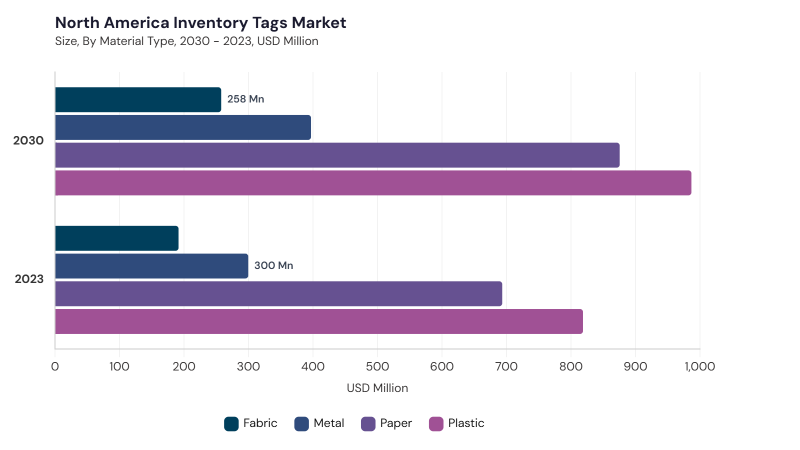
Based on Material Type, the market is segmented into Plastic, Paper, Metal, and Fabric. Plastic tags are widely used because they offer durability, customization flexibility, moisture resistance, RFID compatibility, and suitability for scalable retail, warehouse, healthcare, and food-related applications. Paper tags maintain significant use in high-volume and short-term applications due to cost efficiency, recyclability, printability, and compatibility with barcode and QR code systems.
Metal tags serve harsh industrial, aerospace, automotive, healthcare, and chemical environments where long service life, abrasion resistance, and permanent identification are required. Fabric tags hold a promising role in apparel, textiles, hospitality, healthcare laundry, reusable assets, and applications requiring flexible, washable, and lightweight identification.
Free Valuable Insights: The Global Inventory Tags Market will hit USD 8.2 Billion billion by 2033, at a CAGR of 4.9%
Based on Country, the market is segmented into US, Canada, Mexico, and Rest of North America. The US market dominated the North America Inventory Tags Market by Country in 2025, and would continue to be a dominant market till 2033; thereby, achieving a market value of USD 2093.0 million by 2032, growing at a CAGR of 3.7 % during the forecast period. The Canada market is expected to witness a CAGR of 6.9% during (2026 - 2033). Additionally, The Mexico market is expected to witness a CAGR of 5.7% during (2026 - 2033).
The US is driven by RFID adoption, IoT-enabled inventory visibility, smart labeling, sustainable materials, and omnichannel supply chain requirements, while Canada is supported by automation, RFID and smart tags, recyclable materials, cloud-based analytics, and IoT integration. Mexico is shaped by RFID adoption, eco-friendly tags, ERP integration, IoT connectivity, and smart inventory ecosystems, whereas Rest of North America reflects rising RFID usage, cloud-based inventory platforms, predictive inventory management, sustainable tag materials, and AI-enabled analytics.

By Application
By Technology
By Material Type
By End Use
By Country
Set to reach $2769.1 Million by 2032, growing at 4.4% CAGR during 2026-2033.
The US leads with $2093.0 million by 2032, growing at 3.7% CAGR during the forecast period.
Retail & E-commerce dominates with $911.8 million by 2032, growing at 3.6% CAGR during 2026-2033.
Inventory Tracking & Monitoring hits $987.1 million by 2032, growing at 3.7% CAGR during the forecast period.
Canada is expected to grow at a CAGR of 6.9% during 2026-2033.
The Manufacturing segment is expected to witness the highest CAGR of 4.7% during 2026-2033.
Our team of dedicated experts can provide you with attractive expansion opportunities for your business.




 Unique Offerings
