The sample copy of this report is available for access.
The Europe Inventory Tags Market is expected to reach USD 1910.6 million by 2031, growing at a CAGR of 4.7% during (2026 - 2033).
The Europe Inventory Tags Market originated as a niche segment focused on basic labeling and stock identification across retail and logistics sectors. Early development relied on paper-based tags and barcodes for manual inventory tracking, while later adoption of RFID and NFC-enabled tags improved automated data capture, real-time visibility, and asset management. The market has since advanced with sensor miniaturization, cloud analytics, IoT networks, and predictive inventory capabilities, reflecting stronger demand for operational agility and transparent supply chain management.
Current market growth is shaped by RFID adoption, IoT-cloud integration, and sustainable tagging solutions. RFID is reducing barcode limitations by enabling automated, non-line-of-sight tracking, while IoT and cloud platforms are strengthening predictive inventory management, data aggregation, and faster supply chain response. Eco-friendly materials, recyclable components, biodegradable tags, ERP integration, AI-driven analytics, data security, and regional compliance are also becoming important factors as European businesses modernize inventory systems.
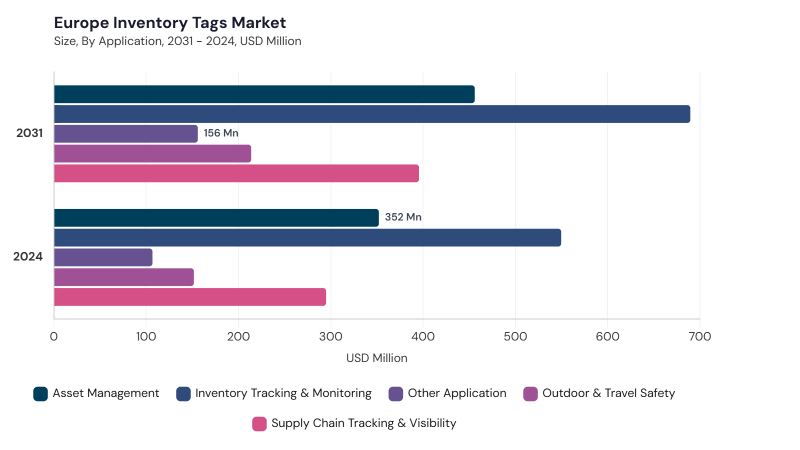
Based on Application, the market is segmented into Inventory Tracking & Monitoring, Asset Management, Supply Chain Tracking & Visibility, Outdoor & Travel Safety, and Other Application. The Inventory Tracking & Monitoring market dominated the Europe Inventory Tags Market by Application in 2025, and would continue to be a dominant market till 2033; thereby, achieving a market value of USD 689.5 million by 2031, growing at a CAGR of 4 % during the forecast period. The Asset Management market is expected to witness a CAGR of 4.5% during (2026 - 2033). The Other Application market is expected to witness a CAGR of 6.2% during (2026 - 2033).
Inventory Tracking & Monitoring remains central as retailers, manufacturers, and warehouses use RFID, barcode, and sensor-enabled tags to improve stock accuracy, reduce shrinkage, and support faster replenishment. Asset Management maintains substantial adoption through equipment tracking, lifecycle visibility, utilization monitoring, and maintenance control. Supply Chain Tracking & Visibility supports product provenance, cross-border logistics, condition monitoring, and traceability across complex European distribution networks. Outdoor & Travel Safety serves baggage, portable-item identification, recreational products, and equipment tracking, while Other Application includes customized tagging for waste management, event logistics, cultural assets, and specialized institutional uses.
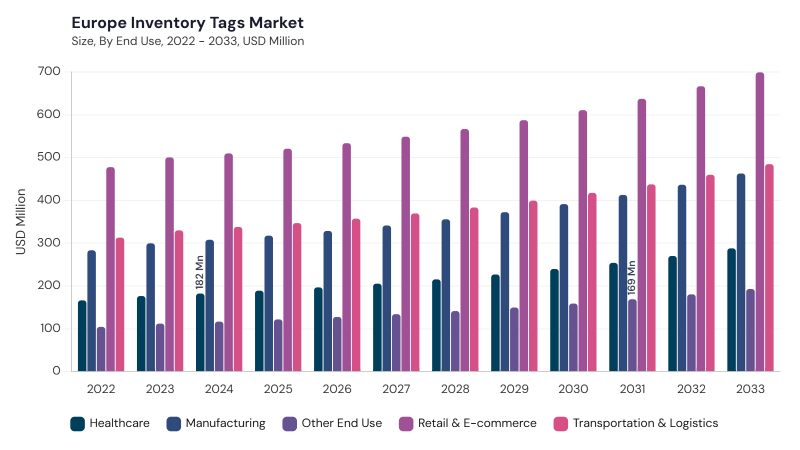
Based on End Use, the market is segmented into Retail & E-commerce, Transportation & Logistics, Manufacturing, Healthcare, and Other End Use. The Retail & E-commerce market dominated the Europe Inventory Tags Market by End Use in 2025, and would continue to be a dominant market till 2033; thereby, achieving a market value of USD 637.2 million by 2031, growing at a CAGR of 3.9 % during the forecast period. The Transportation & Logistics market is expected to witness a CAGR of 4.5% during (2026 - 2033). Additionally, The Manufacturing market is expected to witness highest CAGR of 5% during (2026 - 2033).
Retail & E-commerce uses inventory tags for real-time stock visibility, theft reduction, faster turnover, omnichannel fulfillment, and warehouse automation. Transportation & Logistics depends on tags for pallet, container, shipment, and cargo tracking across complex distribution networks. Manufacturing applies tags for raw material tracking, work-in-progress visibility, finished goods control, equipment identification, and Industry 4.0-driven factory modernization. Healthcare adoption is supported by medical supply tracking, pharmaceutical traceability, reusable clinical asset identification, and regulatory compliance. Other End Use covers aerospace, agriculture, energy, public institutions, hospitality, education, and other specialized environments requiring tailored inventory visibility.
Based on Technology, the market is segmented into RFID, Barcodes, QR Codes, and Other Technology. RFID remains the leading technology due to contactless scanning, bulk reading, automated inventory visibility, reduced manual errors, and strong fit across retail, logistics, automotive, and pharmaceuticals. Barcodes retain substantial adoption because of affordability, simplicity, mature scanning infrastructure, and compatibility with existing systems.
QR Codes continue to gain relevance through higher data capacity, smartphone accessibility, digital platform linkage, authentication, and consumer-facing traceability. Other Technology includes NFC, Bluetooth-enabled tags, microwave or ultrasonic tags, and IoT-based smart sensors used for proximity sensing, condition monitoring, secure authentication, and specialized high-value inventory environments.
Based on Material Type, the market is segmented into Plastic, Paper, Metal, and Fabric. Plastic tags are widely used due to durability, light weight, customization flexibility, RFID compatibility, and suitability for retail, warehouse, and reusable asset applications. Paper tags maintain significant use in temporary or high-volume labeling because of cost efficiency, printability, biodegradability, and suitability for retail and logistics.
Metal tags serve machinery, automotive, heavy industry, and asset-intensive applications where resistance to chemicals, heat, abrasion, and long service conditions is essential. Fabric tags hold a promising role in apparel, textile, laundry, and reusable-item identification where flexibility, washability, and lightweight tagging are required.
Free Valuable Insights: The Worldwide Inventory Tags Market is projected to reach USD 8.2 Billion billion by 2033, at a CAGR of 4.9%
Based on Country, the market is segmented into Germany, UK, France, Russia, Spain, Italy, and Rest of Europe. The Germany market dominated the Europe Inventory Tags Market by Country in 2025, and would continue to be a dominant market till 2033; thereby, achieving a market value of USD 390.8 million by 2031, growing at a CAGR of 3.3 % during the forecast period. The UK market is expected to witness a CAGR of 3.6% during (2026 - 2033). Additionally, The France market is expected to witness a CAGR of 5.5% during (2026 - 2033).
Germany is supported by IoT-enabled inventory tags, Industry 4.0 adoption, traceability requirements, and sustainable tag materials, while the UK is shaped by RFID adoption, eco-friendly materials, IoT platforms, cloud analytics, and digital inventory systems. France reflects smart tagging, recyclable and reusable materials, interoperability, and standardization across supply networks, whereas Russia emphasizes IoT-enabled automation, regulatory alignment, localized production, and smart inventory platforms. Spain is advancing through RFID and IoT-enabled tags, sustainability-focused materials, AI-based analytics, and real-time visibility; Italy is driven by RFID adoption, IoT integration, eco-friendly reusable tags, and ERP/WMS-linked smart tagging; and Rest of Europe is supported by smart inventory tags, IoT sensors, regulatory traceability, AI-driven analytics, and interoperable inventory systems.

By Application
By Technology
By Material Type
By End Use
By Country
Set to reach $1910.6 Million by 2031, growing at 4.7% CAGR during 2026-2033.
Germany leads with $390.8 million by 2031, growing at a CAGR of 3.3% during 2026-2033.
Rising demand in Retail & E-commerce, reaching $637.2 million by 2031 at 3.9% CAGR during 2026-2033.
Expected to achieve $689.5 million by 2031, growing at a 4% CAGR during 2026-2033.
France is expected to witness a CAGR of 5.5% during 2026-2033.
The Manufacturing segment is expected to witness the highest CAGR of 5% during 2026-2033.
Our team of dedicated experts can provide you with attractive expansion opportunities for your business.




 Unique Offerings
