The sample copy of this report is available for access.
“Global Inventory Tags Market to reach a market value of USD 8223.52 Million by 2033 growing at a CAGR of %”
The Global Inventory Tags Market is expected to reach USD 8.2 billion by 2033, growing at a CAGR of 4.9% during (2026 - 2033).
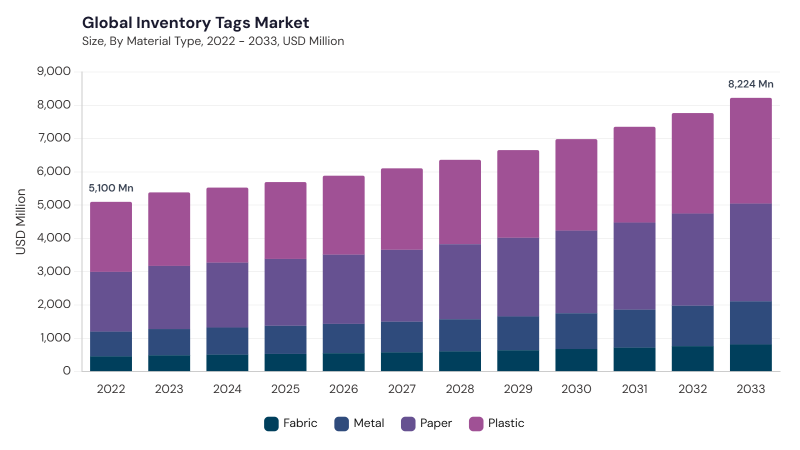
Demand for inventory tags is gaining momentum as businesses seek accurate stock identification, stronger asset visibility, supply chain traceability, and automated inventory control across retail, manufacturing, logistics, healthcare, automotive, and warehousing operations. Companies are using these solutions to reduce manual errors, improve replenishment accuracy, track high-value assets, and link physical inventory with digital management systems. Barcode, RFID, QR code, and smart labeling technologies are becoming important for warehouse automation, e-commerce fulfillment, inventory visibility, and IoT-enabled asset management.
Inventory tag adoption is expanding as enterprises move from periodic stock checks toward continuous inventory visibility and automated data capture. Retailers use tags to improve shelf accuracy, reduce shrinkage, manage returns, and support omnichannel fulfillment, while logistics and manufacturing users rely on tags for shipment visibility, work-in-progress tracking, reusable asset management, and audit control. RFID and smart tags are gaining traction as costs decline and integration with WMS, ERP, IoT platforms, scanners, and cloud analytics improves. Sustainability is also influencing procurement, with rising interest in recyclable paper labels, lower-plastic constructions, and material-efficient RFID inlays.
The competitive landscape is highly fragmented, with global identification technology companies competing alongside RFID specialists, barcode label producers, packaging firms, and regional tag converters. Avery Dennison, CCL Industries, Zebra Technologies, Brady Corporation, SATO, 3M, Beontag, HID Global, Confidex, and Tageos participate across smart labels, RFID, barcode systems, industrial tags, and connected inventory solutions. Competition is increasingly shaped by RFID performance, tag durability, system compatibility, material sustainability, integration capability, and application-specific customization. Vendors offering complete ecosystems across tags, readers, software, analytics, and implementation support are better positioned as customers seek connected inventory visibility rather than standalone labels.

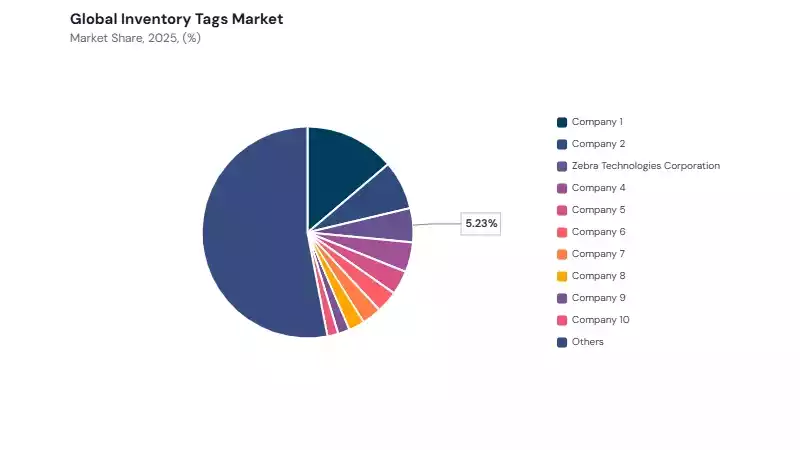
The global Inventory Tags Market is highly fragmented, with large identification and labeling companies competing with regional label converters, RFID specialists, barcode tag manufacturers, packaging firms, and industrial identification suppliers. Avery Dennison holds a leading position through RFID inlays, intelligent labels, pressure-sensitive materials, and digital identification solutions, while CCL Industries, Zebra Technologies, Brady Corporation, and SATO maintain strong roles across labeling, barcode, RFID, and data-capture ecosystems. 3M, Beontag, HID Global, Confidex, and Tageos address specialized applications across durable labels, RFID, smart tags, industrial assets, and item-level identification. Future competition will depend on RFID penetration, inventory automation, sustainable materials, software integration, and durable tag performance in demanding environments.
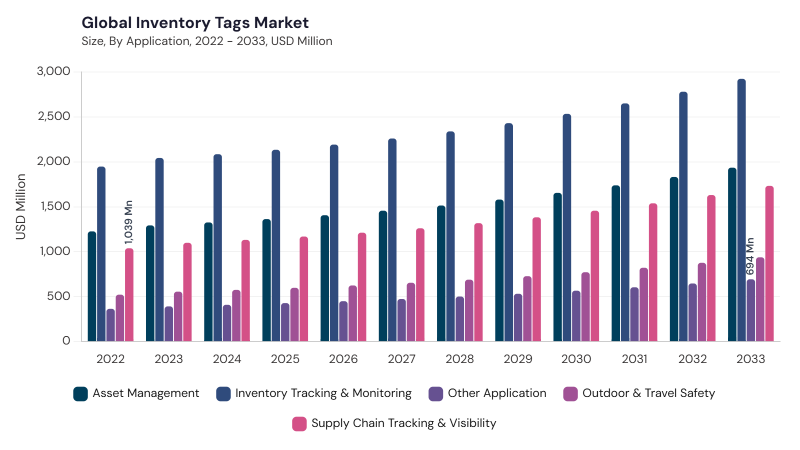
Based on application, the market is segmented into Inventory Tracking & Monitoring, Asset Management, Supply Chain Tracking & Visibility, Outdoor & Travel Safety, and Other Application. The Inventory Tracking & Monitoring market dominated the Global Inventory Tags Market by Application in 2025, and would continue to be a dominant market till 2033; thereby, achieving a market value of USD 2.9 billion by 2033, growing at a CAGR of 4.2 % during the forecast period. The Asset Management market is expected to witness a CAGR of 4.7% during (2026 - 2033). The Other Application market is expected to witness a CAGR of 6.4% during (2026 - 2033).
Inventory Tracking & Monitoring remains the core use case as businesses require accurate stock counts, product movement visibility, and faster replenishment decisions. Asset Management focuses on equipment, tools, IT hardware, and high-value assets that require lifecycle tracking, audit control, and loss prevention. Supply Chain Tracking & Visibility supports shipment traceability, product authentication, and multi-location inventory synchronization. Outdoor & Travel Safety and Other Application cover durable tags for luggage, equipment, outdoor assets, and specialized identification environments.
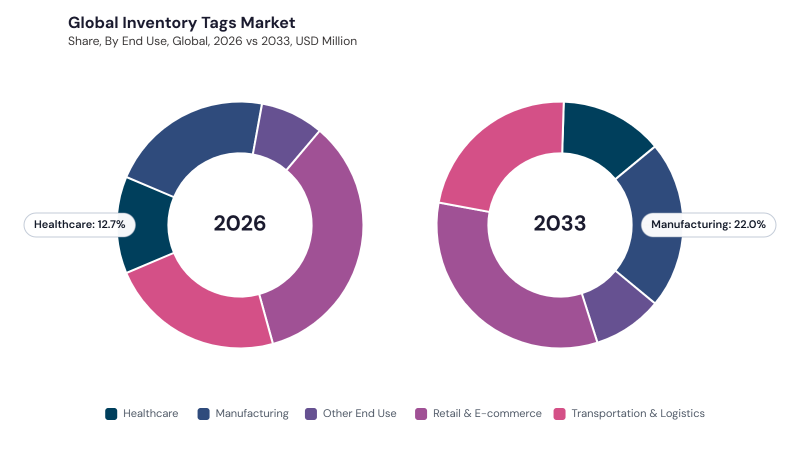
Based on end use, the market is segmented into Retail & E-commerce, Transportation & Logistics, Manufacturing, Healthcare, and Other End Use. The Retail & E-commerce market dominated the Global Inventory Tags Market by End Use in 2025, and would continue to be a dominant market till 2033; thereby, achieving a market value of USD 2.6 billion by 2033, growing at a CAGR of 4.1 % during the forecast period. The Transportation & Logistics market is expected to witness a CAGR of 4.7% during (2026 - 2033). Additionally, The Manufacturing market is expected to witness highest CAGR of 5.2% during (2026 - 2033).
Retail & E-commerce users rely on inventory tags for stock accuracy, item-level identification, omnichannel fulfillment, returns management, and loss prevention. Transportation & Logistics applications include parcel tracking, pallet identification, reusable asset monitoring, and shipment visibility. Manufacturing uses tags for work-in-progress tracking, component control, finished-goods identification, and tool management. Healthcare and Other End Use applications focus on controlled inventory procedures, supply identification, equipment tracking, and operational transparency.
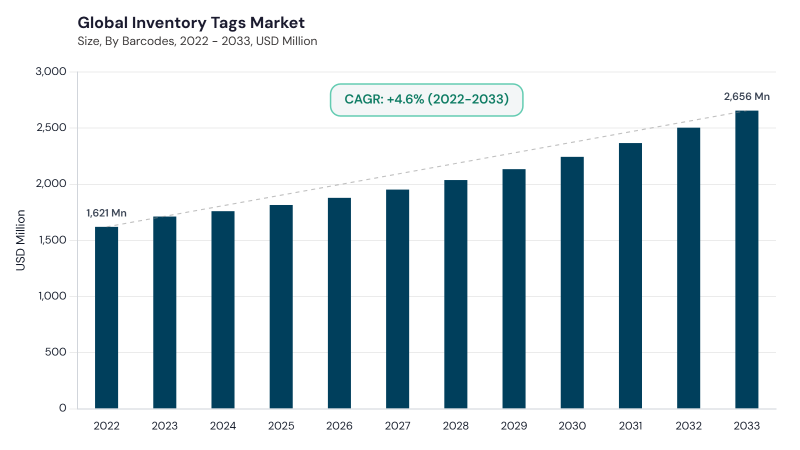
Based on technology, the market is segmented into RFID, Barcodes, QR Codes, and Other Technology. The RFID market dominated the Global Inventory Tags Market by Technology in 2025, and would continue to be a dominant market till 2033; thereby, achieving a market value of USD 3.4 billion by 2033, growing at a CAGR of 4.3 % during the forecast period. The Barcodes market is expected to witness a CAGR of 5.1% during (2026 - 2033). Additionally, The QR Codes market is expected to witness highest CAGR of 5.6% during (2026 - 2033).
RFID is gaining importance because it enables contactless, bulk, and non-line-of-sight identification across warehouses, retail stores, logistics facilities, and industrial environments. Barcodes remain widely used because they are cost-effective, mature, easy to print, and compatible with existing scanning infrastructure. QR Codes support higher data capacity and mobile accessibility, making them useful for digitally connected product information and traceability. Other Technology includes specialized identification formats used where conventional barcode, RFID, or QR systems do not fully meet operational requirements.
Based on material type, the market is segmented into Plastic, Paper, Metal, and Fabric. The Plastic market dominated the Global Inventory Tags Market by Material Type in 2025, and would continue to be a dominant market till 2033; thereby, achieving a market value of USD 3.1 billion by 2033, growing at a CAGR of 4.3 % during the forecast period. The Paper market is expected to witness a CAGR of 5.1% during (2026 - 2033). Additionally, The Metal market is expected to witness highest CAGR of 5.7% during (2026 - 2033).
Plastic tags are used where durability, moisture resistance, flexible printing, and long operational life are important. Paper tags remain relevant for cost-sensitive, high-volume, recyclable, and easy-to-print inventory applications. Metal tags are preferred for harsh industrial settings where tags must withstand heat, chemicals, abrasion, outdoor exposure, or heavy handling. Fabric tags serve applications requiring lightweight, flexible, and durable identification, especially where tags need to be attached to soft goods, equipment, or movable assets without adding rigidity.
Free Valuable Insights: Inventory Tags Market Size to reach $8.2 Billion by 2033
Region-wise, the Inventory Tags Market is analyzed across North America, Europe, Asia Pacific, and LAMEA. The North America market dominated the Global Inventory Tags Market by Region in 2025, and would continue to be a dominant market till 2033; thereby, achieving a market value of USD 2.9 billion by 2033, growing at a CAGR of 4.4 % during the forecast period. The Asia Pacific market is expected to witness a CAGR of 5.4% during (2026 - 2033). Additionally, The Europe market is expected to witness a CAGR of 4.7% during (2026 - 2033).
North America leads due to broad RFID adoption, warehouse automation, advanced retail operations, and mature supply chain technology deployment. Asia Pacific is witnessing strong demand from manufacturing expansion, e-commerce fulfillment growth, logistics modernization, and rising use of automated identification technologies. Europe benefits from supply chain traceability, inventory optimization, digital labeling, and sustainability-driven tracking practices across retail, manufacturing, and logistics. LAMEA is gradually expanding as warehousing, organized retail, distribution infrastructure, and automated inventory management investment improve.
| Report Attribute | Details |
|---|---|
| Market size value in 2026 | USD 5.8 billion |
| Market size forecast in 2033 | USD 8.2 billion |
| Base Year | 2025 |
| Historical Period | 2022 to 2024 |
| Forecast Period | 2026 to 2033 |
| Revenue Growth Rate | CAGR of 4.9% from 2026 to 2033 |
| Number of Pages | XX |
| Tables | XX |
| Report Coverage | Market Definition, Market Overview, COVID-19 Impact, Market Composition and Scenario, Key Factors Impacting Market, Market Share Analysis, Recent Developments, Segment Analysis, Regional Analysis, Company Profiles, SWOT Analysis, Key Customer Criteria, and Winning Imperatives |
| Segments Covered | Application, Technology, Material Type, End Use, and Geography |
| Country Scope |
|
| Companies Included | Avery Dennison; CCL Industries; Zebra Technologies; Brady Corporation; SATO; 3M; Beontag; HID Global; Confidex; Tageos |
By Application
By Technology
By Material Type
By End Use
By Geography
Expected to reach USD 8.2 billion by 2033, growing at 4.9% CAGR during the forecast period (2026-2033).
Inventory Tracking & Monitoring leads, projected to achieve USD 2.9 billion by 2033.
Avery Dennison, CCL Industries, Zebra Technologies, Brady Corporation, SATO, 3M, Beontag, HID Global, Confidex, Tageos.
RFID dominates, projected to reach USD 3.4 billion by 2033.
North America leads, expected to achieve USD 2.9 billion by 2033.
Retail & E-commerce segment is projected to reach USD 2.6 billion by 2033.
Our team of dedicated experts can provide you with attractive expansion opportunities for your business.






 Unique Offerings
