The sample copy of this report is available for access.
The North America High-Speed PCB Market is expected to reach USD 4.1 billion by 2032, growing at a CAGR of 15.8% during (2026 - 2033).
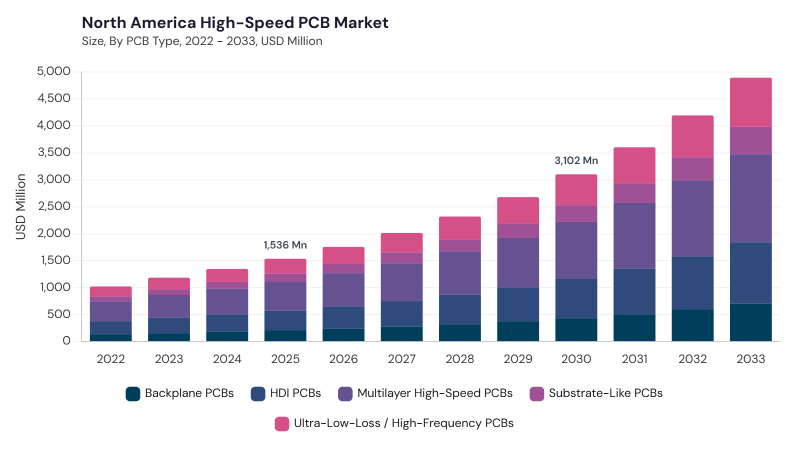
The North America High-Speed PCB Market evolved from conventional single- and double-sided printed circuit boards into highly engineered multilayer structures designed to support demanding high-frequency and high-data-rate applications. Rising requirements from telecommunications, computing, aerospace, and defense accelerated the use of controlled impedance, HDI architectures, advanced laminates, and precision fabrication techniques. The transition from conventional epoxy-glass substrates toward PTFE, ceramic composites, and other low-loss materials improved signal fidelity and enabled higher-frequency operation.
Advanced materials, HDI adoption, AI infrastructure, automation, reshoring, and tighter signal-integrity requirements are shaping current market development. Manufacturers are adopting low-loss and ultra-low-loss laminates, finer line widths, microvias, embedded components, and advanced simulation tools to address growing bandwidth requirements. AI-assisted design, automated inspection, and digital manufacturing are improving process consistency and yield, while supply chain localization is strengthening responsiveness and material availability. Environmental considerations are also influencing greater use of lead-free and halogen-free materials, reinforcing the market’s transition toward higher-performance and more sustainable PCB production.
Based on PCB Type, the market is segmented into Multilayer High-Speed PCBs, HDI PCBs, Ultra-Low-Loss / High-Frequency PCBs, Backplane PCBs, and Substrate-Like PCBs. The Multilayer High-Speed PCBs market dominated the North America High-Speed PCB Market by PCB Type in 2025, and would continue to be a dominant market till 2033; thereby, achieving a market value of USD 1.4 billion by 2032, growing at a CAGR of 14.9 % during the forecast period. The HDI PCBs market is expected to witness a CAGR of 15.5% during (2026 - 2033). The Substrate-Like PCBs market is expected to witness a CAGR of 17% during (2026 - 2033).
Multilayer High-Speed PCBs support complex routing, controlled impedance, reduced crosstalk, and high-density integration across servers, telecom systems, and advanced computing platforms. HDI PCBs use microvias, fine lines, and compact layouts to increase interconnection density in miniaturized systems. Ultra-Low-Loss / High-Frequency PCBs rely on advanced laminates to minimize attenuation in 5G, radar, satellite communication, and other high-frequency applications. Backplane PCBs provide reliable board-to-board communication in servers, storage, and switching systems, while Substrate-Like PCBs enable extremely fine interconnections supporting semiconductor-package convergence and compact high-performance assemblies.
Based on Data Rate Capability, the market is segmented into 56–112 Gbps, 25–56 Gbps, Up to 25 Gbps, and Above 112 Gbps. The 56–112 Gbps market dominated the North America High-Speed PCB Market by Data Rate Capability in 2025, and would continue to be a dominant market till 2033; thereby, achieving a market value of USD 1.5 billion by 2032, growing at a CAGR of 15 % during the forecast period. The 25–56 Gbps market is expected to witness a CAGR of 16% during (2026 - 2033). Additionally, The Up to 25 Gbps market is expected to witness highest CAGR of 16.5% during (2026 - 2033).
Up to 25 Gbps remains relevant for legacy-compatible equipment, moderate-speed enterprise systems, and applications where cost and established designs remain important. The 25–56 Gbps segment supports networking platforms, storage systems, enterprise computing, and intermediate high-speed interfaces requiring improved signal integrity and lower-loss materials. The 56–112 Gbps category addresses advanced AI, cloud, telecom, and high-performance computing systems requiring specialized laminates and tighter impedance control. Above 112 Gbps represents the emerging frontier, supporting next-generation switching, advanced AI clusters, research platforms, and extremely high-throughput interconnect architectures demanding ultra-low-loss materials and highly precise fabrication.
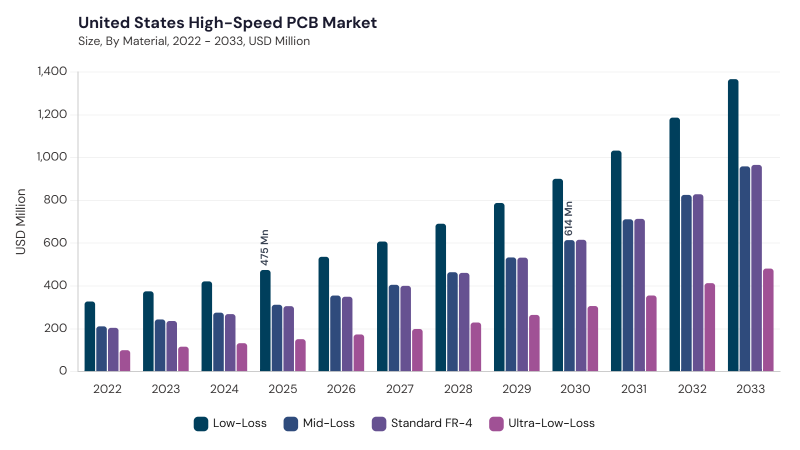
Based on Material, the market is segmented into Low-Loss, Mid-Loss, Standard FR-4, and Ultra-Low-Loss. Low-Loss materials are widely used where reduced dielectric loss, improved signal fidelity, and stable high-frequency operation are essential, particularly across telecom, data center, radar, and advanced computing systems. Mid-Loss materials provide a balance between electrical performance, manufacturability, and cost for mainstream high-speed applications.
Standard FR-4 continues to serve less demanding signal paths and supporting layers because of its established fabrication processes and broad availability. Ultra-Low-Loss materials address the most demanding high-speed and high-frequency environments, using advanced composite laminates to minimize attenuation and support stringent thermal and electrical performance requirements.
Based on End-User, the market is segmented into Hyperscale Data Centers and AI/ML Clusters, Cloud Service Providers, Enterprise HPC, and Government and Research Laboratories. Hyperscale Data Centers and AI/ML Clusters require high-density multilayer PCBs capable of sustaining rapid interconnect speeds, thermal stability, and reliable power distribution across dense compute systems. Cloud Service Providers use high-speed boards in servers, switches, storage arrays, and network infrastructure supporting continuous capacity expansion and technology refresh cycles.
Enterprise HPC relies on advanced PCBs for engineering simulation, financial modeling, biotechnology, analytics, and heterogeneous computing systems combining CPUs, GPUs, and specialized accelerators. Government and Research Laboratories use customized high-speed PCBs in scientific equipment, defense electronics, radar platforms, communication systems, and advanced computing infrastructure requiring stringent reliability and qualification standards.
Free Valuable Insights: The Global High-Speed PCB Market will hit USD 17.1 Billion billion by 2033, at a CAGR of 16.5%
Based on Country, the market is segmented into US, Canada, Mexico, and Rest of North America. The US market dominated the North America High-Speed PCB Market by Country in 2025, and would continue to be a dominant market till 2033; thereby, achieving a market value of USD 3.2 billion by 2032, growing at a CAGR of 15 % during the forecast period. The Canada market is expected to witness a CAGR of 19.2% during (2026 - 2033). Additionally, The Mexico market is expected to witness a CAGR of 17.3% during (2026 - 2033).
Across North America, high-speed PCB adoption is being shaped by AI infrastructure, advanced communications, reshoring, material innovation, automation, and increasingly demanding signal-integrity requirements. The US emphasizes advanced laminates, AI-enabled hardware, localized manufacturing, automation, and high-performance applications across data centers, aerospace, defense, and telecommunications. Canada is strengthening advanced fabrication, low-loss material adoption, miniaturization, domestic capability, and precision manufacturing, while Mexico is advancing multilayer production, 5G-related demand, smart manufacturing, localized supply chains, and improved process automation. Rest of North America continues to develop UHDI, high-frequency laminates, regional manufacturing, rapid prototyping, and specialized high-speed PCB capabilities serving advanced computing, aerospace, communications, and other high-performance applications.

By PCB Type
By Data Rate Capability
By Material
By End-User
By Country
Set to reach $4.1 Billion by 2032, growing at 15.8% CAGR during 2026-2033.
The US leads with $3.2 billion by 2032, growing at 15% CAGR during the forecast period.
Rising demand for 56–112 Gbps PCBs, reaching $1.5 billion by 2032 at 15% CAGR.
Multilayer high-speed PCBs will reach $1.4 billion by 2032, growing at 14.9% CAGR during 2026-2033.
The Canada market is expected to witness a 19.2% CAGR during 2026-2033.
Up to 25 Gbps segment is expected to witness the highest CAGR of 16.5% during 2026-2033.
Our team of dedicated experts can provide you with attractive expansion opportunities for your business.




 Unique Offerings