The sample copy of this report is available for access.
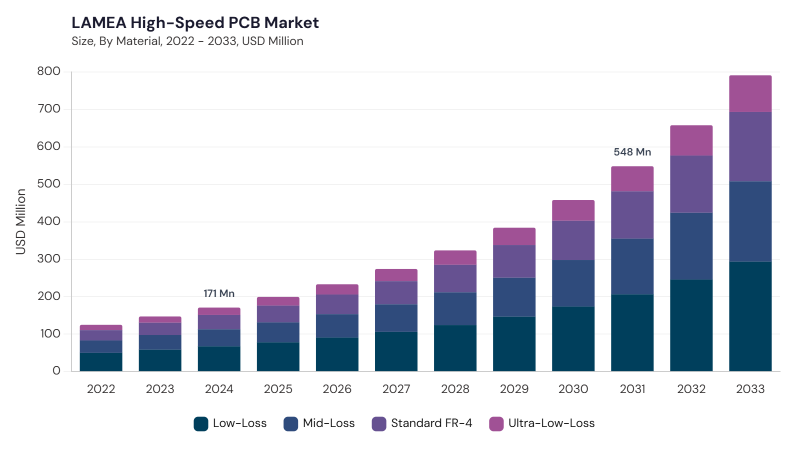
The LAMEA High-Speed PCB Market is expected to reach USD 384.2 million by 2029, growing at a CAGR of 19.1% during (2026 - 2033).
The LAMEA High-Speed PCB Market evolved from conventional single- and double-sided circuit boards toward multilayer, HDI, and high-frequency architectures designed to support increasingly complex electronic systems. Early regional adoption was constrained by limited manufacturing infrastructure and technical expertise, but expanding telecommunications, automotive electronics, industrial automation, and global supply-chain integration encouraged gradual modernization. Improvements in material science, signal-integrity engineering, electromagnetic compatibility, and thermal management enabled more advanced board designs.
Automotive electronics, 5G infrastructure, industrial IoT, AI hardware, digitalization, and advanced materials are shaping current market development. Manufacturers are adopting low-loss laminates, microvias, HDI structures, embedded components, advanced design software, and automated inspection to improve signal fidelity and manufacturing precision. Regional localization efforts are strengthening supply-chain responsiveness, while increased emphasis on environmental compliance and quality standards is raising manufacturing benchmarks.
Based on PCB Type, the market is segmented into Multilayer High-Speed PCBs, HDI PCBs, Ultra-Low-Loss / High-Frequency PCBs, Backplane PCBs, and Substrate-Like PCBs. The Multilayer High-Speed PCBs market dominated the LAMEA High-Speed PCB Market by PCB Type in 2025, and would continue to be a dominant market till 2033; thereby, achieving a market value of USD 135.0 million by 2029, growing at a CAGR of 18.2 % during the forecast period. The HDI PCBs market is expected to witness a CAGR of 18.7% during (2026 - 2033). The Substrate-Like PCBs market is expected to witness a CAGR of 20.9% during (2026 - 2033).
Multilayer High-Speed PCBs provide dense routing, controlled impedance, reduced crosstalk, and reliable signal distribution across telecom, computing, industrial, and defense applications. HDI PCBs use microvias, finer lines, compact layouts, and higher interconnection density to support miniaturized electronic systems. Ultra-Low-Loss / High-Frequency PCBs employ specialized substrates to minimize dielectric loss in satellite communications, radar, advanced wireless networks, and other demanding applications. Backplane PCBs provide dependable module-to-module connectivity in data centers and telecom equipment, while Substrate-Like PCBs support compact high-density assemblies requiring finer interconnection features and closer integration with advanced packaging.
Based on Data Rate Capability, the market is segmented into 56–112 Gbps, 25–56 Gbps, Up to 25 Gbps, and Above 112 Gbps. The 56–112 Gbps market dominated the LAMEA High-Speed PCB Market by Data Rate Capability in 2025, and would continue to be a dominant market till 2033; thereby, achieving a market value of USD 143.9 million by 2029, growing at a CAGR of 18.2 % during the forecast period. The 25–56 Gbps market is expected to witness a CAGR of 19.2% during (2026 - 2033). Additionally, The Up to 25 Gbps market is expected to witness highest CAGR of 19.9% during (2026 - 2033).

Up to 25 Gbps continues to support conventional telecommunications, industrial automation, IoT systems, and cost-sensitive computing environments where moderate bandwidth remains sufficient. The 25–56 Gbps segment serves enterprise networks, carrier infrastructure, data centers, and expanding 5G deployments requiring improved materials, routing precision, and signal control. The 56–112 Gbps category supports advanced communications, AI infrastructure, high-performance computing, aerospace systems, and latency-sensitive applications requiring sophisticated materials and fabrication techniques. Above 112 Gbps represents an emerging frontier for hyperscale facilities, advanced switching, high-end defense systems, future communications infrastructure, and specialized computing environments requiring extreme board-level throughput.
Based on Material, the market is segmented into Low-Loss, Mid-Loss, Standard FR-4, and Ultra-Low-Loss. Low-Loss materials provide improved dielectric performance and signal fidelity for telecommunications, computing, automotive, and moderate-to-high-frequency electronic systems. Mid-Loss materials offer a practical balance between transmission performance, sourcing availability, manufacturability, and cost for mainstream applications.
Standard FR-4 remains important across less demanding high-speed paths and cost-sensitive industrial and commercial electronics because of its broad availability and established manufacturing familiarity. Ultra-Low-Loss materials address specialized applications requiring exceptionally low attenuation, stable high-frequency behavior, and superior thermal performance across advanced communications, defense, aerospace, AI-oriented computing, and other premium systems.
Based on End-User, the market is segmented into Hyperscale Data Centers and AI/ML Clusters, Cloud Service Providers, Enterprise HPC, and Government and Research Laboratories. Hyperscale Data Centers and AI/ML Clusters require advanced multilayer boards, low-loss materials, stable power delivery, and effective thermal management to support dense accelerator platforms and rapidly expanding AI workloads. Cloud Service Providers use high-speed PCBs across servers, routers, switches, storage systems, and regional cloud infrastructure supporting enterprise and public-sector digitalization.
Enterprise HPC relies on high-speed boards for petroleum modeling, mining analysis, financial computation, engineering simulation, and other data-intensive commercial workloads. Government and Research Laboratories use specialized boards in meteorological forecasting, geological research, defense systems, scientific computing, academic infrastructure, and public-sector technology programs requiring customized and highly reliable electronics.
Free Valuable Insights: High-Speed PCB Market Size Worth USD 17.1 Billion billion by 2033
Based on Country, the market is segmented into Brazil, Argentina, UAE, Saudi Arabia, South Africa, Nigeria, and Rest of LAMEA. The Brazil market dominated the LAMEA High-Speed PCB Market by Country in 2025, and would continue to be a dominant market till 2033; thereby, achieving a market value of USD 83.0 million by 2029, growing at a CAGR of 17.3 % during the forecast period. The Argentina market is expected to witness a CAGR of 19.8% during (2026 - 2033). Additionally, The UAE market is expected to witness a CAGR of 18.1% during (2026 - 2033).
Across LAMEA, high-speed PCB development is being shaped by digital infrastructure investment, advanced communications, localization, AI, automotive electronics, and manufacturing modernization. Brazil emphasizes telecom and data infrastructure, high-frequency materials, Industry 4.0, and sustainable production, while Argentina focuses on miniaturization, thermal management, digital design tools, and precision manufacturing. The UAE is advancing 5G, smart-city infrastructure, AI edge systems, and high-frequency multilayer boards, whereas Saudi Arabia emphasizes AI, cloud infrastructure, localization, advanced verification, and domestic electronics capability. South Africa is strengthening high-frequency materials, Industry 4.0, automation, and international collaboration, while Nigeria focuses on thermal reliability, localized assembly, digital infrastructure, and resilient manufacturing. Rest of LAMEA continues to expand 5G-related demand, HDI adoption, advanced substrates, localization, smart manufacturing, and environmentally compliant PCB production.

By PCB Type
By Data Rate Capability
By Material
By End-User
By Country
Set to reach $384.2 Million by 2029, growing at 19.1% CAGR during 2026-2033.
Brazil leads with $83.0 million by 2029, growing at 17.3% CAGR during the forecast period.
Rising demand for multilayer high-speed PCBs, reaching $135.0 million by 2029, is a key driver.
The 56–112 Gbps segment will reach $143.9 million by 2029, growing at 18.2% CAGR during the forecast period.
The UAE market is expected to witness a CAGR of 18.1% during 2026-2033.
The Substrate-Like PCBs market is expected to witness a CAGR of 20.9% during 2026-2033.
Our team of dedicated experts can provide you with attractive expansion opportunities for your business.




 Unique Offerings