The sample copy of this report is available for access.
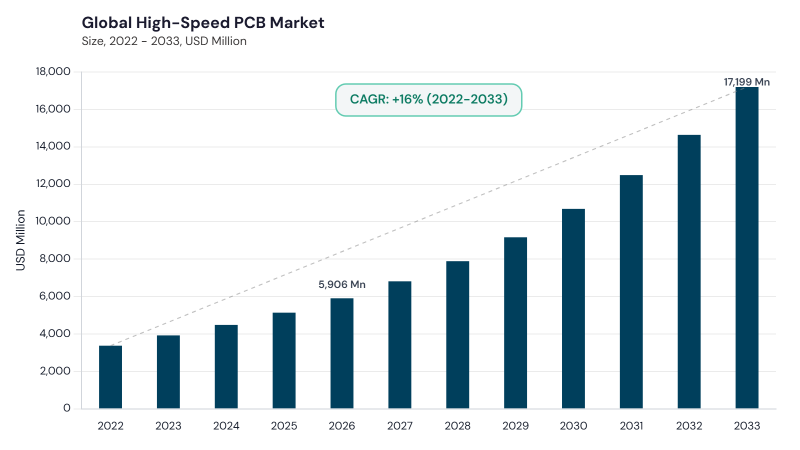
“Global High-Speed PCB Market to reach a market value of USD 17,199.07 Million by 2033 growing at a CAGR of 16.5%”
The Global High-Speed PCB Market is expected to reach USD 17.1 billion by 2033, growing at a CAGR of 16.5% during (2026 - 2033).
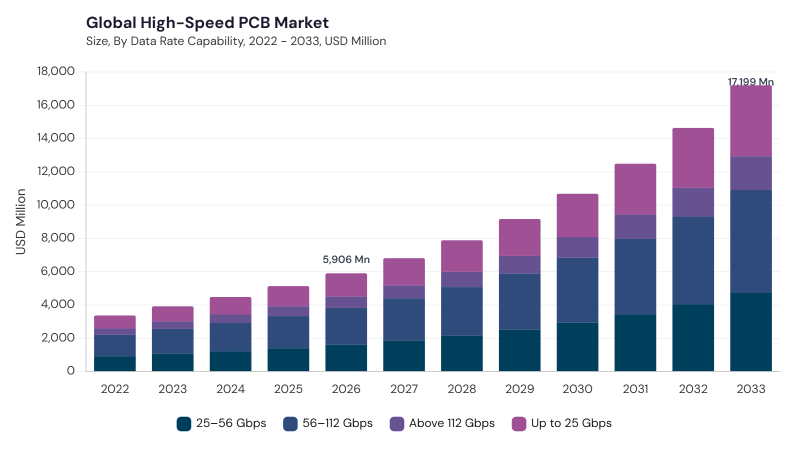
High speed PCB market is experiencing growing demand for stronger signal integrity, faster data transmission, advanced multilayer designs, compact electronic architectures, and enhanced thermal performance across data centers, telecommunications, aerospace, automotive electronics, industrial systems, and consumer electronics. Market is experiencing surging adoption of AI computing, 5G infrastructure, advanced driver assistance systems, high performance servers, and high-speed networking technologies is further supporting market adoption. Market emerged from the need for printed circuit boards capable of handling higher-frequency signals with distortion and minimal loss, initially driven by computing applications and telecommunications.
High-speed PCB market is experiencing growth as electronic systems require lower latency, higher bandwidth, enhanced electromagnetic compatibility, and better impedance control. AI servers, automotive electronics, data centers, 5G infrastructure, advanced communication systems, and high-performance computing are accelerating demand for HDI boards, multilayer PCBs, low-loss materials, and ultra-low-loss high-frequency platforms. Market growth is further driven by laser direct imaging, miniaturization, automated inspection, AI-assisted design, and precision fabrication technologies.
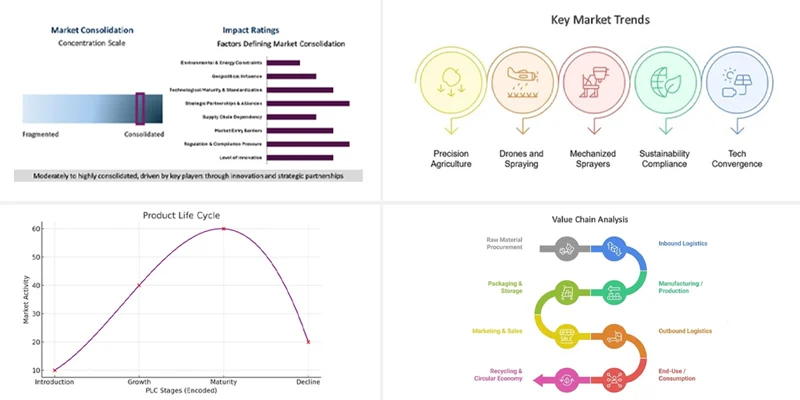
High speed PCB market is technology-intensive and moderately consolidated, with competition driven by HDI specialists, advanced multilayer PCB manufacturers, suppliers serving AI servers, high-frequency board producers, aerospace systems, networking systems, telecommunications equipment, high-performance computing platforms, and automotive electronics. Companies compete through low-loss laminate processing, signal integrity performance, backdrilling, high-layer-count capability, design-for-manufacturability expertise, and automated quality inspection. Market competition relies on ultra-high-layer count manufacturing, AI infrastructure demand, advanced HDI capability, low-loss material expertise, production yield, high-speed interconnect performance, and capacity expansion.

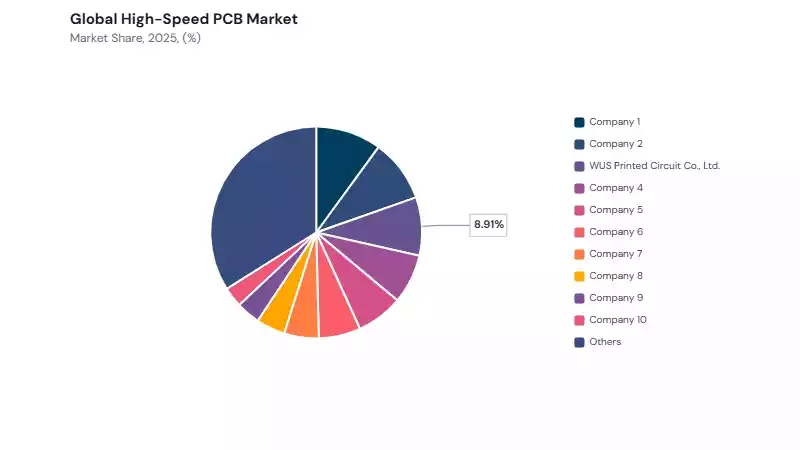
High speed PCB market is intensively competitive with market driven by leading players including Zhen Ding Technology Holding Limited, Unimicron Technology Corporation, and WUS Printed Circuit Co Ltd with strong exposure to HDI boards, high-layer-count PCBs, AI servers, data center infrastructure, and communications systems. TTM Technologies, Compeg Manufacturing, and Shennan Circuits form a strong market across defense, aerospace, HDI, multilayer, telecommunication, and high-reliability boards. AT&S, Kinwong Electronic, Tripod Technology, and Meiko Electronics further support competition through advanced multilayer boards, optical modules, server PCBs, and low-loss transmission-line technologies.
Based on PCB Type, the market is segmented into Multilayer High-Speed PCBs, HDI PCBs, Ultra-Low-Loss / High-Frequency PCBs, Backplane PCBs, and Substrate-Like PCBs. The Multilayer High-Speed PCBs market dominated the Global High-Speed PCB Market by PCB Type in 2025, and would continue to be a dominant market till 2033; thereby, achieving a market value of USD 5.7 billion by 2033, growing at a CAGR of 15.7 % during the forecast period. The HDI PCBs market is expected to witness a CAGR of 16.2% during (2026 - 2033). The Substrate-Like PCBs market is expected to witness a CAGR of 17.9% during (2026 - 2033).
Multilayer High-Speed PCBs dominate the market due to their strong use in servers, routers, switches, networking equipment, and advanced computing systems requiring dense routing and controlled impedance. HDI PCBs are gaining demand as microvias, fine traces, and compact layouts support high-density electronic architectures. Ultra-Low-Loss / High-Frequency PCBs are important for applications requiring minimal insertion loss at higher frequencies. Backplane PCBs support high-capacity board-to-board connectivity, while Substrate-Like PCBs are expanding through finer geometries and advanced integration requirements.
Based on Data Rate Capability, the market is segmented into 56–112 Gbps, 25–56 Gbps, Up to 25 Gbps, and Above 112 Gbps. The 56–112 Gbps market dominated the Global High-Speed PCB Market by Data Rate Capability in 2025, and would continue to be a dominant market till 2033; thereby, achieving a market value of USD 6.1 billion by 2033, growing at a CAGR of 15.7 % during the forecast period. The 25–56 Gbps market is expected to witness a CAGR of 16.7% during (2026 - 2033). Additionally, The Up to 25 Gbps market is expected to witness highest CAGR of 17.2% during (2026 - 2033).
The 56–112 Gbps segment leads the market due to increasing bandwidth requirements across AI infrastructure, data center networks, high-performance computing systems, and next-generation server platforms. The 25–56 Gbps segment remains important for established networking and computing systems undergoing bandwidth upgrades. Up to 25 Gbps supports legacy and cost-sensitive systems where moderate transmission speeds remain sufficient. Above 112 Gbps is emerging as next-generation switches, accelerators, and advanced interconnect architectures require improved signal integrity, tighter stack-ups, and lower-loss materials.
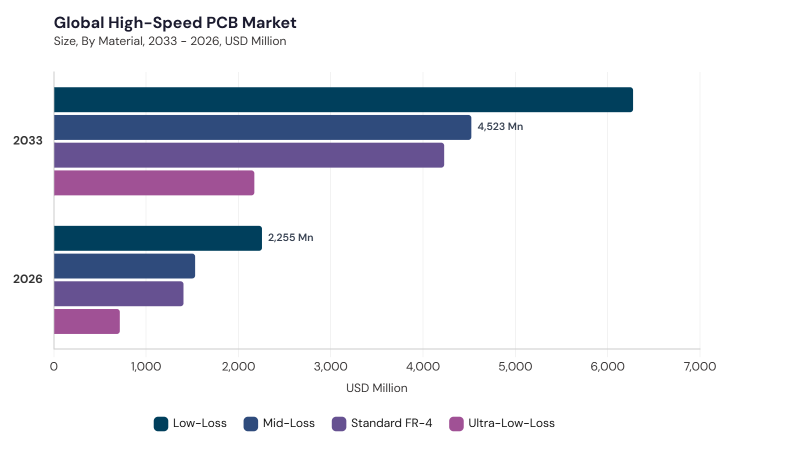
Based on Material, the market is segmented into Low-Loss, Mid-Loss, Standard FR-4, and Ultra-Low-Loss. The Low-Loss market dominated the Global High-Speed PCB Market by Material in 2025, and would continue to be a dominant market till 2033; thereby, achieving a market value of USD 6.2 billion by 2033, growing at a CAGR of 15.7 % during the forecast period. The Mid-Loss market is expected to witness a CAGR of 16.7% during (2026 - 2033). Additionally, The Standard FR-4 market is expected to witness highest CAGR of 17% during (2026 - 2033).
Low-Loss materials dominate the market because they balance electrical performance, manufacturability, scalability, and cost for high-speed digital systems requiring reduced transmission losses. Mid-Loss materials serve applications requiring improved signal integrity without premium ultra-low-loss cost structures. Standard FR-4 remains relevant due to mature manufacturing processes, broad availability, and use in less demanding signal-speed requirements. Ultra-Low-Loss materials are gaining demand in extremely high-frequency and high-data-rate systems where dielectric performance, insertion-loss control, and strict signal integrity are critical.
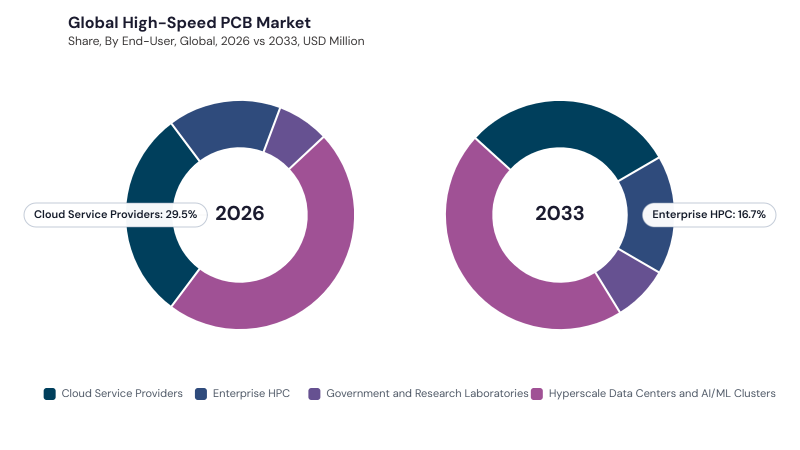
Based on End-User, the market is segmented into Hyperscale Data Centers and AI/ML Clusters, Cloud Service Providers, Enterprise HPC, and Government and Research Laboratories. The Hyperscale Data Centers and AI/ML Clusters market dominated the Global High-Speed PCB Market by End-User in 2025, and would continue to be a dominant market till 2033; thereby, achieving a market value of USD 7.8 billion by 2033, growing at a CAGR of 15.9 % during the forecast period. The Cloud Service Providers market is expected to witness a CAGR of 16.7% during (2026 - 2033). Additionally, The Enterprise HPC market is expected to witness highest CAGR of 17.3% during (2026 - 2033).
Hyperscale Data Centers and AI/ML Clusters dominate the market due to rapid deployment of AI accelerators, high-density servers, high-bandwidth networking, and large-scale computing infrastructure. Cloud Service Providers generate strong demand as cloud workloads, infrastructure upgrades, and high-throughput networking needs increase. Enterprise HPC is supported by simulation, analytics, engineering, financial modeling, and AI workloads requiring high-performance computing systems. Government and Research Laboratories use high-speed PCBs in supercomputing, scientific modeling, national research infrastructure, and mission-critical computational applications.
Free Valuable Insights: High-Speed PCB Market Size to reach $17.1 Billion by 2033
Region-wise, the High-Speed PCB Market is analyzed across North America, Europe, Asia Pacific, and LAMEA. In 2025, the Asia Pacific led the high-speed PCB market and is estimated to remain at the same position till 2033, by gathering a market value of USD 8.2 billion by 2033, expanding at a CAGR of 16.8% in the forecast period. The North America market is anticipated to grow at a CAGR of 15.8% during 2026-2033. Moreover, the Europe market is predicted to expand at a CAGR of 16.2% during the forecast period.
APAC region led the market because of strong electronics supply chains, extensive PCB manufacturing capacity, growing investment in data center and AI infrastructure, semiconductor production ecosystems, and strong electronics supply chains. North America is driven by AI/ML infrastructure, hyperscale computing, and advanced networking systems. Europe benefits from high-performance computing investments, data center modernization, telecommunications infrastructure, and advanced electronics demand. LAMEA is expanding through data center capacity, cloud infrastructure, high-performance networking, and digital services.
| Report Attribute | Details |
|---|---|
| Market size value in 2026 | USD 5.9 billion |
| Market size forecast in 2033 | USD 17.1 billion |
| Base Year | 2025 |
| Historical Period | 2022 to 2024 |
| Forecast Period | 2026 to 2033 |
| Revenue Growth Rate | CAGR of 16.5% from 2026 to 2033 |
| Number of Pages | 736 |
| Tables | 870 |
| Report Coverage | Market Trends, Revenue Estimation and Forecast, Segmentation Analysis, Regional and Country Breakdown, Competitive Landscape, Market Share Analysis, Company Profiling, Companies Strategic Developments, SWOT Analysis, Product Life Cycle Analysis, Value Chain Analysis, Market Consolidation Analysis, Key Customer Criteria, Pandemic Impact Analysis, and Winning Imperatives |
| Segments Covered | PCB Type, Data Rate Capability, Material, End-User, Region |
| Country Scope |
|
| Companies Included | Unimicron Technology Corporation, Zhen Ding Technology Holding Limited, WUS Printed Circuit Co., Ltd., Compeq Manufacturing Co., Ltd., TTM Technologies, Inc., Shennan Circuits Co., Ltd., Tripod Technology Corporation, Kinwong Electronic Co., Ltd., AT&S Austria Technologie & Systemtechnik AG, and Meiko Electronics Co., Ltd. |
By PCB Type
By Data Rate Capability
By Material
By End-User
By Geography
The market is expected to reach USD 17.1 billion by 2033, growing at 16.5% CAGR during 2026-2033.
Multilayer High-Speed PCBs lead, projected to reach USD 5.7 billion by 2033.
Unimicron Technology, Zhen Ding Technology, WUS Printed Circuit, and Compeq Manufacturing are key players.
Asia Pacific leads with a market value of USD 8.2 billion by 2033.
Demand for high-speed data transmission and 5G expansion drive growth.
The 56–112 Gbps segment leads, expected to reach USD 6.1 billion by 2033.
Our team of dedicated experts can provide you with attractive expansion opportunities for your business.







 Unique Offerings