The sample copy of this report is available for access.
The Asia Pacific High-Speed PCB Market is expected to reach USD 5.0 billion by 2030, growing at a CAGR of 16.8% during (2026 - 2033).
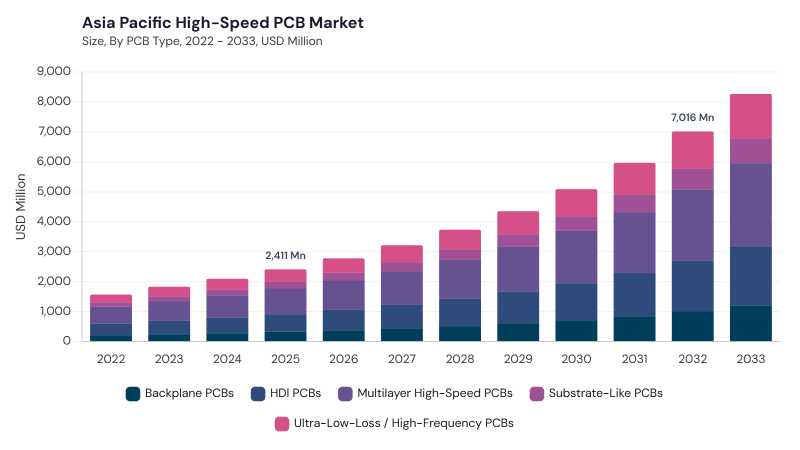
The Asia Pacific High-Speed PCB Market evolved alongside the region’s rapid industrialization, electronics manufacturing expansion, and increasing adoption of advanced communication technologies. Early demand centered on conventional PCBs for consumer electronics and information technology, while the progression from 3G and 4G toward 5G created stronger requirements for higher data rates and improved signal integrity. Advancements in multilayer structures, HDI technology, low-loss dielectric materials, and precision fabrication further expanded application across telecommunications, automotive electronics, semiconductor systems, and advanced computing.
5G deployment, AI infrastructure, semiconductor development, automotive electrification, sustainability, and advanced manufacturing are shaping current market development. PCB manufacturers are adopting low-loss laminates, microvias, fine-line circuitry, advanced thermal-management approaches, automated inspection, and AI-enabled production controls to improve high-frequency performance and manufacturing consistency. Environmental regulations are encouraging lead-free materials, reduced emissions, and more sustainable production practices, while regional supply-chain localization is strengthening responsiveness and resilience.
Based on PCB Type, the market is segmented into Multilayer High-Speed PCBs, HDI PCBs, Ultra-Low-Loss / High-Frequency PCBs, Backplane PCBs, and Substrate-Like PCBs. The Multilayer High-Speed PCBs market dominated the Asia Pacific High-Speed PCB Market by PCB Type in 2025, and would continue to be a dominant market till 2033; thereby, achieving a market value of USD 1.7 billion by 2030, growing at a CAGR of 16 % during the forecast period. The HDI PCBs market is expected to witness a CAGR of 16.6% during (2026 - 2033). The Substrate-Like PCBs market is expected to witness a CAGR of 18.2% during (2026 - 2033).
Multilayer High-Speed PCBs support dense interconnections, controlled impedance, advanced power distribution, and complex routing across servers, networking platforms, and computing systems. HDI PCBs use laser-drilled microvias, fine-line circuitry, sequential lamination, and compact layouts to support miniaturized high-performance electronics. Ultra-Low-Loss / High-Frequency PCBs rely on specialized dielectric materials to minimize attenuation across 5G, radar, satellite communication, and advanced computing applications. Backplane PCBs provide dependable high-capacity board-to-board connectivity in telecom systems, modular computing, and data center equipment, while Substrate-Like PCBs support fine geometries and greater convergence between advanced PCB manufacturing and semiconductor packaging.
Based on Data Rate Capability, the market is segmented into 56–112 Gbps, 25–56 Gbps, Up to 25 Gbps, and Above 112 Gbps. The 56–112 Gbps market dominated the Asia Pacific High-Speed PCB Market by Data Rate Capability in 2025, and would continue to be a dominant market till 2033; thereby, achieving a market value of USD 1.8 billion by 2030, growing at a CAGR of 16.1 % during the forecast period. The 25–56 Gbps market is expected to witness a CAGR of 17.1% during (2026 - 2033). Additionally, The Up to 25 Gbps market is expected to witness highest CAGR of 17.5% during (2026 - 2033).
Up to 25 Gbps remains relevant across industrial electronics, automotive systems, cost-sensitive computing equipment, and installed networking infrastructure where moderate bandwidth is sufficient. The 25–56 Gbps segment supports telecom upgrades, enterprise networking, cloud infrastructure, and mid-tier high-performance systems requiring tighter impedance control and improved materials. The 56–112 Gbps category serves advanced data centers, AI systems, semiconductor test equipment, and next-generation high-speed interfaces requiring low-loss laminates and precise fabrication. Above 112 Gbps represents an emerging frontier supporting ultra-fast Ethernet, advanced AI fabrics, optical communication modules, specialized research systems, and next-generation computing architectures demanding exceptional board-level throughput.
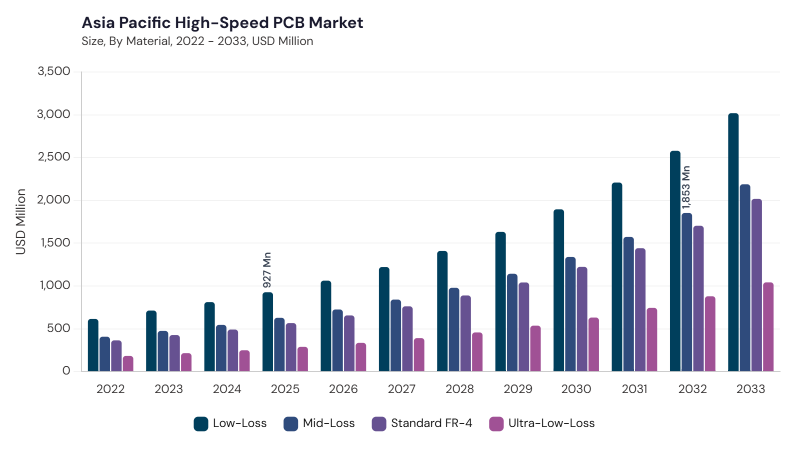
Based on Material, the market is segmented into Low-Loss, Mid-Loss, Standard FR-4, and Ultra-Low-Loss. Low-Loss materials support high-frequency applications requiring reduced dielectric loss, improved signal fidelity, and stable performance across telecommunications, advanced networking, aerospace, defense, and computing systems. Mid-Loss materials provide a balance between performance, manufacturability, supply availability, and cost for mainstream high-speed applications.
Standard FR-4 continues to serve less demanding signal paths and cost-sensitive electronic assemblies because of mature regional processing expertise and supply chains. Ultra-Low-Loss materials address highly specialized applications where exceptionally low attenuation, thermal stability, and superior dielectric characteristics are required across advanced accelerator platforms, high-frequency communications, radar, and next-generation computing systems.
Based on End-User, the market is segmented into Hyperscale Data Centers and AI/ML Clusters, Cloud Service Providers, Enterprise HPC, and Government and Research Laboratories. Hyperscale Data Centers and AI/ML Clusters require sophisticated multilayer boards, advanced thermal management, strong power integrity, and low-loss signal pathways to support accelerator-rich computing environments. Cloud Service Providers use high-speed PCBs across servers, storage platforms, routers, switches, and interface cards supporting regional cloud and edge expansion.
Enterprise HPC relies on high-speed boards for semiconductor engineering, automotive development, financial modeling, industrial simulation, pharmaceuticals, and other data-intensive workloads. Government and Research Laboratories use specialized PCBs in supercomputing, scientific instrumentation, aerospace, defense systems, radar, advanced communication platforms, and national research programs where precision and reliability are critical.
Free Valuable Insights: High-Speed PCB Market is Predicted to reach USD 17.1 Billion billion by 2033, at a CAGR of 16.5%
Based on Country, the market is segmented into China, Japan, India, South Korea, Singapore, Malaysia, and Rest of Asia Pacific. The China market dominated the Asia Pacific High-Speed PCB Market by Country in 2025, and would continue to be a dominant market till 2033; thereby, achieving a market value of USD 1.3 billion by 2030, growing at a CAGR of 14.7 % during the forecast period. The Japan market is expected to witness a CAGR of 15.7% during (2026 - 2033). Additionally, The India market is expected to witness a CAGR of 18.5% during (2026 - 2033).
Across Asia Pacific, high-speed PCB development is being shaped by 5G, AI, semiconductor manufacturing, automotive electronics, localization, automation, and advanced materials. China emphasizes AI and 5G infrastructure, automotive electronics, digitalized manufacturing, and localized high-speed PCB capacity, while Japan focuses on high-frequency materials, miniaturization, sustainable production, and AI-assisted design. India is advancing 5G, edge computing, electric mobility, localized manufacturing, and automated inspection, whereas South Korea emphasizes next-generation communication systems, automotive electronics, precision manufacturing, and advanced substrates. Singapore focuses on high-value semiconductor integration, intelligent manufacturing, signal integrity, and precision engineering, while Malaysia is strengthening advanced substrate production, AI-enabled inspection, thermal management, and localized manufacturing. Rest of Asia Pacific continues to expand 5G-related demand, multilayer and HDI capability, supply-chain localization, advanced materials, and high-performance electronics manufacturing.

By PCB Type
By Data Rate Capability
By Material
By End-User
By Country
Set to reach $5.0 Billion by 2030, growing at 16.8% CAGR during 2026-2033.
China leads with $1.3 billion by 2030, growing at 14.7% CAGR during 2026-2033.
Rising demand for Multilayer High-Speed PCBs, reaching $1.7 billion by 2030 at 16% CAGR during 2026-2033.
Expected to reach $1.8 billion by 2030, growing at 16.1% CAGR during 2026-2033.
Japan is expected to witness a CAGR of 15.7% during 2026-2033.
Substrate-Like PCBs are expected to witness a CAGR of 18.2% during 2026-2033.
Our team of dedicated experts can provide you with attractive expansion opportunities for your business.




 Unique Offerings