The sample copy of this report is available for access.
The North America Graphics Processing Unit (GPU) Market is expected to reach USD 126.4 Billion by 2032, growing at a CAGR of 14.5% during (2026 – 2033).
The North America Graphics Processing Unit (GPU) Market developed from the region’s early leadership in personal computing, gaming hardware, semiconductor design, and advanced visualization technologies. In the beginning, GPUs were primarily used to improve 2D and 3D graphics rendering for PCs, gaming consoles, and professional design systems. The market took a decisive turn when programmable shaders, parallel computing models, and general-purpose GPU computing expanded their role from visual rendering to advanced computation. Over time, GPUs became deeply embedded in AI training, machine learning, data centers, scientific computing, autonomous systems, cloud infrastructure, and real-time simulation.
The regional market is now being shaped by a shift from graphics-centric adoption toward accelerated computing across enterprise, cloud, and AI infrastructure. Demand is no longer limited to gamers and workstation users; it now extends to AI developers, hyperscale cloud providers, research institutions, automotive innovators, healthcare analytics firms, and enterprises using large-scale simulation or data-intensive workloads. Energy efficiency, chip architecture refinement, advanced memory bandwidth, AI-optimized cores, thermal performance, and GPU-as-a-Service models are becoming important buying considerations. North America also benefits from a dense ecosystem of cloud providers, software developers, AI startups, semiconductor firms, and data center operators, making the region a leading environment for GPU deployment, experimentation, and commercialization across both consumer and enterprise markets.
Based on Integration Type, the market is segmented into Discrete GPUs and Integrated GPUs. The Discrete GPUs (dGPU) market dominated the North America Graphics Processing Unit (GPU) Market by Integration Type in 2025, and would continue to be a dominant market till 2033; thereby, achieving a market value of USD 77.4 Billion by 2032, growing at a CAGR of 14.2 % during the forecast period. Additionally, The Integrated GPUs (iGPU) market is expected to witness highest CAGR of 14.9% during (2026 - 2033).
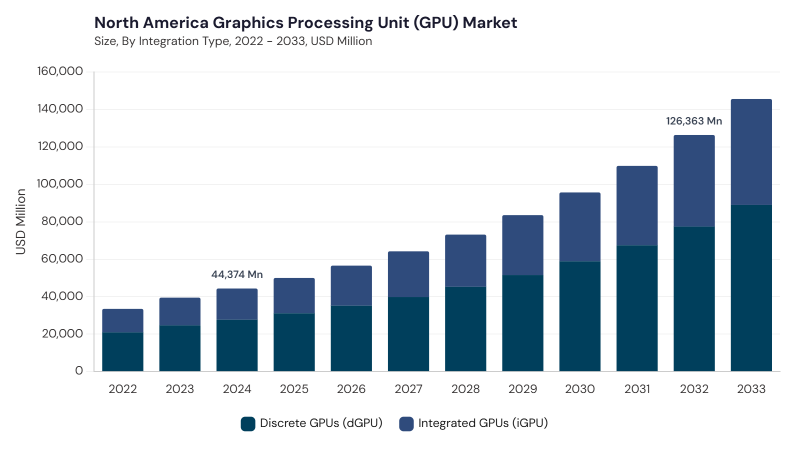
Discrete GPUs remain the leading integration type because they provide dedicated processing power, separate graphics memory, higher thermal capacity, and stronger workload acceleration for demanding computing environments. Their adoption is prominent in AI servers, data centers, gaming PCs, professional workstations, visualization systems, high-performance computing clusters, and enterprise analytics infrastructure. These GPUs are especially important where users need high frame rates, real-time rendering, deep learning acceleration, simulation performance, or advanced 3D workloads. Integrated GPUs continue to serve a large base of laptops, desktops, tablets, and mainstream computing devices, where compact design, lower power use, cost efficiency, and smooth handling of everyday graphics, media playback, office productivity, light gaming, and basic AI-enabled functions are important.
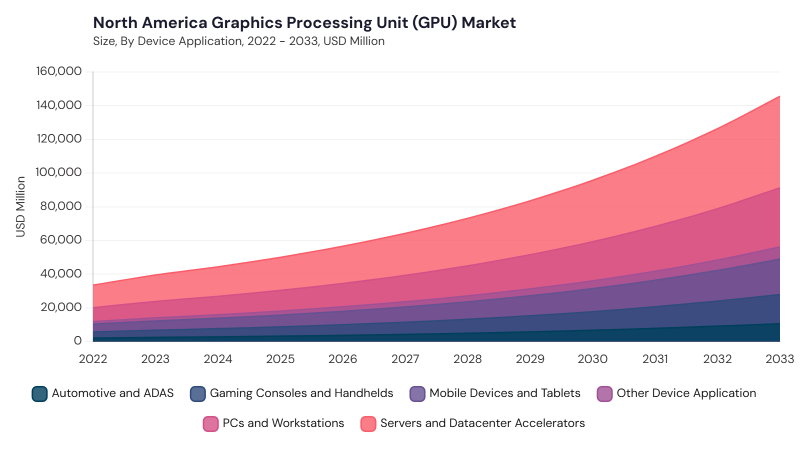
Based on Device Application, the market is segmented into Servers and Datacenter Accelerators, PCs and Workstations, Mobile Devices and Tablets, Gaming Consoles and Handhelds, Automotive and ADAS, and Other Device Application. The Servers and Datacenter Accelerators market dominated the North America Graphics Processing Unit (GPU) Market by Device Application in 2025, and would continue to be a dominant market till 2033; thereby, achieving a market value of USD 47.5 Billion by 2032, growing at a CAGR of 13.7 % during the forecast period. The PCs and Workstations market is expected to witness a CAGR of 14.2% during (2026 - 2033). Additionally, The Mobile Devices and Tablets market is expected to witness highest CAGR of 14.9% during (2026 - 2033).
Servers and Datacenter Accelerators represent the strongest application area as North American enterprises and cloud providers rapidly deploy GPUs for AI model training, generative AI inference, cloud computing, scientific simulation, enterprise acceleration, and high-performance analytics. This segment is supported by hyperscale data center expansion, demand for scalable GPU clusters, and the need for high-throughput computing in AI-heavy environments. PCs and Workstations remain a major application category, driven by gamers, engineers, designers, 3D artists, video editors, developers, and professional users requiring advanced rendering and compute performance. Mobile Devices and Tablets use GPUs for graphics-rich applications, video streaming, gaming, on-device AI, and efficient visual processing. Gaming Consoles and Handhelds rely on GPUs for immersive graphics, low-latency rendering, and high frame rates, while Automotive and ADAS applications are expanding through driver assistance, infotainment, sensor fusion, autonomous driving development, and in-vehicle visualization. Other device applications include edge devices, embedded systems, digital signage, medical imaging, industrial equipment, and specialized visualization platforms.
Free Valuable Insights: The Global Graphics Processing Unit (GPU) Market Report URL: graphics-processing-unit-market will hit USD 396.9 Billion billion by 2033, at a CAGR of 15.2%
Based on Country, the market is segmented into US, Canada, Mexico, and Rest of North America. The US market dominated the North America Graphics Processing Unit (GPU) Market by Country in 2025, and would continue to be a dominant market till 2033; thereby, achieving a market value of USD 98.3 Billion by 2032, growing at a CAGR of 13.7 % during the forecast period. The Canada market is expected to witness a CAGR of 17.6% during (2026 - 2033). Additionally, The Mexico market is expected to witness a CAGR of 16.4% during (2026 - 2033).
The US remains the core growth engine of the North America GPU market due to its concentration of semiconductor companies, cloud service providers, AI developers, gaming hardware firms, hyperscale data centers, software platforms, and enterprise technology buyers. The country has moved from early graphics acceleration toward advanced GPU use in AI, machine learning, healthcare analytics, finance, engineering design, real-time simulation, and cloud-based accelerated computing. Canada contributes through AI research, digital transformation programs, embedded systems, professional visualization, high-performance computing, and energy-efficient GPU adoption across enterprise and academic ecosystems. Mexico is gaining relevance as digital infrastructure, cloud services, AI adoption, smart city initiatives, automotive technology, and localized technology distribution expand.

By Integration Type
By Device Application
By Country
Set to reach USD 126.4 Billion by 2033, growing at 14.5% CAGR during 2026-2033.
The US leads with USD 98.3 Billion by 2032, growing at a 13.7% CAGR during the forecast period.
Rising demand for Servers and Datacenter Accelerators, reaching USD 47.5 Billion by 2032.
Discrete GPUs will achieve USD 77.4 Billion by 2032, growing at a 14.2% CAGR during 2026-2033.
Canada is expected to witness a CAGR of 17.6% during 2026-2033.
Mobile Devices and Tablets will see the highest CAGR of 14.9% during 2026-2033.
Our team of dedicated experts can provide you with attractive expansion opportunities for your business.




 Unique Offerings