The sample copy of this report is available for access.
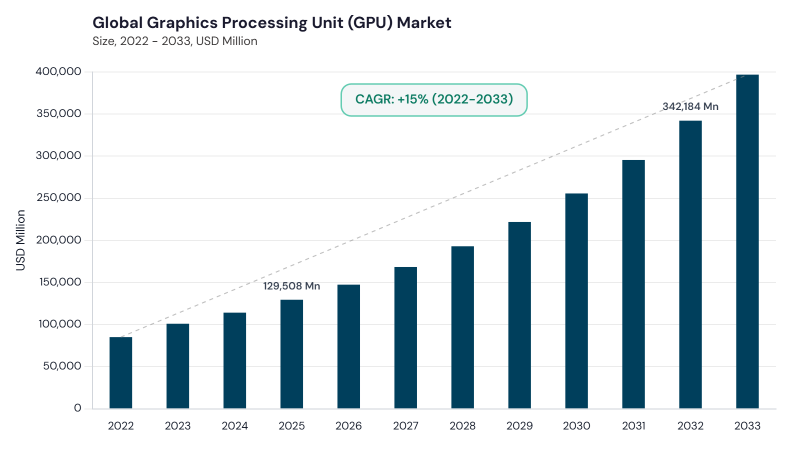
“Global Graphics Processing Unit (GPU) Market to reach a market value of USD 396864.93 Million by 2033 growing at a CAGR of 15.2%”
The Global Graphics Processing Unit (GPU) Market is expected to reach USD 396.9 Billion by 2033, growing at a CAGR of 15.2% during (2026 - 2033).
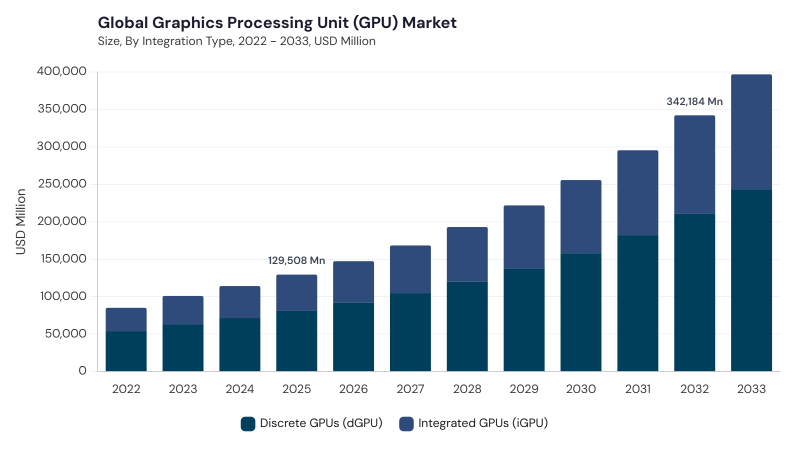
The Global Graphics Processing Unit (GPU) Market is witnessing strong growth, driven by rising demand for artificial intelligence, machine learning, cloud computing, advanced gaming, data center acceleration, and real-time visual computing. The market originated as a specialized hardware category focused on accelerating image rendering and graphics processing, especially for gaming and visualization applications. Over time, GPUs evolved from fixed-function graphics processors into highly programmable parallel computing engines capable of supporting scientific computing, artificial intelligence training, data analytics, professional visualization, and cloud workloads. Presently, the market is shaped by AI-specific GPU architectures, GPU cloud computing, heterogeneous computing, high-performance data center acceleration, immersive media rendering, automotive computing, and increasing demand for scalable and energy-efficient accelerated computing solutions.
The Graphics Processing Unit Market is expanding as GPUs become essential components across consumer, enterprise, and industrial computing environments. Increasing use of GPUs in artificial intelligence, machine learning, generative AI, scientific simulations, data centers, gaming, visualization, automotive systems, and edge computing is broadening the market beyond traditional graphics rendering. The demand for parallel computing, high memory bandwidth, low-latency processing, and scalable acceleration continues to strengthen GPU adoption across multiple sectors. At the same time, cloud-based GPU services are improving accessibility by allowing enterprises, developers, researchers, and startups to access accelerated computing resources without owning physical GPU infrastructure.
The Graphics Processing Unit Market is characterized by a highly competitive and moderately consolidated environment led by major semiconductor companies, supported by cloud providers, OEMs, system integrators, and specialized accelerator developers. Competition is centered on processing performance, energy efficiency, memory bandwidth, AI acceleration, software ecosystem strength, developer support, supply chain reliability, pricing, and integration across cloud and edge platforms. Leading vendors compete through advanced architectures, proprietary software frameworks, data center platforms, gaming GPUs, AI accelerators, and partnerships with hyperscale cloud providers. Specialized and regional players continue to target niche applications, embedded graphics, AI acceleration, and cost-sensitive computing segments.

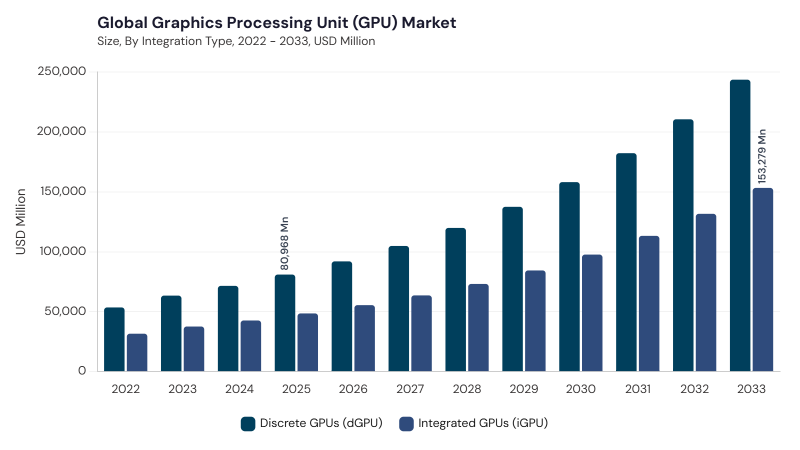
Based on Integration Type, the market is segmented into Discrete GPUs and Integrated GPUs. The Discrete GPUs (dGPU) market dominated the Global Graphics Processing Unit (GPU) Market by Integration Type in 2025, and would continue to be a dominant market till 2033; thereby, achieving a market value of USD 243.6 Billion by 2033, growing at a CAGR of 14.9 % during the forecast period. Additionally, The Integrated GPUs (iGPU) market is expected to witness highest CAGR of 15.6% during (2026 - 2033).
Discrete GPUs are preferred where high frame rates, deep learning acceleration, real-time rendering, simulation, and large-scale parallel processing are required. They continue to benefit from gaming, AI training, cloud computing, and professional visualization demand. Integrated GPUs serve broad-volume markets where users require reliable graphics performance without separate GPU hardware. Improvements in semiconductor integration, system-on-chip design, and energy efficiency are strengthening integrated GPU adoption across portable and mainstream computing devices.
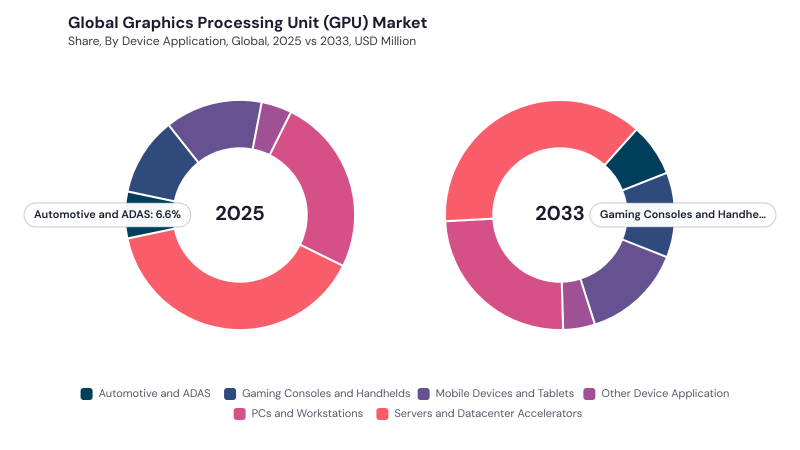
Based on Device Application, the market is segmented into Servers and Datacenter Accelerators, PCs and Workstations, Mobile Devices and Tablets, Gaming Consoles and Handhelds, Automotive and ADAS, and Other Device Application. The Servers and Datacenter Accelerators market dominated the Global Graphics Processing Unit (GPU) Market by Device Application in 2025, and would continue to be a dominant market till 2033; thereby, achieving a market value of USD 148.8 Billion by 2033, growing at a CAGR of 14.5 % during the forecast period. The PCs and Workstations market is expected to witness a CAGR of 15% during (2026 - 2033). Additionally, The Mobile Devices and Tablets market is expected to witness highest CAGR of 15.6% during (2026 - 2033).
Data center GPUs are increasingly critical for AI model training, scientific workloads, cloud platforms, and enterprise-scale analytics. PCs and workstation GPUs support creators, designers, engineers, gamers, and professionals requiring high graphical and computational performance. Mobile GPUs prioritize battery efficiency, thermal control, and multimedia enhancement. Gaming console GPUs are optimized for consistent gameplay, high-fidelity visuals, and immersive graphics. Automotive GPUs support safety-critical processing, visualization, and intelligent mobility systems. Other device applications include industrial automation, medical imaging, embedded systems, robotics, and edge computing platforms.
Free Valuable Insights: Graphics Processing Unit (GPU) Market Size to reach $396.9 Billion by 2033
Region-wise, the Graphics Processing Unit Market is analyzed across North America, Europe, Asia Pacific, and LAMEA. The North America market dominated the Global Graphics Processing Unit (GPU) Market by Region in 2025, and would continue to be a dominant market till 2033; thereby, achieving a market value of USD 145.6 Billion by 2033, growing at a CAGR of 14.5 % during the forecast period. The Europe market is expected to witness a CAGR of 14.9% during (2026 - 2033). Additionally, The Asia Pacific market is expected to witness a CAGR of 15.9% during (2026 - 2033).
North America benefits from hyperscale cloud providers, AI research ecosystems, enterprise technology adoption, and strong semiconductor design capabilities. Asia Pacific is supported by advanced electronics manufacturing, growing AI deployment, gaming markets, and regional data center investments. Europe is shaped by automotive computing, industrial automation, research computing, and regulatory emphasis on energy efficiency. LAMEA continues to grow as cloud services, digital transformation, gaming platforms, and enterprise computing infrastructure expand across developing markets.
| Report Attribute | Details |
|---|---|
| Market size value in 2026 | USD 147.4 Billion |
| Market size forecast in 2033 | USD 396.9 Billion |
| Base Year | 2025 |
| Historical Period | 2022 to 2024 |
| Forecast Period | 2026 to 2033 |
| Revenue Growth Rate | CAGR of 15.2% from 2026 to 2033 |
| Number of Pages | 488 |
| Tables | 540 |
| Report Coverage | Market Trends, Revenue Estimation and Forecast, Segmentation Analysis, Regional and Country Breakdown, Competitive Landscape, Market Share Analysis, Company Profiling, Companies Strategic Developments, SWOT Analysis, Product Life Cycle Analysis, Value Chain Analysis, Market Consolidation Analysis, Key Customer Criteria, Pandemic Impact Analysis, and Winning Imperatives |
| Segments Covered | Integration Type, Device Application, Region |
| Country Scope |
|
| Companies Included |
|
By Integration Type
By Device Application
By Geography
The market is valued at USD 147.4 billion in 2026.
Discrete GPUs lead, projected to reach USD 243.6 billion by 2033.
NVIDIA Corporation, Advanced Micro Devices, Inc., Intel Corporation, and Apple Inc. are key players.
North America dominates, reaching USD 145.6 billion by 2033.
AI and ML applications, PC gaming demand, and GPU integration in autonomous vehicles drive growth.
Servers and Datacenter Accelerators segment leads, reaching USD 148.8 billion by 2033.
Our team of dedicated experts can provide you with attractive expansion opportunities for your business.








 Unique Offerings