The sample copy of this report is available for access.
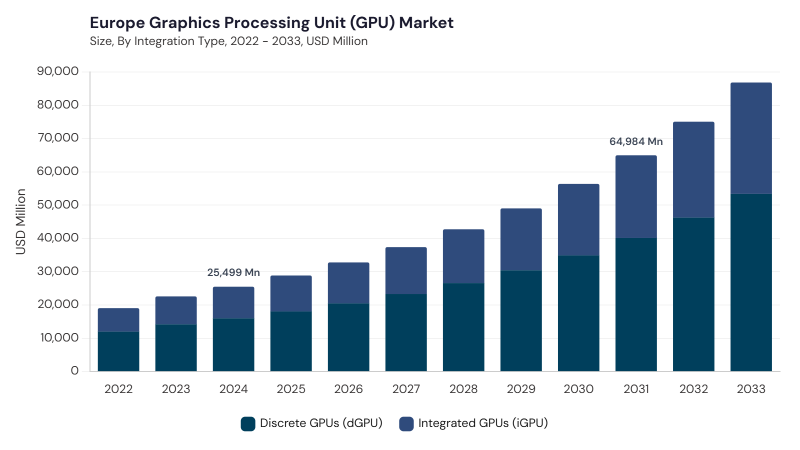
The Europe Graphics Processing Unit (GPU) Market is expected to reach USD 65.0 Billion by 2031, growing at a CAGR of 14.9% during (2026 – 2033).
The Europe Graphics Processing Unit (GPU) Market has progressed from its early role in visual computing to a broader position within the continent’s advanced digital and industrial infrastructure. In its initial phase, GPU adoption was mainly tied to gaming, professional visualization, multimedia systems, and computer graphics applications. As programmable GPU architectures matured, the technology started to move into scientific research, high-performance computing, engineering simulation, data analytics, and artificial intelligence workloads. Europe’s strong base of research institutions, automotive engineering, industrial automation, gaming studios, and cloud infrastructure has helped GPUs become a critical layer of compute acceleration rather than a purely graphics-focused component.
The market’s current direction is strongly influenced by Europe’s emphasis on AI sovereignty, energy-efficient computing, data protection, sustainability, and localized digital infrastructure. GPU demand is increasing across data centers, research computing facilities, automotive electronics, game development, industrial visualization, and cloud platforms. European buyers are placing greater focus on performance-per-watt, thermal control, software ecosystem compatibility, regulatory compliance, and secure deployment within local data frameworks. The rise of GPU-as-a-Service, edge computing, embedded GPU systems, advanced cooling solutions, and domestic semiconductor initiatives is giving the market a more strategic character.
Based on Integration Type, the market is segmented into Discrete GPUs and Integrated GPUs. The Discrete GPUs (dGPU) market dominated the Europe Graphics Processing Unit (GPU) Market by Integration Type in 2025, and would continue to be a dominant market till 2033; thereby, achieving a market value of USD 40.1 Billion by 2031, growing at a CAGR of 14.7 % during the forecast period. Additionally, The Integrated GPUs (iGPU) market is expected to witness highest CAGR of 15.4% during (2026 - 2033).
Discrete GPUs lead the European market because they are essential for workloads requiring dedicated memory, advanced compute capability, stronger rendering performance, and dependable acceleration under heavy processing conditions. Their use is prominent across AI servers, cloud data centers, engineering workstations, gaming computers, visualization platforms, and research computing environments. Enterprises, game developers, design studios, scientific institutions, and industrial users prefer discrete GPUs when applications involve machine learning, simulation, real-time rendering, or high-performance graphics. Integrated GPUs continue to hold an important role in laptops, desktops, tablets, compact PCs, and everyday computing devices. Their appeal is linked to lower power consumption, reduced system cost, compact device design, and sufficient graphics support for productivity tasks, media playback, standard visual processing, light gaming, and common business applications.
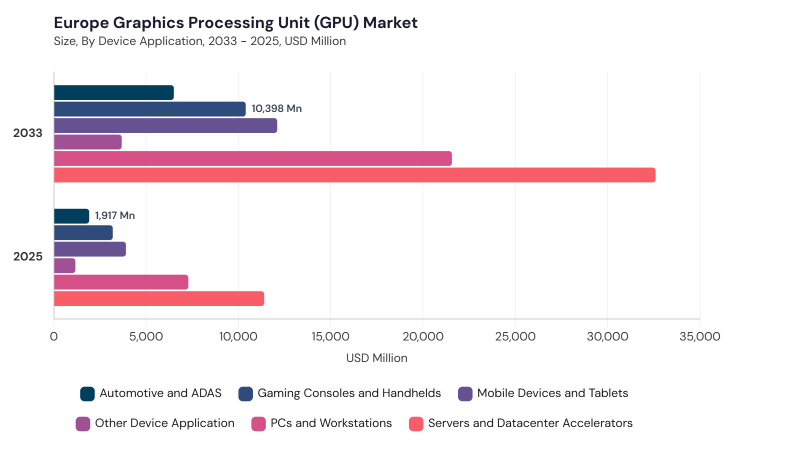
Based on Device Application, the market is segmented into Servers and Datacenter Accelerators, PCs and Workstations, Mobile Devices and Tablets, Gaming Consoles and Handhelds, Automotive and ADAS, and Other Device Application. The Servers and Datacenter Accelerators market dominated the Europe Graphics Processing Unit (GPU) Market by Device Application in 2025, and would continue to be a dominant market till 2033; thereby, achieving a market value of USD 24.7 Billion by 2031, growing at a CAGR of 14.2 % during the forecast period. The PCs and Workstations market is expected to witness a CAGR of 14.7% during (2026 - 2033). Additionally, The Mobile Devices and Tablets market is expected to witness highest CAGR of 15.4% during (2026 - 2033).
Servers and Datacenter Accelerators represent the leading application area as European enterprises, research centers, and cloud providers increase GPU deployment for AI training, inference, cloud computing, scientific modelling, enterprise analytics, digital twins, and high-performance computing. This segment benefits from Europe’s need for secure, scalable, and energy-efficient infrastructure that can support large datasets and advanced computational workloads. PCs and Workstations remain a strong category due to demand from gamers, engineers, architects, software developers, 3D creators, video editors, and professional visualization users. Mobile Devices and Tablets use GPUs for mobile gaming, video streaming, image enhancement, on-device AI, and smooth graphics processing. Gaming Consoles and Handhelds benefit from immersive gaming, high-resolution rendering, portable entertainment, and real-time visual performance. Automotive and ADAS are gaining importance through infotainment, driver assistance, sensor processing, in-vehicle displays, and autonomous mobility development, while other applications include edge devices, embedded systems, medical imaging, digital signage, industrial visualization, and niche computing platforms.
Free Valuable Insights: The Global Graphics Processing Unit (GPU) Market will hit USD 396.9 Billion billion by 2033, at a CAGR of 15.2%
Based on Country, the market is segmented into Germany, UK, France, Russia, Spain, Italy, and Rest of Europe. The Germany market dominated the Europe Graphics Processing Unit (GPU) Market by Country in 2025, and would continue to be a dominant market till 2033; thereby, achieving a market value of USD 14.0 Billion by 2031, growing at a CAGR of 13.5 % during the forecast period. The UK market is expected to witness a CAGR of 13.9% during (2026 - 2033). Additionally, The France market is expected to witness a CAGR of 15.7% during (2026 - 2033).
Germany remains the leading country market due to its strong industrial base, automotive technology ecosystem, AI research activity, data center infrastructure, and Industry 4.0 adoption. GPU use in Germany is closely linked with cloud computing, machine learning, big data analytics, scientific simulation, autonomous systems, and industrial visualization. The UK contributes through its AI ecosystem, hyperscale data center demand, GPU virtualization, cloud integration, gaming development, and software-led innovation. France is gaining significance through sovereign AI infrastructure, national digital policy support, high-performance computing initiatives, and domestic AI capacity development. Russia shows demand from GPU-based servers, AI workloads, data centers, cloud rentals, and localized infrastructure models. Spain is supported by gaming, AI research, data center upgrades, cloud GPU services, and mobile workstation adoption, while Italy benefits from AI computing, professional visualization, scientific workloads, edge computing, hybrid cloud deployment, and energy-conscious GPU use. Rest of Europe adds further demand through localized data infrastructure, sustainability-oriented procurement, supply chain resilience, and GPU deployments across healthcare, automotive, finance, cloud, and industrial sectors.

By Integration Type
By Device Application
By Country
Set to reach USD 65.0 Billion by 2033, growing at 14.9% CAGR during 2026-2033.
Germany leads with USD 14.0 Billion by 2031, growing at 13.5% CAGR during the forecast period.
The Integrated GPUs market is expected to witness highest CAGR of 15.4% during 2026-2033.
Discrete GPUs will reach USD 40.1 Billion by 2031, growing at 14.7% CAGR during the forecast period.
The France market is expected to witness a CAGR of 15.7% during 2026-2033.
The Mobile Devices and Tablets market is expected to witness highest CAGR of 15.4% during 2026-2033.
Our team of dedicated experts can provide you with attractive expansion opportunities for your business.




 Unique Offerings