The sample copy of this report is available for access.
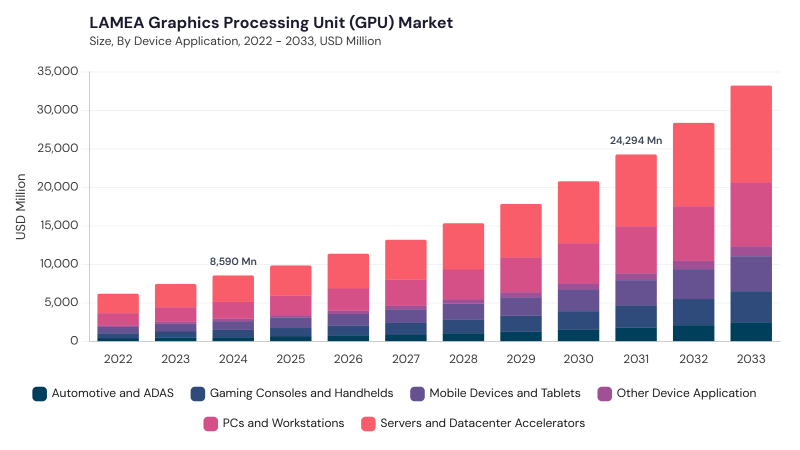
The LAMEA Graphics Processing Unit (GPU) Market is expected to reach USD 17.9 Billion by 2029, growing at a CAGR of 16.5% during (2026 – 2033).
The LAMEA Graphics Processing Unit (GPU) Market has advanced from limited graphics hardware adoption into a broader computing category serving digital transformation, gaming, enterprise analytics, AI experimentation, and cloud-based services. In the early stages, GPUs in LAMEA were mainly used for gaming systems, multimedia workloads, professional graphics, and basic enterprise computing. As parallel processing became more relevant for artificial intelligence, machine learning, data analytics, medical imaging, and high-performance workloads, GPUs began gaining importance beyond consumer entertainment. The region’s market has developed differently from more mature technology hubs, as adoption is strongly shaped by affordability, infrastructure readiness, import dependency, localized distribution, and uneven access to high-performance computing resources.
The regional market is now influenced by a practical need for GPUs that combine performance, affordability, energy efficiency, and easier deployment within diverse operating conditions. Many LAMEA countries face power supply limitations, higher import costs, fragmented regulations, and varied digital infrastructure maturity, making cost-effective and energy-conscious GPU solutions especially important. At the same time, rising gaming culture, e-sports participation, AI adoption, cloud-enabled GPU services, edge computing, smart city programs, and professional visualization are opening new demand pockets. Vendors are responding by offering tiered products, localized support, cloud access models, energy-efficient architectures, and partnerships with distributors, telecom operators, educational institutions, and public-sector technology programs.
Based on Integration Type, the market is segmented into Discrete GPUs and Integrated GPUs. The Discrete GPUs (dGPU) market dominated the LAMEA Graphics Processing Unit (GPU) Market by Integration Type in 2025, and would continue to be a dominant market till 2033; thereby, achieving a market value of USD 11.2 Billion by 2029, growing at a CAGR of 16.2 % during the forecast period. Additionally, The Integrated GPUs (iGPU) market is expected to witness highest CAGR of 17% during (2026 - 2033).
Discrete GPUs hold the primary integration position as they are preferred for AI servers, data centers, gaming systems, professional workstations, visualization platforms, and performance-intensive computing environments. These GPUs offer dedicated graphics memory, stronger compute capacity, high-speed rendering, and workload acceleration, making them suitable for enterprises, research institutions, gaming users, design professionals, cloud operators, and organizations investing in AI, simulation, analytics, and advanced graphics. Integrated GPUs also have a strong role across LAMEA because they support more affordable and power-efficient computing devices. Their adoption is visible in laptops, desktops, tablets, compact PCs, and mainstream consumer devices used for productivity tasks, media playback, standard graphics, light gaming, online education, small business computing, and everyday digital workloads.
Based on Device Application, the market is segmented into Servers and Datacenter Accelerators, PCs and Workstations, Mobile Devices and Tablets, Gaming Consoles and Handhelds, Automotive and ADAS, and Other Device Application. The Servers and Datacenter Accelerators market dominated the LAMEA Graphics Processing Unit (GPU) Market by Device Application in 2025, and would continue to be a dominant market till 2033; thereby, achieving a market value of USD 6.9 Billion by 2029, growing at a CAGR of 15.8 % during the forecast period. The PCs and Workstations market is expected to witness a CAGR of 16.2% during (2026 - 2033). Additionally, The Mobile Devices and Tablets market is expected to witness highest CAGR of 17% during (2026 - 2033).
Servers and Datacenter Accelerators lead the market as enterprises, governments, cloud providers, and research users increasingly require GPU capacity for AI training, inference, cloud services, enterprise analytics, large-scale data processing, virtualization, and high-performance computing. This application area is gaining importance as local data centers, GPU-as-a-service models, and cloud platforms help users access advanced computing without large upfront hardware investments. PCs and Workstations remain prominent due to demand from gaming users, engineers, designers, animators, architects, video editors, software developers, and professional visualization users. Mobile Devices and Tablets support mobile gaming, video streaming, camera processing, on-device AI, and graphics-rich applications, especially in mobile-first markets. Gaming Consoles and Handhelds are driven by immersive gameplay, portable gaming, real-time rendering, and entertainment demand. Automotive and ADAS applications are gradually expanding through infotainment, digital dashboards, driver assistance, sensor processing, autonomous driving development, and in-vehicle visualization, while other device applications include embedded systems, edge computing devices, medical imaging, digital signage, industrial visualization, and niche computing platforms.
Free Valuable Insights: The Global Graphics Processing Unit (GPU) Market will hit USD 396.9 Billion billion by 2033, at a CAGR of 15.2%
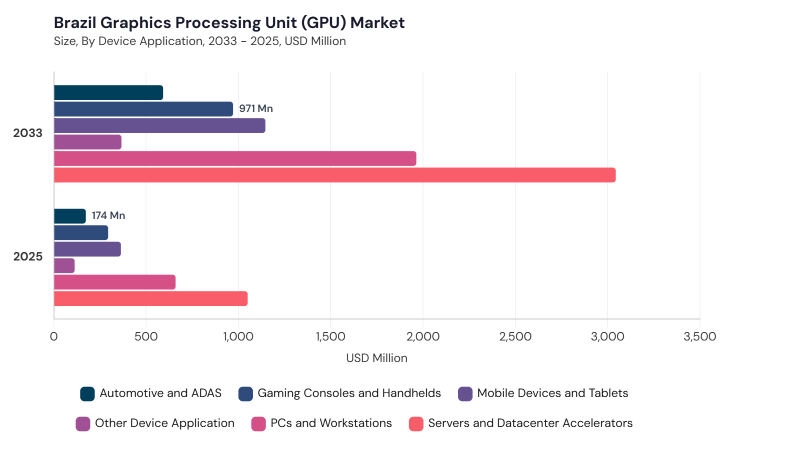
Based on Country, the market is segmented into Brazil, Argentina, UAE, Saudi Arabia, South Africa, Nigeria, and Rest of LAMEA. The Brazil market dominated the LAMEA Graphics Processing Unit (GPU) Market by Country in 2025, and would continue to be a dominant market till 2033; thereby, achieving a market value of USD 4.6 Billion by 2029, growing at a CAGR of 15.1 % during the forecast period. The Argentina market is expected to witness a CAGR of 17.2% during (2026 - 2033). Additionally, The UAE market is expected to witness a CAGR of 15.3% during (2026 - 2033).
Brazil remains the leading country market, supported by growing AI demand, cloud computing infrastructure, gaming adoption, research activity, startup innovation, and increasing use of GPUs in data processing and scientific computing. Argentina is gaining traction through AI-driven computational needs, fintech applications, scientific research, autonomous vehicle development, supply chain localization efforts, and cloud-based GPU solutions. The UAE represents a high-potential market due to strong digital infrastructure, smart city investments, AI strategies, GPU-as-a-Service adoption, immersive technologies, tourism-linked digital media, and cloud computing growth. Saudi Arabia is advancing through national digital transformation programs, AI infrastructure, cloud GPU adoption, gaming demand, energy-sector analytics, healthcare technology, and localization of advanced computing services. South Africa contributes through GPU-accelerated AI infrastructure, data center adoption, professional workstations, cloud GPU platforms, and growing enterprise technology use. Nigeria is emerging through fintech, telecom digitalization, AI literacy programs, academic research initiatives, localized GPU access models, and startup-led computing demand.

By Integration Type
By Device Application
By Country
Set to reach USD 17.9 Billion by 2033, growing at 16.5% CAGR during 2026-2033.
Brazil leads with USD 4.6 Billion by 2029, growing at 15.1% CAGR during the forecast period.
The Mobile Devices and Tablets segment is expected to witness the highest CAGR of 17% during 2026-2033.
Discrete GPUs will reach USD 11.2 Billion by 2029, growing at 16.2% CAGR during the forecast period.
Argentina is expected to grow at a CAGR of 17.2% during 2026-2033.
This segment will achieve USD 6.9 Billion by 2029, with a CAGR of 15.8% during the forecast period.
Our team of dedicated experts can provide you with attractive expansion opportunities for your business.




 Unique Offerings