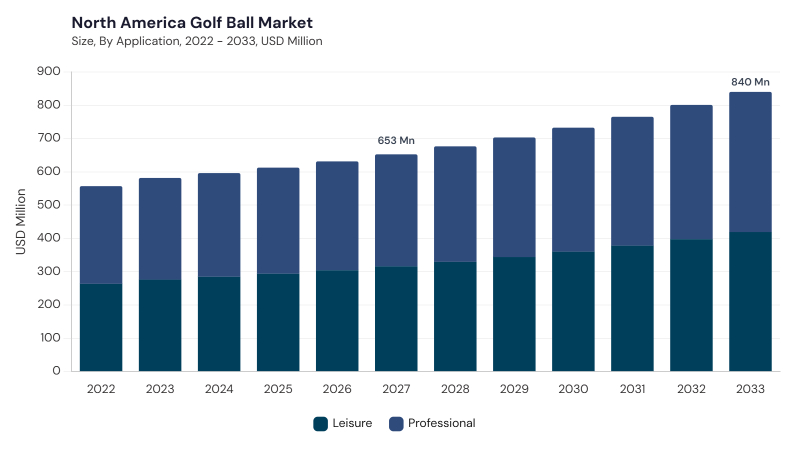
The North America Golf Ball Market is expected to reach USD 801.1 million by 2032, growing at a CAGR of 4.2% during (2026 – 2033).
The North America Golf Ball Market developed as traditional golf ball materials were gradually replaced by stronger synthetic materials and more performance-oriented constructions. Improvements in polymer chemistry, layered design, dimple engineering, and computer-aided manufacturing helped enhance durability, flight consistency, distance, control, and spin performance. Multi-layer golf balls became an important turning point as manufacturers combined different core, mantle, and cover materials to optimize performance for varied skill levels. The market later evolved through synthetic resins, urethane covers, precision molding, and aerodynamic refinements that improved consistency across repeated play.
The North America Golf Ball Market is being shaped by recreational golf participation, professional tournament activity, health-oriented outdoor lifestyles, e-commerce growth, advanced material science, and rising demand for personalized golf equipment. Golfers are selecting balls based on distance, spin control, feel, durability, compression, price value, and suitability for different course conditions. Demand is supported by public and semi-private golf facilities, training academies, corporate golf events, golf tourism, online fitting tools, and direct-to-consumer platforms. Vendors are focusing on multi-layer construction, aerodynamic dimple patterns, urethane and ionomer materials, AI-enabled fitting, digital customization, and sustainable materials.
Based on Application, the market is segmented into Professional and Leisure. The Professional market dominated the North America Golf Ball Market by Application in 2025, and would continue to be a dominant market till 2033; thereby, achieving a market value of USD 403.3 million by 2032, growing at a CAGR of 3.7 % during the forecast period. The Leisure market is expected to witness a CAGR of 4.7% during (2026 - 2033).
Professional leads as competitive golfers, tournament players, training academies, and skilled club-level users require premium golf balls with strong spin control, optimized aerodynamics, consistent compression, and precise shot feedback. These users prefer advanced constructions that support distance, greenside control, and repeatable performance under varied playing conditions. Leisure remains significant as casual golfers, weekend players, corporate participants, and recreational users prioritize durability, affordability, and comfortable playability. This segment benefits from public golf course accessibility, driving ranges, golf simulators, family-oriented participation, and value-focused balls that support enjoyable play without requiring premium technical specifications.
Based on Product, the market is segmented into 4-piece, 2-piece, and 3-piece. 4-piece golf balls lead due to superior control, optimized spin, premium feel, advanced core designs, urethane covers, and strong suitability for professionals and experienced golfers. These balls are designed for nuanced shot shaping, greenside control, and consistent performance across different course conditions.
2-piece golf balls remain significant because they offer durability, longer travel distance, affordability, and low-maintenance performance for beginners and recreational users. 3-piece golf balls support intermediate and serious amateur golfers seeking a balanced combination of distance, feel, spin control, and shot versatility through improved compression and cover material innovation.
Free Valuable Insights: The Global Golf Ball Market will hit USD 2237.6 Million billion by 2033, at a CAGR of 4.7%
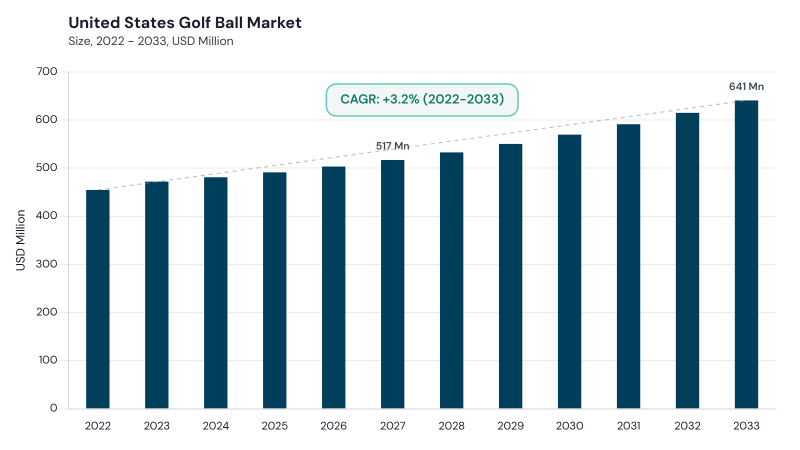
Based on Country, the market is segmented into US, Canada, Mexico, and Rest of North America. The US market dominated the North America Golf Ball Market by Country in 2025, and would continue to be a dominant market till 2033; thereby, achieving a market value of USD 615.1 million by 2032, growing at a CAGR of 3.5 % during the forecast period. The Canada market is expected to witness a CAGR of 6.3% during (2026 - 2033). Additionally, The Mexico market is expected to witness a CAGR of 6.2% during (2026 - 2033).
The US leads due to its large golfing population, professional tournament ecosystem, strong retail network, advanced product innovation, and demand for premium golf balls with distance, control, and personalization features. Canada supports market growth through recreational golf participation, climate-adapted product needs, eco-friendly ball interest, digital retail adoption, and demand from amateur and professional players. Mexico is advancing through golf tourism, growing course infrastructure, premium equipment adoption, international tournament influence, and rising interest in customized and performance-oriented golf balls. Rest of North America benefits from recreational participation, digital sales channels, localized product availability, and growing interest in golf balls tailored to diverse player skill levels and course conditions.

By Application
By Product
By Country
Set to reach $801.1 Million by 2032, growing at 4.2% CAGR during (2026-2033).
The US leads with $615.1 million by 2032, growing at a CAGR of 3.5% during the forecast period.
Rising popularity of leisure golf activities contributes to a 4.7% CAGR in the leisure segment during (2026-2033).
Professional segment will reach $403.3 million by 2032, growing at a CAGR of 3.7% during the forecast period.
The Canada market is expected to witness a CAGR of 6.3% during (2026-2033).
The Mexico market is expected to witness a CAGR of 6.2% during (2026-2033).
Our team of dedicated experts can provide you with attractive expansion opportunities for your business.




 Unique Offerings