The LAMEA Golf Ball Market is expected to reach USD 275.2 million by 2029, growing at a CAGR of 5.3% during (2026 – 2033).
The LAMEA Golf Ball Market developed as golf gradually expanded across Latin America, the Middle East, and Africa through expatriate communities, premium clubs, resorts, and emerging local participation. Early market availability depended heavily on imported golf balls, with traditional wound designs and basic durable products serving limited professional and leisure demand. As golf courses, academies, tournaments, and tourism-linked facilities expanded, demand shifted toward multi-layer balls with stronger cores, urethane covers, improved spin, and better flight consistency. The market later began reflecting a hybrid structure where imported premium balls coexist with regional and cost-effective offerings.
The LAMEA Golf Ball Market is being shaped by integrated golf resorts, government-led sports diversification, junior golf development, regional tournaments, corporate golf events, and expanding online retail access. Golfers and institutional buyers are selecting balls based on distance, trajectory, spin control, material resilience, affordability, regional service support, and suitability for humid, desert, coastal, and high-temperature conditions. Demand is supported by premium sporting facilities, academies, golf clubs, resorts, training centers, tournament organizers, and hospitality-driven golfing activities. Vendors are focusing on advanced materials, durable covers, aerodynamic dimple configurations, smart customization, sustainable components, and stronger distribution partnerships.
Based on Application, the market is segmented into Professional and Leisure. The Professional market dominated the LAMEA Golf Ball Market by Application in 2025, and would continue to be a dominant market till 2033; thereby, achieving a market value of USD 141.8 million by 2029, growing at a CAGR of 4.8 % during the forecast period. The Leisure market is expected to witness a CAGR of 5.8% during (2026 - 2033).
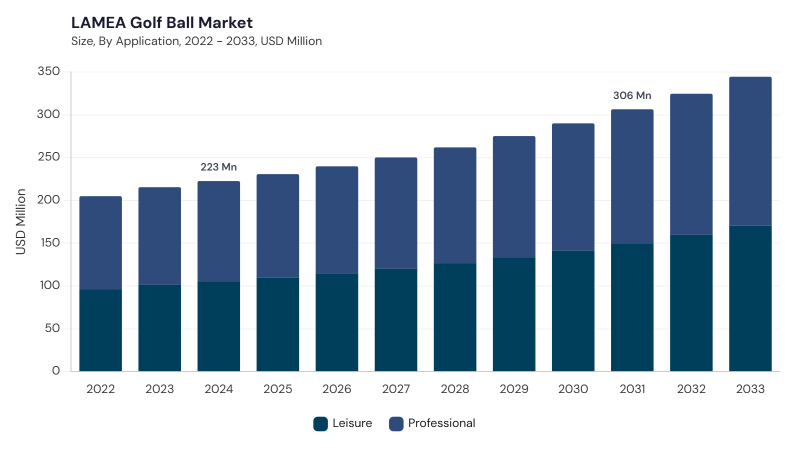
Professional leads as tournament players, skilled golfers, academies, and competitive clubs require premium golf balls with accurate spin response, stable flight, distance control, and consistent performance under varied course conditions. This segment is supported by regional tournaments, professional training, premium sporting facilities, and growing exposure to international golf standards. Leisure remains significant as recreational golfers, resort visitors, corporate event participants, and amateur players prioritize affordability, durability, and easy playability. This segment benefits from golf tourism, luxury resorts, social golfing, community programs, and broader participation among new and developing players across LAMEA.
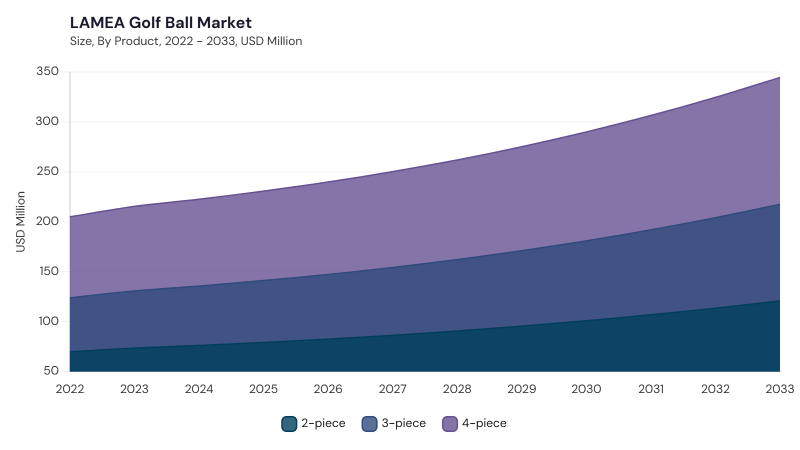
Based on Product, the market is segmented into 4-piece, 2-piece, and 3-piece. 4-piece golf balls lead due to advanced multilayer construction, superior spin performance, premium feel, enhanced shot control, and preference among professional and highly skilled golfers. These balls support accurate approach shots, flight stability, optimized spin, and distance control on premium and tournament-level courses.
2-piece golf balls remain significant because they offer durability, affordability, longer travel distance, and strong suitability for beginners, recreational golfers, training centers, and resort-based activities. 3-piece golf balls support intermediate golfers seeking balanced distance, feel, greenside control, compression optimization, and improved playability at a more accessible performance level.
Free Valuable Insights: Golf Ball Market Size Worth USD 2237.6 Million billion by 2033
Based on Country, the market is segmented into Brazil, Argentina, UAE, Saudi Arabia, South Africa, Nigeria, and Rest of LAMEA. The South Africa market dominated the LAMEA Golf Ball Market by Country in 2025, and would continue to be a dominant market till 2033; thereby, achieving a market value of USD 63.9 million by 2029, growing at a CAGR of 3.9 % during the forecast period. The Argentina market is expected to witness a CAGR of 5.9% during (2026 - 2033). Additionally, The UAE market is expected to witness a CAGR of 4.6% during (2026 - 2033).
Brazil leads due to growing golf visibility, expanding retail access, digital sales growth, rising tournament participation, and demand for performance-oriented golf balls across professional and recreational users. Argentina supports market growth through performance customization, pro-shop analytics, golf club activity, and demand for products suited to local altitude and climate variations. The UAE contributes through luxury golf tourism, premium courses, resort-based participation, sustainability interest, and high demand for balls adapted to desert and hot-weather conditions. Saudi Arabia, South Africa, and Nigeria add momentum through sports diversification, youth programs, tournaments, course development, and localized supply strategies, while Rest of LAMEA benefits from golf tourism, eco-conscious products, digital engagement, and affordable regional offerings.

By Application
By Product
By Country
Set to reach $275.2 Million by 2029, growing at 5.3% CAGR during (2026–2033).
South Africa leads with a market value of $63.9 million by 2029, growing at a 3.9% CAGR during the forecast period.
The Professional segment dominates, expected to reach $141.8 million by 2029, growing at a 4.8% CAGR during the forecast period.
The Leisure segment is expected to witness a 5.8% CAGR during (2026–2033).
The Argentina market is expected to witness a 5.9% CAGR during (2026–2033).
The UAE market is expected to witness a 4.6% CAGR during (2026–2033).
Our team of dedicated experts can provide you with attractive expansion opportunities for your business.




 Unique Offerings