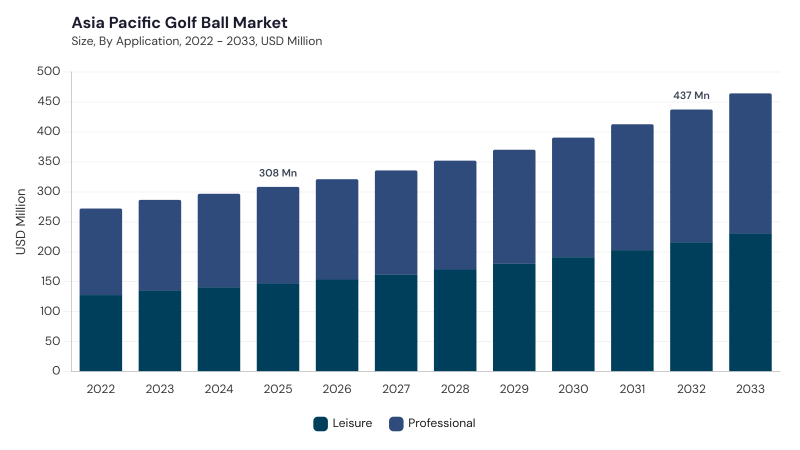
The Asia Pacific Golf Ball Market is expected to reach USD 390.5 million by 2030, growing at a CAGR of 5.4% during (2026 – 2033).
The Asia Pacific Golf Ball Market developed from traditional golf ball materials toward advanced synthetic compounds, multi-layer constructions, and precision-engineered performance designs. Early market activity was largely import-driven, but rising golf participation, urbanization, and course development encouraged broader regional demand. Improvements in rubber compounds, dimple optimization, core materials, and cover technologies enhanced durability, spin, control, distance, and playing consistency. Regional manufacturers gradually expanded product portfolios to address both amateur and professional users across diverse playing environments.
The Asia Pacific Golf Ball Market is being shaped by golf infrastructure expansion, rising disposable income, golf tourism, tournament activity, synthetic material innovation, and demand for performance-oriented products. Golfers are selecting balls based on distance control, spin rate, cover durability, flight consistency, compression, affordability, and compatibility with local humidity, altitude, turf, and course conditions. Demand is supported by golf courses, resorts, training academies, indoor simulators, artificial turf facilities, e-commerce platforms, and professional coaching centers. Vendors are focusing on region-tailored formulations, eco-friendly materials, smart sensor integration, premium multilayer designs, efficient supply chains, and localized distribution.
Based on Application, the market is segmented into Professional and Leisure. The Professional market dominated the Asia Pacific Golf Ball Market by Application in 2025, and would continue to be a dominant market till 2033; thereby, achieving a market value of USD 199.7 million by 2030, growing at a CAGR of 4.9 % during the forecast period. The Leisure market is expected to witness a CAGR of 5.9% during (2026 - 2033).
Professional leads as competitive golfers, tournament players, academies, and advanced training facilities require premium golf balls with precise spin control, reliable flight, optimized compression, and consistent shot performance. This segment is supported by regional tournaments, professional coaching, performance analytics, and demand for balls that meet international play standards. Leisure remains significant as casual golfers, beginners, social players, and recreational users seek durable, affordable, and easy-to-use golf balls. This segment benefits from rising middle-class participation, golf tourism, public courses, driving ranges, indoor golf formats, and value-oriented products designed for frequent non-competitive play.
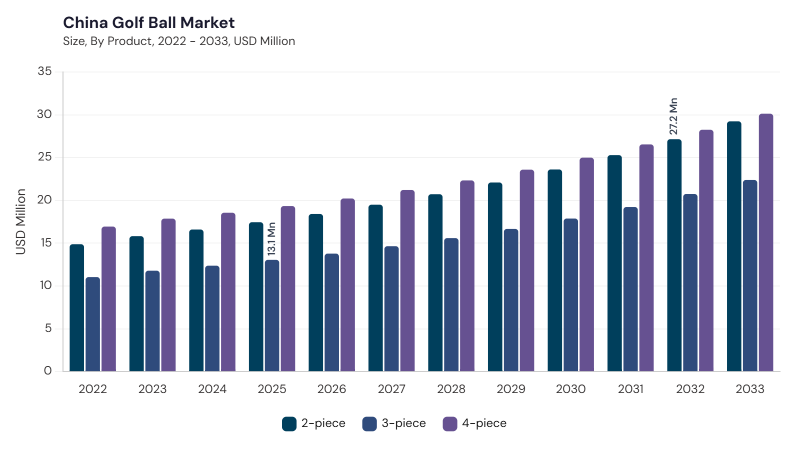
Based on Product, the market is segmented into 4-piece, 2-piece, and 3-piece. 4-piece golf balls lead due to strong demand from professionals and highly skilled golfers seeking advanced spin control, premium feel, shot precision, and stable performance across competitive course conditions. These balls use complex multilayer structures, optimized cores, soft urethane covers, and aerodynamic dimple designs to support high-performance play.
2-piece golf balls remain significant because they offer durability, affordability, longer travel distance, and strong suitability for beginners, training centers, and recreational users. 3-piece golf balls serve intermediate and serious amateur golfers seeking balanced distance, feel, greenside control, and improved shot versatility at a more accessible performance tier.
Free Valuable Insights: Golf Ball Market is Predicted to reach USD 2237.6 Million billion by 2033, at a CAGR of 4.7%
Based on Country, the market is segmented into China, Japan, India, South Korea, Singapore, Malaysia, and Rest of Asia Pacific. The Japan market dominated the Asia Pacific Golf Ball Market by Country in 2025, and would continue to be a dominant market till 2033; thereby, achieving a market value of USD 105.2 million by 2030, growing at a CAGR of 3.5 % during the forecast period. The South Korea market is expected to witness a CAGR of 4.8% during (2026 - 2033). Additionally, The India market is expected to witness a CAGR of 6.6% during (2026 - 2033).
China leads due to expanding golf courses, domestic manufacturing growth, sports development support, cost-efficient production, and increasing demand from amateur and intermediate golfers. Japan supports market growth through advanced material science, strong domestic golf culture, precision-focused performance expectations, sustainability interest, and smart golf ball innovation. India is advancing through golf academies, rising recreational participation, localized production, affordable product demand, and growing interest in customized and performance-optimized balls. South Korea, Singapore, and Malaysia add momentum through digital golf experiences, premium product adoption, indoor golf, personalization, and high-quality retail channels, while Rest of Asia Pacific benefits from golf tourism, resort development, e-commerce growth, and localized products suited to regional playing conditions.

By Application
By Product
By Country
Set to reach $390.5 Million by 2030, growing at 5.4% CAGR during (2026 – 2033).
Japan leads, achieving a market value of USD 105.2 million by 2030, with a CAGR of 3.5% during the forecast period.
Rising demand in the Professional segment, reaching USD 199.7 million by 2030, is a main catalyst.
The Professional segment will achieve USD 199.7 million by 2030, growing at a CAGR of 4.9% during the forecast period.
The India market is expected to witness a CAGR of 6.6% during (2026 - 2033).
The Leisure segment is expected to witness a CAGR of 5.9% during (2026 - 2033).
Our team of dedicated experts can provide you with attractive expansion opportunities for your business.




 Unique Offerings