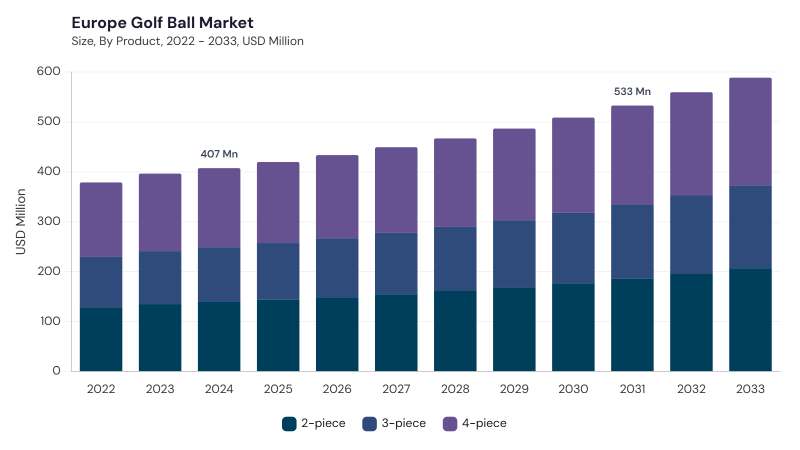
The Europe Golf Ball Market is expected to reach USD 532.8 million by 2031, growing at a CAGR of 4.5% during (2026 – 2033).
The Europe Golf Ball Market evolved alongside the development of golf as a structured sport, moving from early gutta-percha and rubber-core balls toward engineered performance products. Over time, multi-layer construction, dimple pattern refinement, synthetic polymers, urethane covers, and precision molding improved distance, control, durability, and spin behavior. European manufacturers and global brands gradually adapted ball designs to suit varied weather, turf, and playing conditions across the region. Professional tournaments, golf clubs, and recreational participation further encouraged the need for more specialized product lines.
The Europe Golf Ball Market is being shaped by eco-conscious consumer behavior, smart technology integration, golf tourism, recreational participation, professional golf activity, and broader demographic inclusion. Golfers are selecting balls based on spin control, flight stability, durability, distance, feel, compression, sustainability, and suitability for different skill levels. Demand is supported by championship courses, golf clubs, pro shops, online retail platforms, indoor simulators, academies, and tourism-led golf destinations across countries such as Spain, Portugal, Scotland, and other European markets. Vendors are focusing on biodegradable materials, smart sensors, data-driven customization, aerodynamic engineering, premium urethane covers, and regional product localization.
Based on Application, the market is segmented into Professional and Leisure. The Professional market dominated the Europe Golf Ball Market by Application in 2025, and would continue to be a dominant market till 2033; thereby, achieving a market value of USD 270.9 million by 2031, growing at a CAGR of 4 % during the forecast period. The Leisure market is expected to witness a CAGR of 5% during (2026 - 2033).
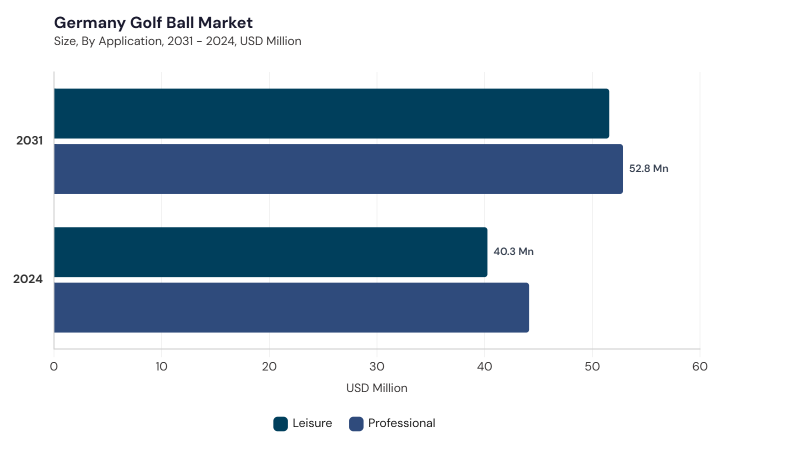
Professional leads as tournament players, serious competitors, golf academies, and skilled club-level users require golf balls with precise aerodynamics, optimized compression, enhanced spin control, and consistent shot behavior. This segment is influenced by professional endorsements, regulatory standards, tournament eligibility, and continuous R&D focused on performance refinement. Leisure remains significant as recreational golfers, social players, tourists, and beginners prioritize affordability, durability, distance, and ease of play. This segment benefits from rising golf tourism, broader participation by youth and women, beginner-friendly courses, driving ranges, simulators, and value-oriented golf balls that support enjoyable recreational play.
Based on Product, the market is segmented into 4-piece, 2-piece, and 3-piece. 4-piece golf balls lead due to superior spin control, shot precision, premium feel, advanced multilayer construction, and strong suitability for professional and highly skilled players. These balls support driver distance, wedge control, launch stability, and performance consistency across varied European course conditions.
2-piece golf balls remain significant because they offer durability, longer flight distance, affordability, and strong appeal among beginner, leisure, and training users. 3-piece golf balls serve intermediate and advanced amateurs seeking a balanced combination of distance, feel, control, spin response, and versatility across different playing styles.
Free Valuable Insights: The Worldwide Golf Ball Market is projected to reach USD 2237.6 Million billion by 2033, at a CAGR of 4.7%
Based on Country, the market is segmented into Germany, UK, France, Russia, Spain, Italy, and Rest of Europe. The UK market dominated the Europe Golf Ball Market by Country in 2025, and would continue to be a dominant market till 2033; thereby, achieving a market value of USD 134.5 million by 2031, growing at a CAGR of 3.3 % during the forecast period. The Germany market is expected to witness a CAGR of 3.6% during (2026 - 2033). Additionally, The France market is expected to witness a CAGR of 5.2% during (2026 - 2033).
Germany leads due to premium golf equipment adoption, sustainability-focused manufacturing expectations, data-driven personalization, strong club participation, and demand for technologically refined golf balls. The UK supports market growth through deep golf heritage, professional play, regulatory awareness, performance rollbacks, digital training tools, and strong retail access. France contributes through growing golf participation, environmental consciousness, smart golf ball interest, personalization, and demand for precision-focused products. Russia, Spain, and Italy add momentum through golf infrastructure, tourism, regional customization, premium product adoption, and digital retail growth, while Rest of Europe benefits from sustainable materials, beginner-friendly products, localized distribution, and diversified player profiles.

By Application
By Product
By Country
Set to reach $532.8 Million by 2031, growing at 4.5% CAGR during 2026-2033.
The UK leads with a market value of $134.5 million by 2031, growing at a 3.3% CAGR during the forecast period.
Rising demand in the Professional segment, reaching $270.9 million by 2031, is a main catalyst.
The Leisure segment is expected to witness a CAGR of 5% during 2026-2033.
The Germany market is expected to witness a CAGR of 3.6% during 2026-2033.
The France market is expected to witness a CAGR of 5.2% during 2026-2033.
Our team of dedicated experts can provide you with attractive expansion opportunities for your business.




 Unique Offerings