The sample copy of this report is available for access.
The North America Electronic Design Automation Software Market is expected to reach USD 13.8 billion by 2032, growing at a CAGR of 9.2% during (2026 - 2033).
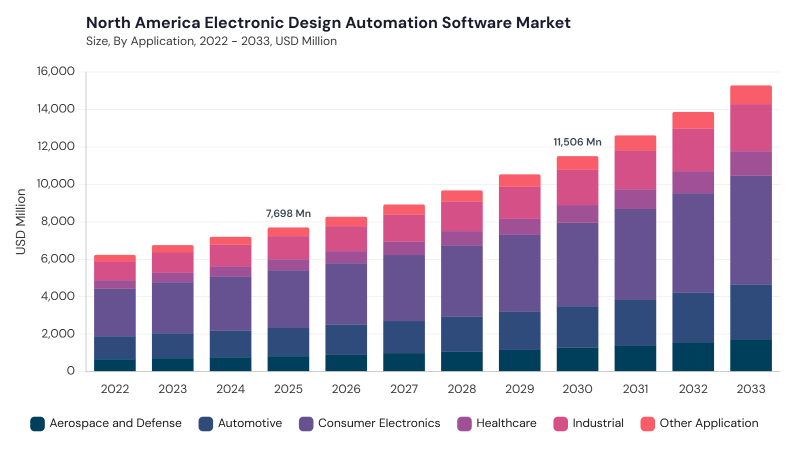
The North America Electronic Design Automation Software Market evolved from early logic simulation, schematic capture, and verification tools into comprehensive platforms supporting increasingly complex semiconductor and system-level design. Adoption of hardware description languages, automated place-and-route, advanced verification, and physical-design technologies progressively expanded the role of EDA across semiconductor development. Increasing transistor density, system-on-chip architectures, advanced packaging, and heterogeneous integration have further raised design complexity. Current platforms increasingly incorporate cloud computing, artificial intelligence, thermal analysis, security-aware design, photonics, and multi-domain simulation to improve design accuracy, scalability, and development speed.
AI-driven automation, cloud-based design environments, power and thermal optimization, predictive verification, and hardware security are shaping current market development. Semiconductor developers increasingly use machine learning to automate error detection, layout optimization, verification prioritization, and design analysis while reducing development cycles. Cloud-enabled platforms provide scalable computing and collaboration for geographically distributed engineering teams, while advanced thermal and power-analysis capabilities help address increasingly dense semiconductor architectures. Security-aware design, IP protection, interoperability, and compliance requirements are also gaining importance as EDA workflows expand across automotive, aerospace, healthcare, consumer electronics, data centers, and advanced computing applications.
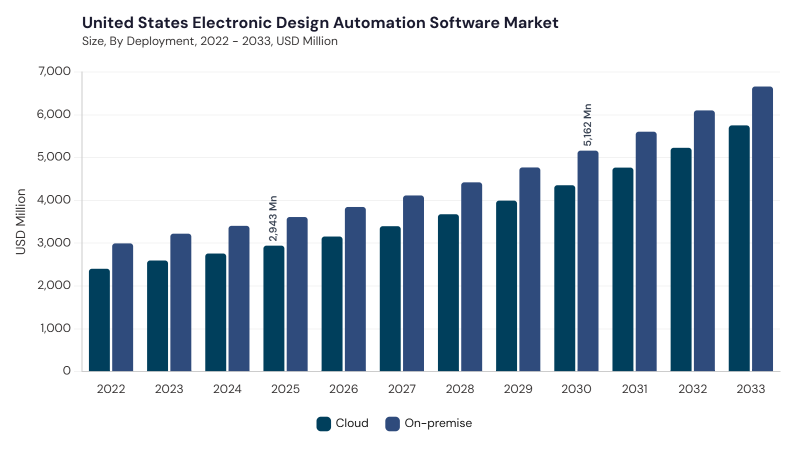
Based on Deployment, the market is segmented into On-premise and Cloud. The On-premise market dominated the North America Electronic Design Automation Software Market by Deployment in 2025, and would continue to be a dominant market till 2033; thereby, achieving a market value of USD 7.4 billion by 2032, growing at a CAGR of 8.8 % during the forecast period. The Cloud market is expected to witness a CAGR of 9.6% during (2026 - 2033).
On-premise deployment provides semiconductor companies, integrated device manufacturers, aerospace contractors, and electronics developers with direct control over computing environments, sensitive design data, security policies, and customized engineering workflows. Cloud deployment provides scalable computing resources for simulation, verification, physical design, and collaborative development while reducing the need for continual internal infrastructure expansion. Growing availability of secure cloud environments, high-performance computing, AI-assisted design tools, and hybrid architectures is supporting adoption among startups, fabless semiconductor companies, and distributed engineering teams.
Based on End-use, the market is segmented into Microprocessors & Controllers, Memory Management Unit (MMU), and Other End-use. The Microprocessors & Controllers market dominated the North America Electronic Design Automation Software Market by End-use in 2025, and would continue to be a dominant market till 2033; thereby, achieving a market value of USD 9.5 billion by 2032, growing at a CAGR of 8.9 % during the forecast period. The Memory Management Unit (MMU) market is expected to witness a CAGR of 9.5% during (2026 - 2033). The Other End-use market is expected to witness a CAGR of 10.4% during (2026 - 2033).
Microprocessors & Controllers require advanced architecture modeling, simulation, verification, synthesis, physical design, and hardware-software co-design capabilities as processor complexity increases. Memory Management Unit (MMU) applications use EDA software to support address translation, memory protection, virtualization, cache management, memory isolation, and increasingly complex processor-memory interactions. Other End-use includes specialized integrated circuits, connectivity devices, sensors, custom accelerators, networking components, research-oriented electronics, quantum computing systems, and other domain-specific semiconductor architectures requiring flexible and highly customized design environments.
Based on Product, the market is segmented into Computer-aided Engineering (CAE), Semiconductor Intellectual Property (SIP), IC Physical Design and Verification, Printed Circuit Board and Multi-chip Module (PCB and MCM), and Services. Computer-aided Engineering supports circuit simulation, signal integrity, thermal analysis, electromagnetic compatibility, and multi-physics modeling to identify design issues earlier in development. Semiconductor Intellectual Property enables reuse of verified processor cores, interfaces, connectivity functions, memory blocks, and specialized accelerators within system-on-chip designs.
IC Physical Design and Verification includes placement, routing, timing analysis, power optimization, layout verification, and design-rule checking for increasingly advanced semiconductor nodes. PCB and MCM solutions support board-level electrical, thermal, mechanical, and heterogeneous integration requirements, while Services include consulting, implementation, technical support, training, customization, and workflow optimization.
Based on Application, the market is segmented into Consumer Electronics, Automotive, Industrial, Aerospace and Defense, Healthcare, and Other Application. Consumer Electronics relies on EDA software for rapid design cycles, miniaturization, power efficiency, advanced functionality, and complex system-on-chip development. Automotive applications require rigorous verification for electrification, advanced driver-assistance systems, connectivity, digital cockpits, and software-defined vehicle architectures.
Industrial applications include factory automation, robotics, machine vision, industrial IoT, and intelligent control systems, while Aerospace and Defense requires highly secure, reliable, and traceable electronics for avionics, communications, radar, navigation, satellites, and defense platforms. Healthcare applications support medical imaging, diagnostics, monitoring, wearable health devices, and other regulated electronics, while Other Application includes telecommunications, energy systems, specialized computing, research platforms, and emerging technology applications.
Free Valuable Insights: The Global Electronic Design Automation Software Market will hit USD 35.9 Billion billion by 2033, at a CAGR of 9.6%
Based on Country, the market is segmented into US, Canada, Mexico, and Rest of North America. The US market dominated the North America Electronic Design Automation Software Market by Country in 2025, and would continue to be a dominant market till 2033; thereby, achieving a market value of USD 11.3 billion by 2032, growing at a CAGR of 8.5 % during the forecast period. The Canada market is expected to witness a CAGR of 12.9% during (2026 - 2033). Additionally, The Mexico market is expected to witness a CAGR of 11.3% during (2026 - 2033).
Across North America, EDA software adoption is being shaped by AI integration, cloud computing, semiconductor design complexity, localized engineering capabilities, and advanced system requirements. The US emphasizes AI-enabled automation, cloud-based EDA, open-source components, export-control compliance, advanced-node design, and heterogeneous integration, while Canada focuses on AI-assisted workflows, cloud-native platforms, customization for emerging technology nodes, collaborative research, and secure infrastructure. Mexico is advancing AI-enhanced EDA, nearshoring-supported semiconductor development, cloud-based collaboration, automotive electronics, and localized design centers, whereas Rest of North America emphasizes AI-driven optimization, multi-physics simulation, cloud-enabled collaboration, open standards, interoperability, and advanced semiconductor design workflows.

By Deployment
By End-use
By Product
By Application
By Country
Set to reach $13.8 Billion by 2032, growing at 9.2% CAGR during 2026-2033.
The US leads with $11.3 billion by 2032, growing at 8.5% CAGR during 2026-2033.
Rising enterprise cloud adoption and AI-driven workloads are the main catalysts.
On-premise segment to reach $7.4 billion by 2032, growing at 8.8% CAGR during 2026-2033.
Canada is expected to witness a CAGR of 12.9% during 2026-2033.
Microprocessors & controllers segment to reach $9.5 billion by 2032, growing at 8.9% CAGR during 2026-2033.
Our team of dedicated experts can provide you with attractive expansion opportunities for your business.




 Unique Offerings