The sample copy of this report is available for access.
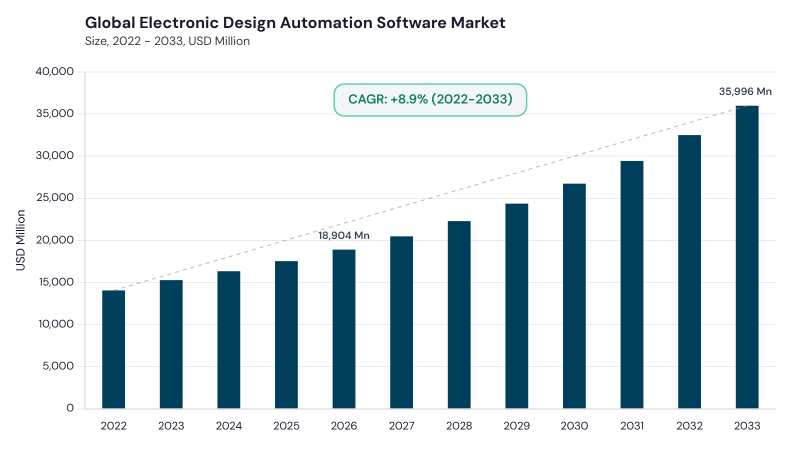
“Global Electronic Design Automation Software Market to reach a market value of USD 35,995.93 Million by 2033 growing at a CAGR of 9.6%”
The Global Electronic Design Automation Software Market is expected to reach USD 35.9 billion by 2033, growing at a CAGR of 9.6% during (2026 - 2033).
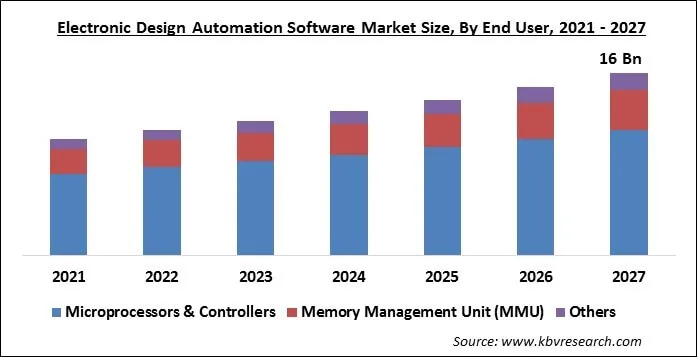
Growing semiconductor design complexity, advanced integrated circuit demand, and expanding use of AI, high-performance computing, automotive electronics, telecommunications, connected devices, and advanced process nodes are driving adoption of Electronic Design Automation Software. EDA tools are increasingly used across IC design, PCB development, simulation, verification, and manufacturing workflows. The market originated in the mid to late 20th century as semiconductor designs became too complex for manual drafting and circuit layout. Early tools focused on schematic capture and basic layout before evolving into hardware description languages, logic synthesis, simulation, verification, and physical design automation.
Growth in the Electronic Design Automation Software Market is driven by rising semiconductor complexity, increasing transistor density, advanced-node development, chiplet architectures, 2.5D and 3D packaging, automotive electrification, 5G infrastructure, AI accelerators, and high-performance computing demand. EDA tools are becoming critical for reducing design errors, shortening design cycles, improving verification accuracy, supporting power-performance optimization, and enabling complex hardware-software co-design. Cloud-based access and AI-assisted engineering are also expanding the user base by improving collaboration, scalability, and design productivity.
The competitive environment is highly consolidated and innovation-driven, with leading vendors competing through full-stack EDA platforms, semiconductor IP, physical verification, RF and PCB design, TCAD, device modeling, multiphysics simulation, and AI-enabled workflows. Synopsys, Cadence, and Siemens EDA remain the leading full-stack participants, while Keysight, Renesas through Altium, Dassault Systèmes, Empyrean Technology, Zuken, Silvaco, and Primarius serve specialized roles across RF, PCB, simulation, regional semiconductor ecosystems, and device-level design. Competition is increasingly shaped by AI-assisted design automation, advanced packaging support, cloud deployment, workflow integration, and foundry collaboration.
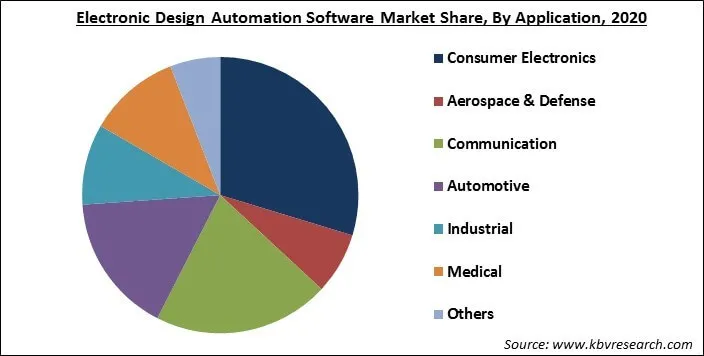
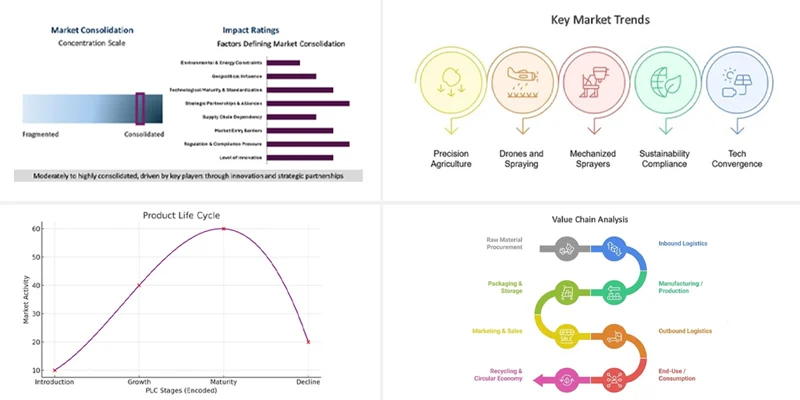

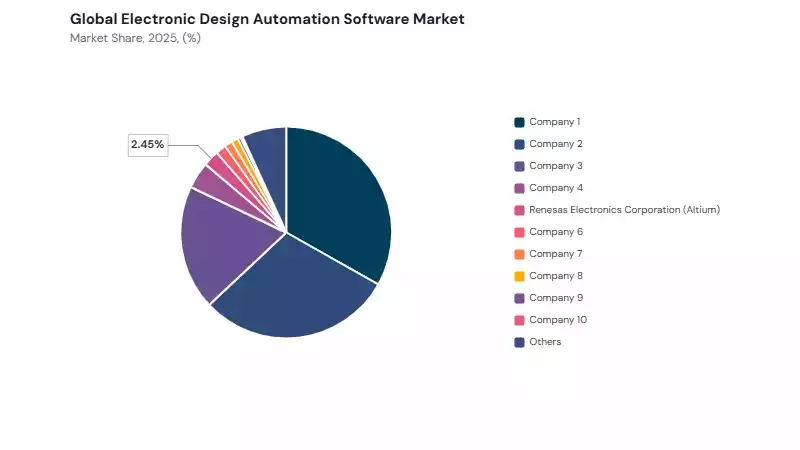
The global Electronic Design Automation Software Market is highly consolidated, with Synopsys, Cadence, and Siemens EDA forming the strongest competitive core due to their broad semiconductor design, verification, implementation, signoff, simulation, PCB, and system-level engineering capabilities. Keysight, Renesas through Altium, Dassault Systèmes, Empyrean Technology, Zuken, Silvaco, and Primarius strengthen the market through RF design, PCB engineering, TCAD, device modeling, regional EDA ecosystems, and specialized semiconductor software. Competitive advantage is increasingly determined by AI-assisted workflows, advanced-node support, chiplet and 3D IC design, multiphysics simulation, foundry certification, workflow interoperability, cloud deployment, and the ability to connect chip, package, board, and system-level design environments.
Based on Deployment, the market is segmented into On-premise and Cloud. The On-premise market dominated the Global Electronic Design Automation Software Market by Deployment in 2025, and would continue to be a dominant market till 2033; thereby, achieving a market value of USD 19.4 billion by 2033, growing at a CAGR of 9.3 % during the forecast period. The Cloud market is expected to witness a CAGR of 10.1% during (2026 - 2033).
On-premise deployment remains important for semiconductor firms and electronics companies that need strict control over proprietary design data, computing infrastructure, security, and intellectual property. It supports high-performance workflows where predictable processing, internal integration, and confidential design environments are critical. Cloud deployment is expanding as design teams seek scalable computing resources, collaborative access, flexible licensing, and faster design iteration. Both models are increasingly moving toward hybrid structures as companies balance security-sensitive workloads with elastic compute requirements.
Based on End-use, the market is segmented into Microprocessors & Controllers, Memory Management Unit (MMU), and Other End-use. The Microprocessors & Controllers market dominated the Global Electronic Design Automation Software Market by End-use in 2025, and would continue to be a dominant market till 2033; thereby, achieving a market value of USD 24.8 billion by 2033, growing at a CAGR of 9.3 % during the forecast period. The Memory Management Unit (MMU) market is expected to witness a CAGR of 10% during (2026 - 2033). The Other End-use market is expected to witness a CAGR of 10.9% during (2026 - 2033).
Microprocessors & Controllers remain the leading end-use area as CPUs, microcontrollers, SoCs, embedded processors, AI accelerators, and application-specific computing platforms require advanced simulation, verification, and physical design tools. Memory Management Unit applications are gaining relevance as processors, GPUs, AI systems, and data center architectures need efficient memory addressing, virtualization, cache coordination, and secure workload isolation. Other End-use includes specialized chips, custom accelerators, telecommunications hardware, research architectures, and emerging semiconductor designs that require flexible and scalable EDA environments.
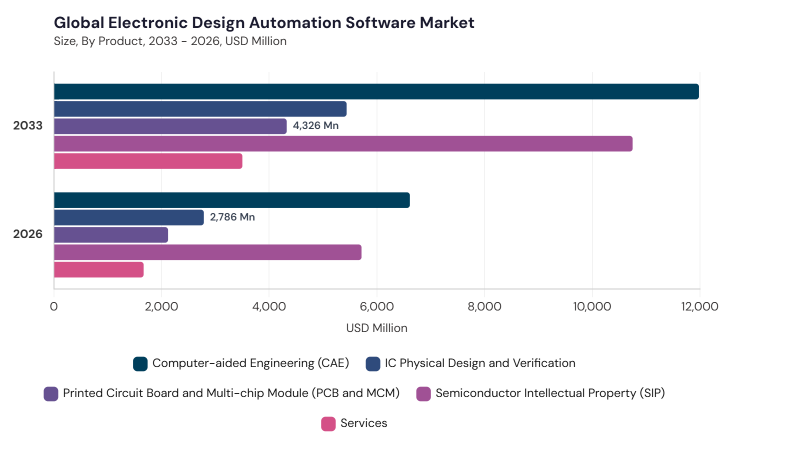
Based on Product, the market is segmented into Computer-aided Engineering (CAE), Semiconductor Intellectual Property (SIP), IC Physical Design and Verification, Printed Circuit Board and Multi-chip Module (PCB and MCM), and Services. The Computer-aided Engineering (CAE) market dominated the Global Electronic Design Automation Software Market by Product in 2025, and would continue to be a dominant market till 2033; thereby, achieving a market value of USD 11.9 billion by 2033, growing at a CAGR of 8.9 % during the forecast period. The Semiconductor Intellectual Property (SIP) market is expected to witness a CAGR of 9.4% during (2026 - 2033). Additionally, The IC Physical Design and Verification market is expected to witness highest CAGR of 10% during (2026 - 2033).
Computer-aided Engineering remains central to the market due to its role in simulation, modeling, multiphysics analysis, signal integrity, thermal behavior, and early-stage design validation. Semiconductor Intellectual Property supports faster chip development through reusable and verified IP blocks used in complex SoC and application-specific designs. IC Physical Design and Verification is essential for layout, timing closure, manufacturability, and design-rule compliance at advanced process nodes. PCB and MCM tools support board-level and module-level integration, while Services help customers manage implementation, customization, training, workflow optimization, and technical support.
Based on Application, the market is segmented into Consumer Electronics, Automotive, Industrial, Aerospace and Defense, Healthcare, and Other Application. The Consumer Electronics market dominated the Global Electronic Design Automation Software Market by Application in 2025, and would continue to be a dominant market till 2033; thereby, achieving a market value of USD 13.7 billion by 2033, growing at a CAGR of 9 % during the forecast period. The Automotive market is expected to witness a CAGR of 9.3% during (2026 - 2033). Additionally, The Industrial market is expected to witness highest CAGR of 10% during (2026 - 2033).
Consumer Electronics remains the dominant application as smartphones, wearables, computing devices, smart home products, and connected devices require compact, power-efficient, and high-performance semiconductor designs. Automotive adoption is rising with electrification, ADAS, digital cockpits, vehicle connectivity, and software-defined vehicles increasing semiconductor content and verification needs. Industrial applications are supported by robotics, automation, industrial IoT, and embedded control systems. Aerospace and Defense demand secure, high-reliability, and mission-critical design workflows, while Healthcare and Other Application segments are expanding through connected medical devices, diagnostics, telecommunications, research electronics, and specialized computing platforms.
Free Valuable Insights: Electronic Design Automation Software Market Size to reach $35.9 Billion by 2033
Region-wise, the Electronic Design Automation Software Market is analyzed across North America, Europe, Asia Pacific, and LAMEA. The North America market dominated the Global Electronic Design Automation Software Market by Region in 2025, and would continue to be a dominant market till 2033; thereby, achieving a market value of USD 15.2 billion by 2033, growing at a CAGR of 9.2 % during the forecast period. The Asia Pacific market is expected to witness a CAGR of 10.1% during (2026 - 2033). Additionally, The Europe market is expected to witness a CAGR of 9% during (2026 - 2033).
North America remains a major market due to strong semiconductor design activity, advanced computing companies, cloud infrastructure, AI-chip development, aerospace and defense electronics, and established EDA vendor presence. Europe benefits from automotive electronics, industrial automation, semiconductor sovereignty initiatives, secure engineering requirements, and growing demand for advanced simulation and verification. Asia Pacific is strongly positioned through large semiconductor manufacturing ecosystems, electronics production, domestic EDA development, and high demand from China, Japan, South Korea, India, Singapore, and Malaysia. LAMEA is developing through electronics manufacturing, cloud accessibility, embedded systems, telecom infrastructure, and gradual adoption of advanced semiconductor design workflows.
| Report Attribute | Details |
|---|---|
| Market size value in 2026 | USD 18.9 billion |
| Market size forecast in 2033 | USD 35.9 billion |
| Base Year | 2025 |
| Historical Period | 2022 to 2024 |
| Forecast Period | 2026 to 2033 |
| Revenue Growth Rate | CAGR of 9.6% from 2026 to 2033 |
| Number of Pages | 683 |
| Tables | 840 |
| Report Coverage | Market Trends, Revenue Estimation and Forecast, Segmentation Analysis, Regional and Country Breakdown, Competitive Landscape, Market Share Analysis, Company Profiling, Companies Strategic Developments, SWOT Analysis, Product Life Cycle Analysis, Value Chain Analysis, Market Consolidation Analysis, Key Customer Criteria, Pandemic Impact Analysis, and Winning Imperatives |
| Segments Covered | Deployment, End-use, Product, Application, and Region |
| Country Scope |
|
| Companies Included | Synopsys; Cadence; Siemens EDA; Keysight; Renesas; Dassault Systèmes; Empyrean Technology; Zuken; Silvaco; Primarius |
By Deployment
By End-use
By Product
By Application
By Geography
Expected to reach USD 35.9 billion by 2033, growing at 9.6% CAGR during 2026-2033.
On-premise deployment leads with a market value of USD 19.4 billion by 2033.
Synopsys, Cadence, Siemens EDA, Keysight, Renesas, Dassault Systèmes, Empyrean Technology, Zuken, Silvaco, and Primarius.
Microprocessors & Controllers lead, reaching USD 24.8 billion by 2033.
North America leads with a market value of USD 15.2 billion by 2033.
Computer-aided Engineering (CAE) tops with a market value of USD 11.9 billion by 2033.
Our team of dedicated experts can provide you with attractive expansion opportunities for your business.








 Unique Offerings