The sample copy of this report is available for access.
The LAMEA Electronic Design Automation Software Market is expected to reach USD 1476.4 million by 2029, growing at a CAGR of 12.1% during (2026 - 2033).
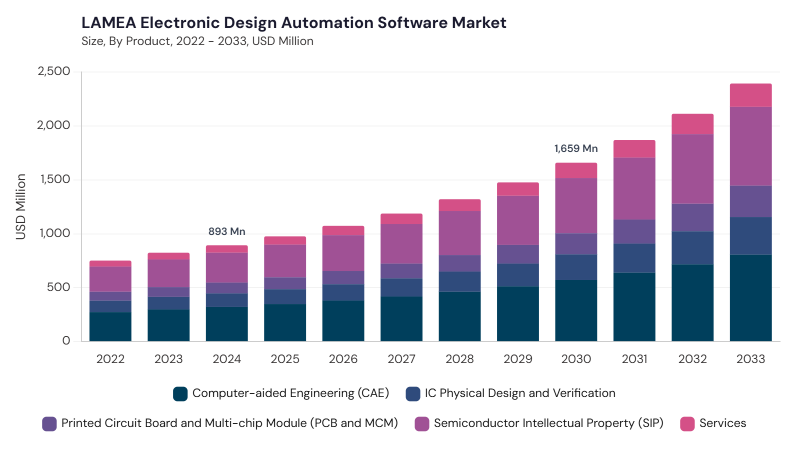
The LAMEA Electronic Design Automation Software Market evolved from basic circuit layout, logic simulation, and verification tools into increasingly integrated platforms supporting simulation, physical design, verification, and semiconductor development. Growing digitalization and demand for locally developed electronics gradually expanded EDA adoption across Latin America, the Middle East, and Africa. Regional semiconductor initiatives, collaboration with global technology providers, and greater use of cloud infrastructure further accelerated market development. Current platforms increasingly combine artificial intelligence, machine learning, multi-physics simulation, cloud-enabled collaboration, cybersecurity, and automated verification to address expanding design complexity and regional technology requirements.
AI-driven design acceleration, cloud deployment, localization, sustainability, and custom silicon development are shaping current market evolution. Machine learning is increasingly used for predictive analytics, automated error detection, verification, and design optimization, helping reduce manual effort and shorten development cycles. Cloud and microservice architectures are widening access to scalable computational resources for distributed engineering teams, while localized EDA tools are being adapted to regional manufacturing capabilities, regulatory conditions, and design standards. Growing emphasis on energy-efficient electronics, embedded systems, telecommunications infrastructure, semiconductor self-reliance, and collaboration among academia, startups, and industry is also supporting broader adoption.
Based on Deployment, the market is segmented into On-premise and Cloud. The On-premise market dominated the LAMEA Electronic Design Automation Software Market by Deployment in 2025, and would continue to be a dominant market till 2033; thereby, achieving a market value of USD 818.0 million by 2029, growing at a CAGR of 11.7 % during the forecast period. The Cloud market is expected to witness a CAGR of 12.6% during (2026 - 2033).
On-premise deployment provides enterprises with direct control over intellectual property, security policies, workflow configuration, simulation infrastructure, and high-performance computing resources, particularly across defense, aerospace, telecommunications, and other sensitive applications. Cloud deployment offers scalable computing, lower upfront infrastructure requirements, remote collaboration, flexible licensing, and easier access to advanced design capabilities for startups, SMEs, educational institutions, and distributed teams. Expansion of regional internet infrastructure, encryption, multi-factor authentication, localized cloud environments, AI-assisted tools, and pay-as-you-go models is improving cloud adoption while addressing data-security and sovereignty concerns.
Based on End-use, the market is segmented into Microprocessors & Controllers, Memory Management Unit (MMU), and Other End-use. The Microprocessors & Controllers market dominated the LAMEA Electronic Design Automation Software Market by End-use in 2025, and would continue to be a dominant market till 2033; thereby, achieving a market value of USD 1044.4 million by 2029, growing at a CAGR of 11.8 % during the forecast period. The Memory Management Unit (MMU) market is expected to witness a CAGR of 12.5% during (2026 - 2033). The Other End-use market is expected to witness a CAGR of 14% during (2026 - 2033).
Microprocessors & Controllers require EDA software for processor, microcontroller, embedded-system, PCB, verification, and semiconductor-related development across expanding digital applications. Memory Management Unit applications are supported by growing cloud infrastructure, enterprise computing, telecommunications, artificial intelligence, and connected systems requiring efficient memory access, virtualization, cache behavior, security, and system performance. Other End-use includes telecommunications development, academic research, defense electronics, specialized embedded systems, industrial applications, sensing, connectivity, and emerging semiconductor research requiring flexible and scalable design environments.
Based on Product, the market is segmented into Computer-aided Engineering (CAE), Semiconductor Intellectual Property (SIP), IC Physical Design and Verification, Printed Circuit Board and Multi-chip Module (PCB and MCM), and Services. Computer-aided Engineering supports thermal analysis, signal integrity, electromagnetic interference assessment, power optimization, and simulation-driven design before physical prototyping. Semiconductor Intellectual Property enables reuse and management of verified processor, memory, interface, and security blocks to reduce design complexity and development time.
IC Physical Design and Verification supports layout, place-and-route, design-rule checking, timing, and manufacturability validation, while PCB and MCM tools address routing, power distribution, thermal management, electromagnetic compatibility, and multi-component integration. Services include consulting, training, customization, implementation, maintenance, support, workflow optimization, and technical expertise for organizations adopting sophisticated EDA platforms.
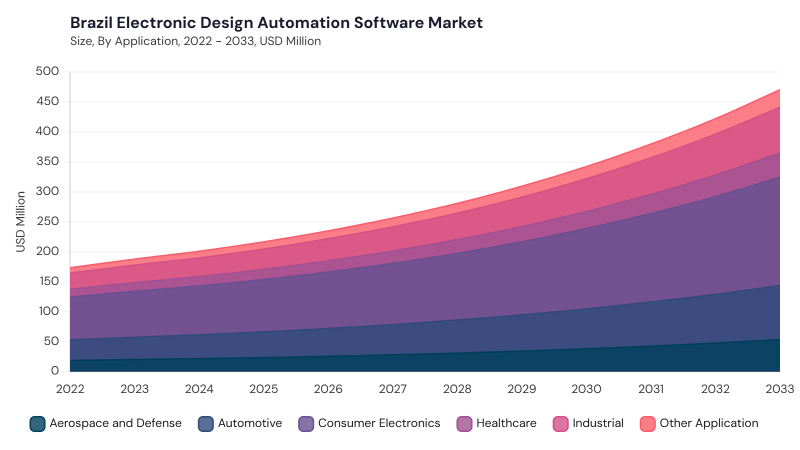
Based on Application, the market is segmented into Consumer Electronics, Automotive, Industrial, Aerospace and Defense, Healthcare, and Other Application. Consumer Electronics uses EDA software for smartphones, tablets, wearables, smart-home devices, system-on-chip development, PCB design, power efficiency, miniaturization, and faster product cycles. Automotive applications require design and verification for electronic control units, advanced driver-assistance systems, infotainment, electric vehicles, and connected mobility.
Industrial applications include automation, robotics, power electronics, smart manufacturing, and industrial IoT, while Aerospace and Defense requires secure and highly reliable electronic systems for avionics, radar, satellites, and communications. Healthcare applications support diagnostic equipment, patient monitoring, connected medical devices, and wearable technologies, while Other Application includes telecommunications, smart grids, utilities, research, education, and other specialized electronic-system development.
Free Valuable Insights: Electronic Design Automation Software Market Size Worth USD 35.9 Billion billion by 2033
Based on Country, the market is segmented into Brazil, Argentina, UAE, Saudi Arabia, South Africa, Nigeria, and Rest of LAMEA. The Brazil market dominated the LAMEA Electronic Design Automation Software Market by Country in 2025, and would continue to be a dominant market till 2033; thereby, achieving a market value of USD 309.2 million by 2029, growing at a CAGR of 10.4 % during the forecast period. The Argentina market is expected to witness a CAGR of 14.5% during (2026 - 2033). Additionally, The UAE market is expected to witness a CAGR of 9.9% during (2026 - 2033).
Across LAMEA, EDA software adoption is being shaped by AI integration, cloud computing, semiconductor localization, digital transformation, and evolving engineering ecosystems. Brazil emphasizes AI-enhanced design, multi-cloud infrastructure, hyperautomation, localized software, and cybersecurity, while Argentina focuses on AI-driven automation, Industry 4.0 integration, cloud platforms, interoperability, and regional compliance. The UAE is advancing AI-enabled verification, hyperautomation, cloud-based design, localized support, and collaborative semiconductor development, whereas Saudi Arabia emphasizes AI-powered workflows, SaaS deployment, cloud scalability, localization, data sovereignty, and semiconductor ecosystem development. South Africa focuses on AI-driven design, hyperautomation, Industry 4.0 integration, collaborative ecosystems, and localized EDA capabilities, while Nigeria emphasizes AI-enhanced tools, cloud deployment, capacity building, localization, cybersecurity, and accessible design environments. Rest of LAMEA continues to develop AI-assisted automation, cloud-enabled design, domain-specific tools, localized interfaces, cybersecurity, and customized EDA environments for automotive, telecommunications, industrial, and other emerging applications.

By Deployment
By End-use
By Product
By Application
By Country
Set to reach $1476.4 Million by 2029, growing at 12.1% CAGR during 2026-2033.
Brazil leads with $309.2 million by 2029, growing at a 10.4% CAGR during the forecast period.
The Microprocessors & Controllers segment will reach $1044.4 million by 2029, growing at 11.8% CAGR during 2026-2033.
The Cloud market is expected to witness a 12.6% CAGR during 2026-2033.
The Argentina market is expected to witness a 14.5% CAGR during 2026-2033.
The Memory Management Unit market is expected to witness a 12.5% CAGR during 2026-2033.
Our team of dedicated experts can provide you with attractive expansion opportunities for your business.




 Unique Offerings