The sample copy of this report is available for access.
The North America Digital Workplace Market is expected to reach USD 85.7 billion by 2032, growing at a CAGR of 22.3% during (2026 – 2033).
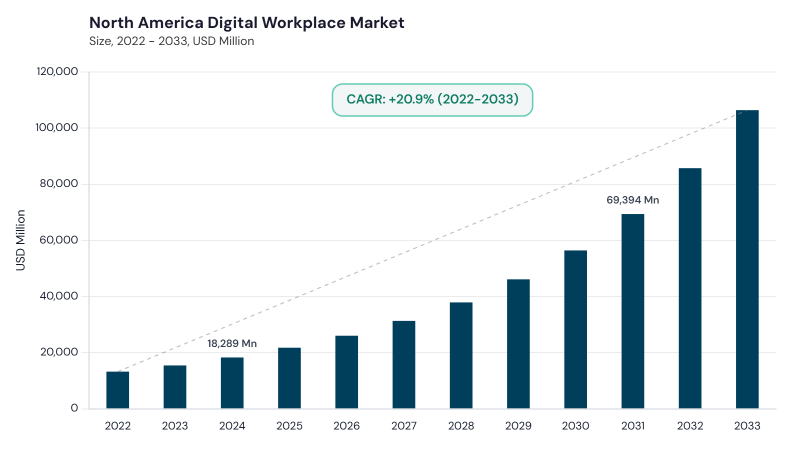
The North America Digital Workplace Market developed from early enterprise IT environments that supported office productivity through on-premise systems, email, intranets, and standalone collaboration tools. Over time, cloud computing, mobile access, broadband connectivity, and SaaS platforms shifted workplace technology from isolated applications toward integrated digital ecosystems. The adoption of unified communication platforms, cloud productivity suites, and secure remote access tools enabled employees to collaborate beyond physical offices. Hybrid work adoption further accelerated the transition toward connected, flexible, and employee-centric digital workplaces.
The North America Digital Workplace Market is advancing through AI-infused productivity tools, hybrid work models, cybersecurity requirements, compliance readiness, and digital employee experience platforms. Enterprises are deploying intelligent assistants, automated workflows, cloud collaboration suites, unified communications, secure endpoint management, and analytics-driven workforce tools to improve productivity and engagement. Demand is supported by distributed teams, remote access needs, regulatory pressure, digital skills development, and enterprise modernization initiatives. Vendors are focusing on platform integration, AI automation, zero-trust security, user-friendly interfaces, and scalable service ecosystems.
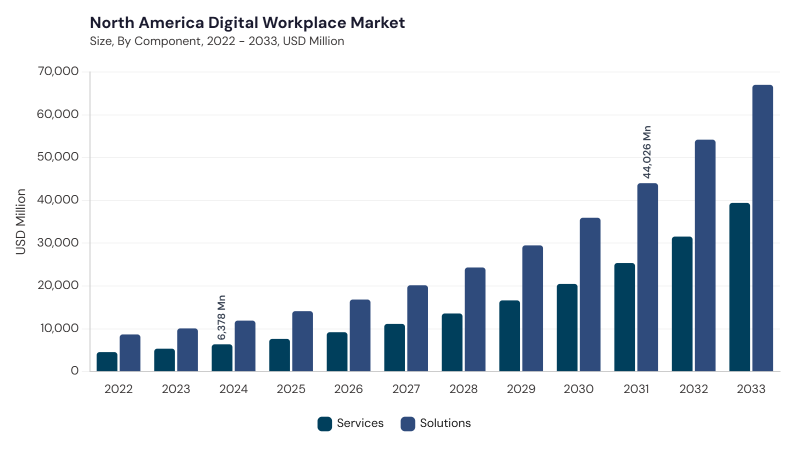
Based on Component, the market is segmented into Solutions and Services. The Solutions market dominated the North America Digital Workplace Market by Component in 2025, and would continue to be a dominant market till 2033; thereby, achieving a market value of USD 54.2 billion by 2032, growing at a CAGR of 21.8 % during the forecast period. Additionally, The Services market is expected to witness highest CAGR of 23.1% during (2026 - 2033).
Solutions lead due to widespread enterprise adoption of cloud collaboration platforms, unified communication tools, digital employee experience applications, workflow automation software, cybersecurity platforms, and AI-enabled productivity suites. These solutions support hybrid work, secure access, real-time communication, digital content management, and workforce collaboration across distributed organizations. Services remain important as enterprises require consulting, implementation, integration, managed support, change management, training, and continuous optimization to modernize workplace infrastructure. The services segment also benefits from rising demand for AI deployment support, compliance configuration, cybersecurity advisory, and migration from legacy systems to cloud-native workplace environments.
Based on Organization Size, the market is segmented into Large Enterprises and Small and Medium-sized Enterprises (SMEs). The Large Enterprises market dominated the North America Digital Workplace Market by Organization Size in 2025, and would continue to be a dominant market till 2033; thereby, achieving a market value of USD 52.5 billion by 2032, growing at a CAGR of 21.8 % during the forecast period. Additionally, The Small and Medium-sized Enterprises (SMEs) market is expected to witness highest CAGR of 23% during (2026 - 2033).
Large Enterprises lead due to mature cloud strategies, larger IT budgets, distributed workforce structures, strict compliance requirements, and broad adoption of AI-powered workplace platforms. These organizations use digital workplace solutions for secure collaboration, enterprise mobility, workflow automation, employee engagement, analytics, and integration with ERP, CRM, HRMS, and identity platforms. SMEs are increasingly adopting digital workplace technologies as SaaS models, subscription pricing, mobile-first tools, and cloud-based deployment reduce upfront infrastructure needs. SME demand is supported by remote work, affordable collaboration suites, basic automation, secure file sharing, and the need to improve productivity with lean IT teams.
Based on End-use, the market is segmented into BFSI, IT & Telecommunication, Retail & Consumer Goods, Healthcare & Pharmaceuticals, Manufacturing, and Other End-use. BFSI leads due to secure collaboration needs, remote workforce management, regulatory compliance, fraud-risk monitoring, customer engagement, workflow automation, and protection of sensitive financial data. IT & Telecommunication follows due to cloud-native work environments, DevOps collaboration, remote infrastructure management, network operations, and rapid adoption of AI-enabled productivity tools.
Retail & Consumer Goods uses digital workplace platforms for omnichannel coordination, workforce scheduling, training, inventory visibility, and customer experience management. Healthcare & Pharmaceuticals, Manufacturing, and Other End-use areas add demand through secure clinical workflows, telehealth support, connected operations, industrial collaboration, government services, education, professional services, and digital content workflows.
Free Valuable Insights: The Global Digital Workplace Market will hit USD 306.8 Billion billion by 2033, at a CAGR of 23.1%
Based on Country, the market is segmented into US, Canada, Mexico, and Rest of North America. The US market dominated the North America Digital Workplace Market by Country in 2025, and would continue to be a dominant market till 2033; thereby, achieving a market value of USD 67.5 billion by 2032, growing at a CAGR of 21.5 % during the forecast period. The Canada market is expected to witness a CAGR of 25.2% during (2026 - 2033). Additionally, The Mexico market is expected to witness a CAGR of 24.7% during (2026 - 2033).
The US leads due to strong enterprise cloud adoption, AI-enabled workplace transformation, cybersecurity investment, hybrid work maturity, large technology vendor presence, and demand for integrated productivity platforms. Canada supports growth through human-centric workplace design, immersive collaboration tools, AI adoption, secure cloud infrastructure, and localized compliance-focused digital workplace solutions. Mexico is advancing through cloud migration, nearshoring-driven digital modernization, AI automation, hybrid work adoption, and demand from enterprises aligning with international operational standards. Rest of North America benefits from broader remote work enablement, employee experience platforms, secure collaboration, and cloud-based workplace modernization.

By Component
By Organization Size
By End-use
By Country
Set to reach $85.7 Billion by 2032, growing at 22.3% CAGR during 2026-2033.
The US leads with $67.5 billion by 2032, growing at a 21.5% CAGR during the forecast period.
Rising enterprise cloud adoption and AI-driven workloads are the main catalysts.
Solutions segment hits $54.2 billion by 2032 at 21.8% CAGR during 2026-2033.
The Canada market is expected to witness a CAGR of 25.2% during 2026-2033.
SMEs expected to witness highest CAGR of 23% during 2026-2033.
Our team of dedicated experts can provide you with attractive expansion opportunities for your business.




 Unique Offerings