The sample copy of this report is available for access.
The Europe Digital Workplace Market is expected to reach USD 54.2 billion by 2031, growing at a CAGR of 22.7% during (2026 – 2033).
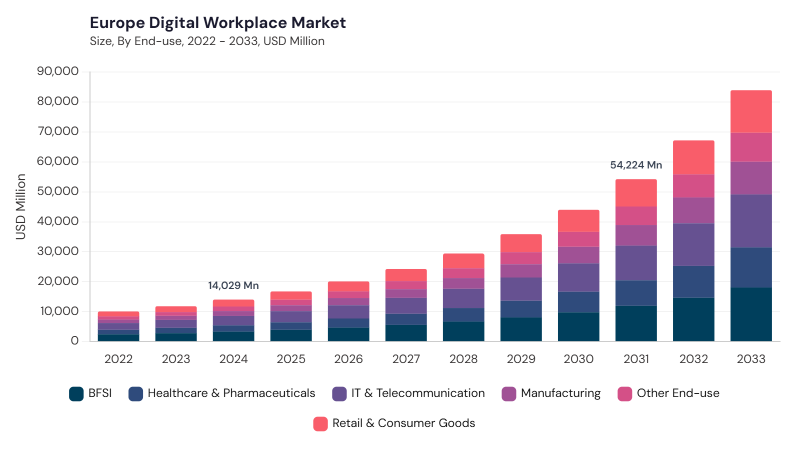
The Europe Digital Workplace Market developed from early enterprise digitization efforts focused on email, intranets, document sharing, and basic communication systems. As cloud computing, mobile access, unified communications, and collaboration platforms matured, organizations began replacing fragmented workplace tools with connected digital ecosystems. The market gained momentum as enterprises adopted secure remote access, workflow automation, real-time collaboration, and cloud-native applications to support distributed workforces. Regulatory emphasis on data privacy, digital skills, and secure information handling also shaped adoption across European countries.
The Europe Digital Workplace Market is being shaped by hybrid work adoption, AI-driven personalization, automation, data privacy regulation, employee wellbeing, and digital transformation investments. Enterprises are deploying integrated collaboration suites, AI assistants, secure cloud platforms, employee experience tools, workflow automation, and analytics-driven workplace systems. Demand is supported by cross-border operations, multilingual workforces, GDPR compliance needs, digital sovereignty concerns, and the need to improve productivity across remote and office-based teams. Vendors are focusing on interoperability, privacy-by-design architectures, scalable cloud delivery, localized compliance, and user-centric design.
Based on Component, the market is segmented into Solutions and Services. The Solutions market dominated the Europe Digital Workplace Market by Component in 2025, and would continue to be a dominant market till 2033; thereby, achieving a market value of USD 34.6 billion by 2031, growing at a CAGR of 22.2 % during the forecast period. Additionally, The Services market is expected to witness highest CAGR of 23.5% during (2026 - 2033).
Solutions lead due to strong adoption of cloud collaboration suites, unified communication platforms, enterprise content management, digital employee experience tools, productivity applications, and AI-powered workplace software. These solutions help organizations manage hybrid work, secure communication, task automation, knowledge sharing, and employee engagement across diverse business environments. Services remain important as enterprises require consulting, integration, migration, training, change management, managed services, and technical support to deploy workplace technologies effectively. Service demand is also supported by GDPR compliance configuration, cybersecurity advisory, legacy system integration, AI enablement, and continuous optimization of digital workplace ecosystems.
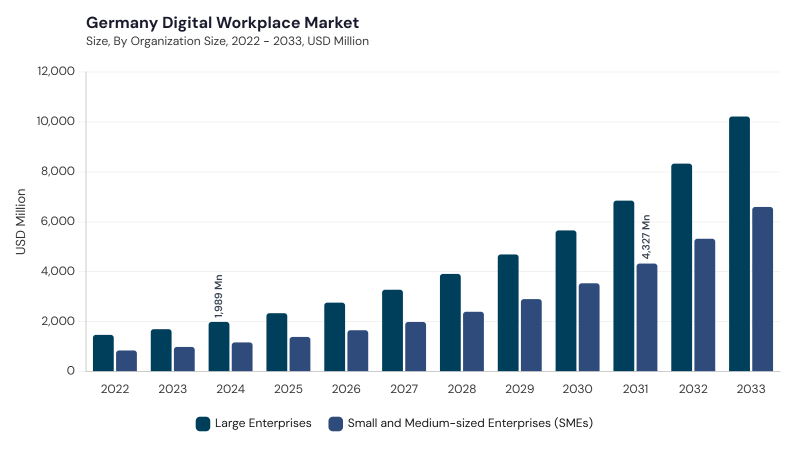
Based on Organization Size, the market is segmented into Large Enterprises and Small and Medium-sized Enterprises (SMEs). The Large Enterprises market dominated the Europe Digital Workplace Market by Organization Size in 2025, and would continue to be a dominant market till 2033; thereby, achieving a market value of USD 33.5 billion by 2031, growing at a CAGR of 22.2 % during the forecast period. Additionally, The Small and Medium-sized Enterprises (SMEs) market is expected to witness highest CAGR of 23.4% during (2026 - 2033).
Large Enterprises lead due to multinational operations, distributed teams, larger digital transformation budgets, complex compliance obligations, and strong demand for secure cloud-based collaboration. These organizations deploy digital workplace platforms to support cross-border communication, workflow automation, employee analytics, AI-driven productivity, and integration with ERP, CRM, HRMS, and identity systems. SMEs are increasingly adopting digital workplace solutions through SaaS pricing, cloud-based delivery, government-backed digitalization programs, and simplified collaboration tools. SME adoption is supported by the need to improve business continuity, reduce technology complexity, support flexible working, and strengthen productivity with limited internal IT resources.
Based on End-use, the market is segmented into BFSI, IT & Telecommunication, Retail & Consumer Goods, Healthcare & Pharmaceuticals, Manufacturing, and Other End-use. BFSI leads due to digital banking expansion, secure collaboration needs, audit-ready workflows, compliance management, identity governance, and protection of sensitive financial information. IT & Telecommunication follows due to cloud-native operations, DevOps collaboration, agile software development, network management, and strong adoption of AI-enabled productivity platforms.
Retail & Consumer Goods uses digital workplace tools for omnichannel coordination, mobile workforce communication, supply chain collaboration, and frontline employee engagement. Healthcare & Pharmaceuticals, Manufacturing, and Other End-use areas add demand through secure clinical collaboration, telehealth support, smart factory workflows, engineering coordination, public administration, education, legal services, and professional consulting operations.
Free Valuable Insights: The Worldwide Digital Workplace Market is projected to reach USD 306.8 Billion billion by 2033, at a CAGR of 23.1%
Based on Country, the market is segmented into Germany, UK, France, Russia, Spain, Italy, and Rest of Europe. The Germany market dominated the Europe Digital Workplace Market by Country in 2025, and would continue to be a dominant market till 2033; thereby, achieving a market value of USD 11.2 billion by 2031, growing at a CAGR of 21 % during the forecast period. The UK market is expected to witness a CAGR of 21.6% during (2026 - 2033). Additionally, The France market is expected to witness a CAGR of 23.4% during (2026 - 2033).
Germany leads due to strong enterprise digitization, Industry 4.0 alignment, secure workplace adoption, strict labor and data protection expectations, and demand for interoperable collaboration platforms. The UK supports market growth through AI-enabled workplace tools, hybrid work maturity, employee experience platforms, cybersecurity-focused digital workplaces, and strong cloud adoption. France contributes through secure digital infrastructure, AI automation, data privacy compliance, language-localized platforms, and strong demand for flexible workplace ecosystems. Russia, Spain, and Italy add demand through localization, AI adoption, hybrid work models, cybersecurity investment, and cloud workplace modernization, while Rest of Europe benefits from digital skills programs, remote work enablement, and growing employee wellbeing priorities.

By Component
By Organization Size
By End-use
By Country
Set to reach $54.2 Billion by 2031, growing at 22.7% CAGR during 2026-2033.
Germany leads with a market value of USD 11.2 billion by 2031, growing at 21% CAGR during the forecast period.
Rising demand for solutions, projected to reach USD 34.6 billion by 2031, is a key growth driver.
The services segment is expected to witness the highest CAGR of 23.5% during 2026-2033.
The UK market is expected to witness a CAGR of 21.6% during 2026-2033.
The SME segment is expected to witness a CAGR of 23.4% during 2026-2033.
Our team of dedicated experts can provide you with attractive expansion opportunities for your business.




 Unique Offerings