The sample copy of this report is available for access.
The LAMEA Digital Workplace Market is expected to reach USD 12.2 billion by 2029, growing at a CAGR of 25% during (2026 – 2033).
The LAMEA Digital Workplace Market developed as organizations across Latin America, the Middle East, and Africa began adopting digital tools to improve productivity across dispersed and multilingual workforces. Early adoption centered on basic communication platforms, email systems, intranets, and localized collaboration tools that helped businesses overcome geographic barriers. Over time, broadband expansion, cloud computing, mobile technologies, unified communications, and document management platforms shifted the market toward more integrated digital ecosystems. The rise of cloud services enabled scalable and cost-effective workplace modernization across organizations with different maturity levels.
The LAMEA Digital Workplace Market is being shaped by hybrid work adoption, AI-powered automation, cybersecurity needs, workforce upskilling, cloud migration, and localized digital transformation programs. Organizations are deploying collaboration platforms, secure remote access, workflow automation, cloud productivity suites, employee experience tools, and digital analytics to improve agility and productivity. Demand is supported by public-sector modernization, fintech expansion, telecom infrastructure growth, healthcare digitization, and enterprise mobility across emerging economies. Vendors are focusing on multilingual capabilities, local compliance, mobile-first design, scalable SaaS delivery, and stronger security frameworks.
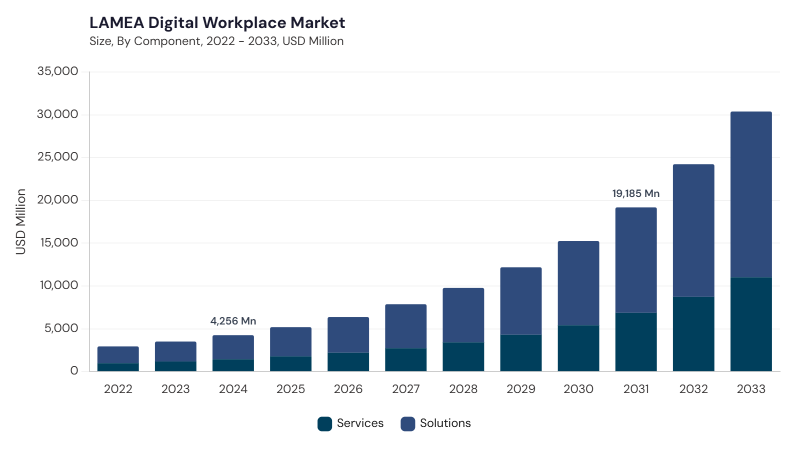
Based on Component, the market is segmented into Solutions and Services. The Solutions market dominated the LAMEA Digital Workplace Market by Component in 2025, and would continue to be a dominant market till 2033; thereby, achieving a market value of USD 7.9 billion by 2029, growing at a CAGR of 24.5 % during the forecast period. Additionally, The Services market is expected to witness highest CAGR of 25.9% during (2026 - 2033).
Solutions lead due to rising adoption of cloud collaboration platforms, enterprise communication suites, document management systems, virtual desktop tools, workflow automation, and AI-enabled productivity applications. These solutions help organizations support remote work, hybrid operations, real-time collaboration, secure information sharing, and digital workforce engagement. Services remain important as enterprises require consulting, implementation, integration, managed support, workforce training, and change management to maximize the value of digital workplace investments. Service demand is also supported by uneven IT maturity, cybersecurity requirements, legacy migration, localization needs, and ongoing support for cloud-based workplace ecosystems.
Based on Organization Size, the market is segmented into Large Enterprises and Small and Medium-sized Enterprises (SMEs). The Large Enterprises market dominated the LAMEA Digital Workplace Market by Organization Size in 2025, and would continue to be a dominant market till 2033; thereby, achieving a market value of USD 7.6 billion by 2029, growing at a CAGR of 24.5 % during the forecast period. Additionally, The Small and Medium-sized Enterprises (SMEs) market is expected to witness highest CAGR of 25.8% during (2026 - 2033).
Large Enterprises lead due to higher investments in cloud infrastructure, cybersecurity, enterprise communication platforms, AI-enabled workplace systems, and distributed workforce management. These organizations use digital workplace solutions to support complex operations, secure collaboration, compliance, workflow automation, employee analytics, and integration with enterprise applications across multiple locations. SMEs are adopting digital workplace platforms through affordable SaaS subscriptions, improving internet accessibility, mobile-first tools, and national digital transformation initiatives. Their demand is supported by remote collaboration needs, document sharing, customer communication, basic automation, cost control, and the need to remain competitive with limited IT resources.
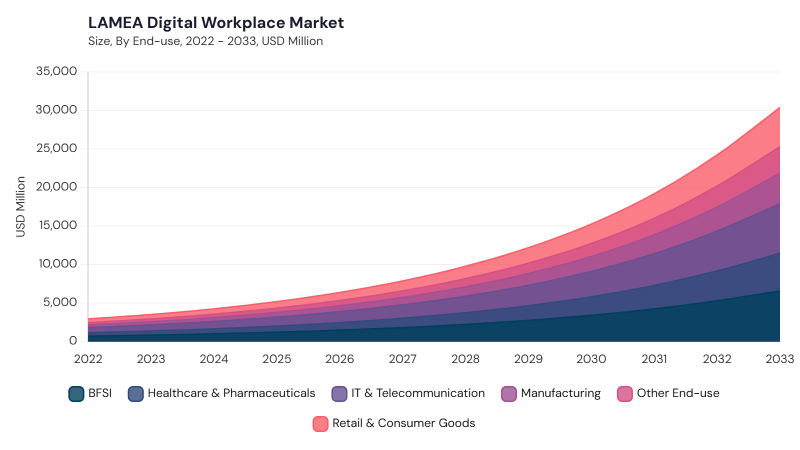
Based on End-use, the market is segmented into BFSI, IT & Telecommunication, Retail & Consumer Goods, Healthcare & Pharmaceuticals, Manufacturing, and Other End-use. BFSI leads due to digital banking growth, fintech expansion, secure collaboration, regulatory compliance, customer data protection, and remote financial service delivery. IT & Telecommunication follows due to broadband expansion, cloud service growth, network operations, software delivery, and the need for connected teams across geographically distributed locations.
Retail & Consumer Goods uses digital workplace tools for e-commerce coordination, omnichannel operations, workforce communication, logistics visibility, and customer engagement. Healthcare & Pharmaceuticals, Manufacturing, and Other End-use areas add demand through telemedicine, clinical collaboration, connected production, industrial coordination, education, public administration, hospitality, professional services, and energy-sector digital workflows.
Free Valuable Insights: Digital Workplace Market Size Worth USD 306.8 Billion billion by 2033
Based on Country, the market is segmented into Brazil, Argentina, UAE, Saudi Arabia, South Africa, Nigeria, and Rest of LAMEA. The Brazil market dominated the LAMEA Digital Workplace Market by Country in 2025, and would continue to be a dominant market till 2033; thereby, achieving a market value of USD 3.1 billion by 2029, growing at a CAGR of 23.4 % during the forecast period. The Argentina market is expected to witness a CAGR of 25.8% during (2026 - 2033). Additionally, The UAE market is expected to witness a CAGR of 23.9% during (2026 - 2033).
Brazil leads due to hybrid work adoption, cloud collaboration, AI readiness, cybersecurity investment, and rising demand for localized workplace solutions across finance, telecom, and enterprise sectors. Argentina supports market growth through cloud-based collaboration, workforce-centric platforms, AI automation, localized compliance, and hybrid work enablement. The UAE contributes through smart government programs, cloud-native workplace modernization, AI adoption, cybersecurity frameworks, and advanced digital infrastructure. Saudi Arabia, South Africa, and Nigeria add momentum through national digital strategies, mobile-first platforms, workforce upskilling, fintech growth, cloud adoption, and secure collaboration needs, while Rest of LAMEA benefits from digital inclusion, remote work expansion, and localized workplace modernization.

By Component
By Organization Size
By End-use
By Country
Set to reach $12.2 Billion by 2029, growing at 25% CAGR during 2026–2033.
Brazil leads with a market value of USD 3.1 billion by 2029, growing at a 23.4% CAGR during the forecast period.
Rising enterprise cloud adoption and AI-driven workloads are the main catalysts.
Solutions segment to reach USD 7.9 billion by 2029, growing at a 24.5% CAGR during the forecast period.
The UAE market is expected to witness a CAGR of 23.9% during 2026–2033.
Large Enterprises segment to reach USD 7.6 billion by 2029, growing at a 24.5% CAGR during the forecast period.
Our team of dedicated experts can provide you with attractive expansion opportunities for your business.




 Unique Offerings