The sample copy of this report is available for access.
The North America Cognitive Collaboration Market is expected to reach USD 25.1 billion by 2032, growing at a CAGR of 21.2% during (2026 - 2033).
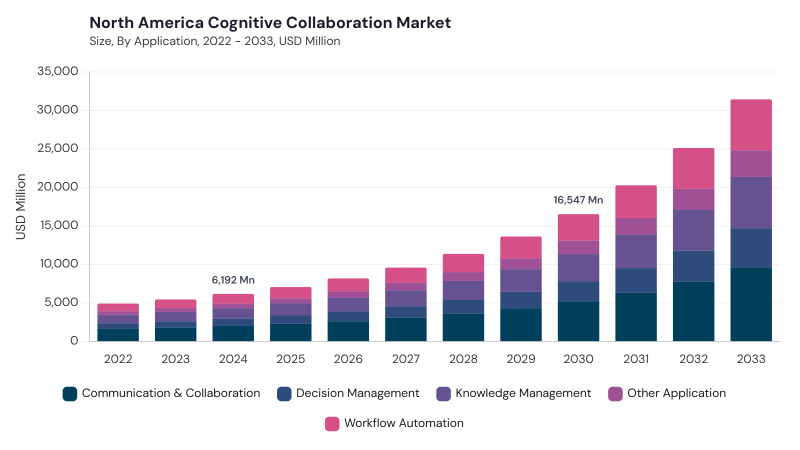
The North America Cognitive Collaboration Market evolved from basic AI-enabled communication, chatbots, virtual assistants, and workflow automation into integrated platforms capable of supporting context-aware interaction, intelligent knowledge sharing, and real-time decision support. Progress in natural language processing, machine learning, cloud computing, and cognitive analytics expanded these solutions beyond isolated automation use cases. Widespread cloud adoption and AI-as-a-Service models improved scalability and accessibility, while enterprise demand for hybrid work capabilities accelerated mainstream adoption. Current development increasingly emphasizes generative AI, adaptive user experiences, intelligent automation, secure collaboration, interoperability, and deeper integration of cognitive capabilities into enterprise workflows.
AI-driven workflow automation, hybrid work, personalized collaboration, and stronger security governance are shaping current market development. Enterprises increasingly use cognitive collaboration platforms for intelligent messaging, automated meeting summaries, contextual search, predictive recommendations, sentiment analysis, task management, and real-time knowledge access. Cloud-native architectures, advanced analytics, AI copilots, edge computing, and scalable integration frameworks are improving platform capability and responsiveness. At the same time, organizations are placing greater emphasis on responsible AI, data privacy, interoperability, and regulatory compliance. High implementation costs, integration complexity, fragmented technical standards, security concerns, and budget limitations continue to influence enterprise deployment decisions.
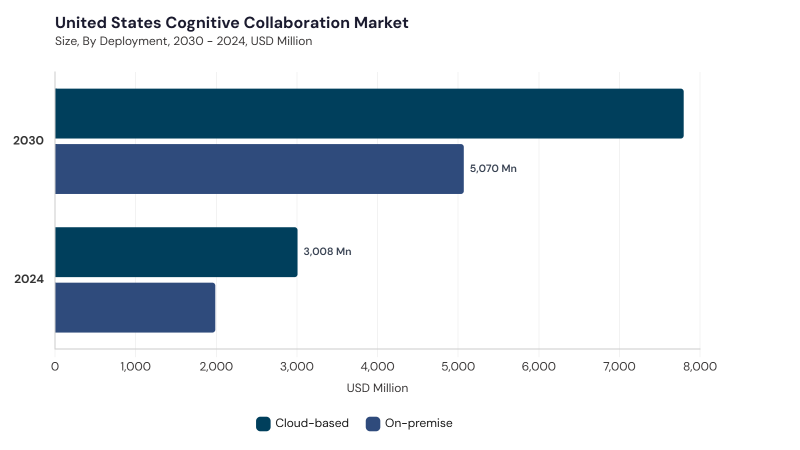
Based on Deployment, the market is segmented into Cloud-based and On-premise. The Cloud-based market dominated the North America Cognitive Collaboration Market by Deployment in 2025, and would continue to be a dominant market till 2033; thereby, achieving a market value of USD 15.2 billion by 2032, growing at a CAGR of 21.3 % during the forecast period. The On-premise market is expected to witness a CAGR of 21% during (2026 - 2033).
Cloud-based deployment supports rapid implementation, remote accessibility, continuous feature updates, scalable computing resources, and integration of conversational AI, intelligent search, virtual assistants, and automated collaboration capabilities. It is particularly suited to organizations prioritizing agility, lower infrastructure management, and distributed access. On-premise deployment remains relevant among organizations requiring greater control over sensitive data, internal infrastructure, security policies, and legacy system integration. Government, healthcare, defense, and other regulated environments continue to sustain selective demand for locally controlled cognitive collaboration systems.
Based on Component, the market is segmented into Solutions and Services. The Solutions market dominated the North America Cognitive Collaboration Market by Component in 2025, and would continue to be a dominant market till 2033; thereby, achieving a market value of USD 16.5 billion by 2032, growing at a CAGR of 21 % during the forecast period. The Services market is expected to witness a CAGR of 21.6% during (2026 - 2033).
Solutions include AI-enabled communication tools, intelligent meeting platforms, natural language processing applications, speech recognition, virtual assistants, knowledge systems, and other cognitive workplace technologies that support productivity and decision-making. Services include consulting, implementation, integration, customization, training, technical support, and optimization required to align cognitive collaboration platforms with enterprise environments. Increasing platform complexity, security requirements, hybrid infrastructure, and organizational change management continue to strengthen demand for specialized service capabilities alongside software deployment.
Based on Application, the market is segmented into Communication & Collaboration, Knowledge Management, Workflow Automation, Decision Management, and Other Application. Communication & Collaboration includes intelligent messaging, virtual assistants, transcription, translation, automated meeting summaries, and context-aware coordination tools. Knowledge Management focuses on semantic search, content classification, expertise identification, and organizational knowledge retrieval, while Workflow Automation applies AI to task orchestration, repetitive process automation, and cross-functional coordination.
Decision Management uses cognitive analytics, predictive insights, scenario modeling, and recommendation engines to support business decisions. Other Application includes emerging uses such as AI-enabled compliance monitoring, cognitive security collaboration, and specialized departmental workflows.
Based on End User, the market is segmented into IT and Telecom, BFSI, Retail, Manufacturing, Healthcare, and Other End User. IT and Telecom uses cognitive platforms for service desks, network operations, intelligent communication, workflow automation, and distributed team coordination. BFSI applies these tools across document processing, compliance, risk management, and secure collaboration, while Retail uses them for workforce coordination, customer engagement, omnichannel operations, and inventory-related decision support.
Manufacturing adoption centers on engineering collaboration, connected operations, predictive maintenance, and remote expertise. Healthcare uses secure cognitive tools for multidisciplinary coordination and digital workflows, while Other End User includes education, government, professional services, and related enterprise environments adopting AI-supported collaboration.
Free Valuable Insights: The Global Cognitive Collaboration Market will hit USD 86.3 Billion billion by 2033, at a CAGR of 21.8%
Based on Country, the market is segmented into US, Canada, Mexico, and Rest of North America. The US market dominated the North America Cognitive Collaboration Market by Country in 2025, and would continue to be a dominant market till 2033; thereby, achieving a market value of USD 19.2 billion by 2032, growing at a CAGR of 20.4 % during the forecast period. The Canada market is expected to witness a CAGR of 23.9% during (2026 - 2033). Additionally, The Mexico market is expected to witness a CAGR of 23.3% during (2026 - 2033).
Across North America, cognitive collaboration adoption is being shaped by generative AI, cloud migration, hybrid work, contextual intelligence, and stronger data governance requirements. The US emphasizes generative AI, adaptive learning, multimodal collaboration, automated knowledge synthesis, and responsible AI governance, while Canada focuses on human-AI collaboration, cloud-based platforms, real-time analytics, federated learning, and data-sovereignty requirements. Mexico is advancing scalable AI adoption, SME-focused collaboration, localized language capabilities, cloud integration, and enterprise automation, whereas Rest of North America increasingly emphasizes contextual analytics, interoperability, API-rich architectures, advanced security, edge computing, and platform flexibility tailored to local regulatory and operational requirements.

By Deployment
By Component
By Application
By End User
By Country
Set to reach $25.1 Billion by 2032, growing at 21.2% CAGR during 2026-2033.
The US leads with $19.2 billion by 2032, growing at 20.4% CAGR during the forecast period.
Rising enterprise cloud adoption and AI-driven workloads are the main catalysts.
Cloud-based segment hits $15.2 billion by 2032 at 21.3% CAGR during 2026-2033.
The Canada market is expected to witness a CAGR of 23.9% during 2026-2033.
Solutions segment achieves $16.5 billion by 2032, growing at 21% CAGR during the forecast period.
Our team of dedicated experts can provide you with attractive expansion opportunities for your business.




 Unique Offerings