The sample copy of this report is available for access.
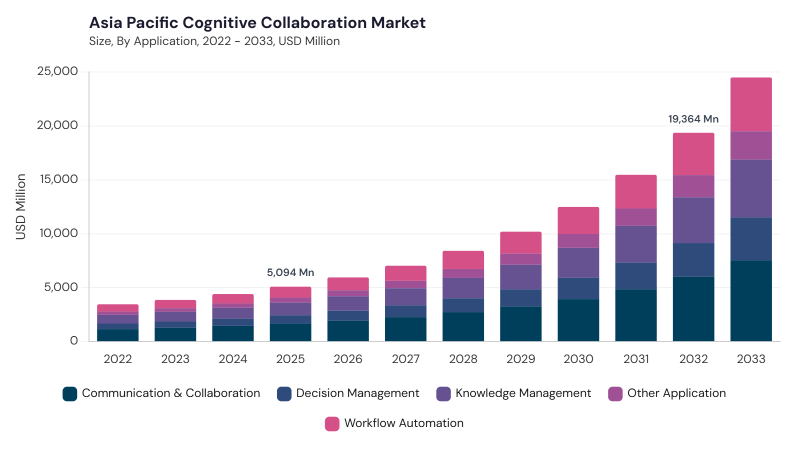
The Asia Pacific Cognitive Collaboration Market is expected to reach USD 12.4 billion by 2030, growing at a CAGR of 22.4% during (2026 - 2033).
The Asia Pacific Cognitive Collaboration Market evolved from basic AI-supported communication and workflow tools into integrated cognitive platforms capable of intelligent interaction, contextual analysis, automated knowledge sharing, and real-time decision support. Early adoption was concentrated in technology-intensive sectors such as manufacturing and financial services, while advances in natural language processing, machine learning, cloud computing, and AI-powered virtual assistants broadened enterprise use. Expanding cloud infrastructure and digital transformation accelerated the shift from isolated collaboration tools toward scalable cognitive ecosystems. Current development increasingly emphasizes multilingual intelligence, generative AI, AI-as-a-Service, localization, secure data exchange, predictive analytics, and seamless human-AI collaboration across diverse regional work environments.
Generative AI adoption, AI-as-a-Service, multilingual collaboration, regulatory compliance, and sector-specific cognitive platforms are shaping current market development. Enterprises are increasingly using intelligent conferencing, automated transcription, real-time translation, predictive analytics, enterprise search, AI assistants, and workflow automation to improve distributed teamwork and decision-making. Cloud-native architectures, edge computing, localization, and subscription-based models are expanding accessibility among both large enterprises and SMEs. At the same time, data privacy concerns, uneven infrastructure maturity, regulatory fragmentation, interoperability barriers, cybersecurity requirements, and differences in digital readiness continue to influence adoption across Asia Pacific markets.
Based on Deployment, the market is segmented into Cloud-based and On-premise. The Cloud-based market dominated the Asia Pacific Cognitive Collaboration Market by Deployment in 2025, and would continue to be a dominant market till 2033; thereby, achieving a market value of USD 7.6 billion by 2030, growing at a CAGR of 22.5 % during the forecast period. The On-premise market is expected to witness a CAGR of 22.2% during (2026 - 2033).
Cloud-based deployment provides flexible access, rapid scalability, continuous software updates, and easier integration of generative AI, virtual assistants, automated content discovery, and multilingual collaboration capabilities. It is particularly relevant to organizations pursuing hybrid work and lower infrastructure requirements. On-premise deployment remains important among government agencies, healthcare organizations, financial institutions, and infrastructure-intensive enterprises requiring tighter control over sensitive information, cybersecurity, and data residency. Virtualization, containerization, hybrid-cloud integration, and localized infrastructure are improving on-premise flexibility while preserving governance and legacy-system compatibility.
Based on Component, the market is segmented into Solutions and Services. The Solutions market dominated the Asia Pacific Cognitive Collaboration Market by Component in 2025, and would continue to be a dominant market till 2033; thereby, achieving a market value of USD 8.2 billion by 2030, growing at a CAGR of 22.2 % during the forecast period. The Services market is expected to witness a CAGR of 22.8% during (2026 - 2033).
Solutions include cognitive communication tools, enterprise search, virtual assistants, contextual analytics, intelligent meeting platforms, and integrated collaboration suites that support real-time knowledge exchange and automated workflows. Services include consulting, implementation, migration, integration, training, maintenance, AI governance, and technical support required to deploy and optimize these platforms. Uneven digital maturity, diverse regulatory environments, legacy infrastructure, and localization requirements are strengthening demand for specialized service providers capable of supporting enterprise transformation across multiple Asia Pacific markets.
Based on Application, the market is segmented into Communication & Collaboration, Knowledge Management, Workflow Automation, Decision Management, and Other Application. Communication & Collaboration includes AI-enhanced meetings, virtual assistants, intelligent messaging, real-time translation, transcription, and context-aware communication tools. Knowledge Management focuses on semantic search, document classification, knowledge retrieval, automated summarization, and institutional information access.
Workflow Automation applies AI to task orchestration, intelligent approvals, workload balancing, and process coordination, while Decision Management uses predictive analytics, scenario modeling, and machine-generated insights to improve operational and strategic decisions. Other Application includes emerging uses such as cognitive security, innovation management, customer experience collaboration, and specialized industry workflows.
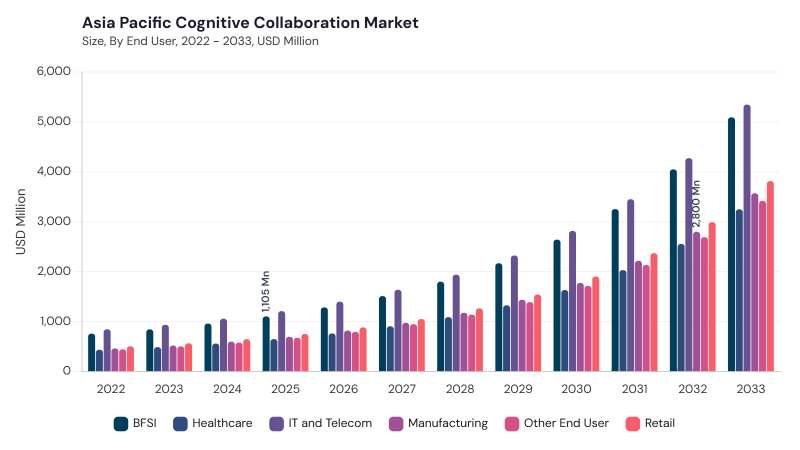
Based on End User, the market is segmented into IT and Telecom, BFSI, Retail, Manufacturing, Healthcare, and Other End User. IT and Telecom uses cognitive collaboration for network management, customer support, software development, and distributed workforce coordination. BFSI applies these platforms to risk assessment, fraud detection, customer advisory, secure data exchange, and compliance workflows, while Retail uses them for omnichannel coordination, customer engagement, inventory management, and supply-chain responsiveness.
Manufacturing combines cognitive tools with smart factories, IoT, predictive maintenance, and cross-functional production collaboration. Healthcare increasingly uses secure cognitive platforms for clinical communication, patient coordination, and digital workflows, while Other End User includes education, government, professional services, and other organizations adopting AI-supported collaboration.
Free Valuable Insights: Cognitive Collaboration Market is Predicted to reach USD 86.3 Billion billion by 2033, at a CAGR of 21.8%
Based on Country, the market is segmented into China, Japan, India, South Korea, Singapore, Malaysia, and Rest of Asia Pacific. The China market dominated the Asia Pacific Cognitive Collaboration Market by Country in 2025, and would continue to be a dominant market till 2033; thereby, achieving a market value of USD 3.5 billion by 2030, growing at a CAGR of 20.3 % during the forecast period. The Japan market is expected to witness a CAGR of 21.8% during (2026 - 2033). Additionally, The India market is expected to witness a CAGR of 23.1% during (2026 - 2033).
Across Asia Pacific, cognitive collaboration adoption is being shaped by localization, cloud infrastructure, AI governance, human-AI integration, and multilingual enterprise requirements. China emphasizes localized AI models, cloud integration, data security, and adaptive cognitive platforms, while Japan focuses on context-aware AI, cybersecurity, IoT integration, and language-specific intelligence. India is advancing multilingual collaboration, enterprise-system integration, AI automation, and wider adoption beyond metropolitan markets, whereas South Korea emphasizes AI-powered knowledge management, cloud-based collaboration, international innovation networks, and domain-specific cognitive tools. Singapore focuses on generative AI, hybrid work, intelligent meetings, responsible AI governance, and secure regional collaboration, while Malaysia emphasizes human-centric AI, workforce upskilling, contextual intelligence, generative AI, and localized enterprise adoption. Rest of Asia Pacific continues to develop multilingual AI, ethical governance, cloud-based collaboration, enterprise integration, localized solutions, and scalable cognitive platforms suited to varied infrastructure and business environments.

By Deployment
By Component
By Application
By End User
By Country
Set to reach $12.4 Billion by 2030, growing at 22.4% CAGR during 2026-2033.
China leads with a market value of USD 3.5 billion by 2030, growing at a CAGR of 20.3% during 2026-2033.
Rising adoption of cloud-based solutions, projected to reach USD 7.6 billion by 2030 at a 22.5% CAGR during 2026-2033.
Solutions segment expected to achieve USD 8.2 billion by 2030, growing at a CAGR of 22.2% during 2026-2033.
India market expected to witness a CAGR of 23.1% during 2026-2033.
Services segment expected to grow at a CAGR of 22.8% during 2026-2033.
Our team of dedicated experts can provide you with attractive expansion opportunities for your business.




 Unique Offerings