The sample copy of this report is available for access.
The LAMEA Cognitive Collaboration Market is expected to reach USD 2847.7 million by 2029, growing at a CAGR of 23.9% during (2026 - 2033).
The LAMEA Cognitive Collaboration Market evolved from early AI-enabled communication and decision-support initiatives into integrated cognitive environments that combine machine intelligence with human expertise. Advances in artificial intelligence, natural language processing, machine learning, spatial computing, cloud infrastructure, and adaptive analytics broadened the scope of collaboration beyond basic communication. Increasing regional demand for multilingual, culturally relevant, and scalable platforms further accelerated adoption across enterprises and institutions. Current development increasingly emphasizes hybrid human-AI workflows, immersive collaboration, localized cognitive models, edge-enabled processing, workforce training, and intelligent platforms capable of supporting cross-border teams operating across diverse infrastructure and socio-economic environments.
Human-AI collaboration, spatial computing, localization, digital ecosystems, and workforce development are shaping current market development. Enterprises are increasingly adopting intelligent conferencing, multilingual communication, virtual assistants, cognitive analytics, automated workflows, real-time knowledge sharing, and adaptive decision-support systems. Cloud-based architectures, edge computing, immersive technologies, and personalized AI models are improving accessibility and scalability across varied regional environments. At the same time, organizations continue to address high implementation costs, infrastructure limitations, integration complexity, regulatory fragmentation, cybersecurity requirements, data residency concerns, and uneven digital maturity across Latin America, the Middle East, and Africa.
Based on Deployment, the market is segmented into Cloud-based and On-premise. The Cloud-based market dominated the LAMEA Cognitive Collaboration Market by Deployment in 2025, and would continue to be a dominant market till 2033; thereby, achieving a market value of USD 1751.0 million by 2029, growing at a CAGR of 24.1 % during the forecast period. The On-premise market is expected to witness a CAGR of 23.7% during (2026 - 2033).
Cloud-based deployment enables scalable access to virtual assistants, intelligent search, cognitive analytics, conferencing, and collaborative AI capabilities while reducing dependence on extensive local infrastructure. It is particularly relevant for SMEs, startups, telecommunications firms, and digitally transforming enterprises requiring flexible deployment. On-premise deployment remains important among government organizations, financial institutions, healthcare providers, and large enterprises requiring greater control over sensitive data, infrastructure, and compliance. Data residency requirements, cybersecurity concerns, legacy environments, and uneven connectivity continue to sustain selective adoption of internally hosted cognitive collaboration systems.
Based on Component, the market is segmented into Solutions and Services. The Solutions market dominated the LAMEA Cognitive Collaboration Market by Component in 2025, and would continue to be a dominant market till 2033; thereby, achieving a market value of USD 1911.3 million by 2029, growing at a CAGR of 23.7 % during the forecast period. The Services market is expected to witness a CAGR of 24.4% during (2026 - 2033).
Solutions include cognitive communication platforms, natural language processing tools, machine learning frameworks, virtual assistants, contextual analytics, intelligent search, and workflow technologies that enhance collaboration and decision-making. Services include consulting, implementation, integration, customization, training, managed support, and performance optimization required to adapt cognitive platforms to enterprise environments. Diverse digital maturity levels, localized compliance requirements, integration complexity, talent gaps, and the need for workforce enablement continue to strengthen demand for specialized services across LAMEA.
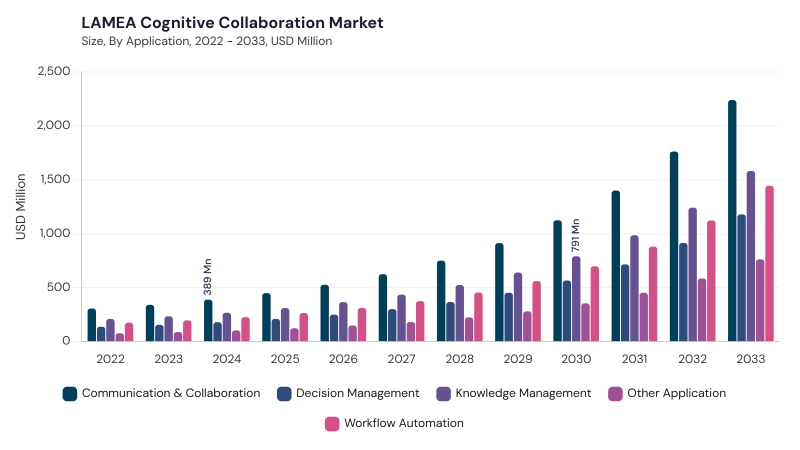
Based on Application, the market is segmented into Communication & Collaboration, Knowledge Management, Workflow Automation, Decision Management, and Other Application. Communication & Collaboration includes intelligent messaging, virtual meetings, real-time translation, AI assistants, transcription, and multimodal communication tools. Knowledge Management focuses on semantic search, contextual information retrieval, cognitive indexing, and institutional knowledge sharing, while Workflow Automation applies AI to task orchestration, administrative processes, intelligent routing, and operational coordination.
Decision Management supports predictive analytics, risk modeling, recommendations, and context-aware decision support. Other Application includes emerging areas such as spatial collaboration, cognitive robotics, sentiment analysis, immersive training, entrepreneurship support, and specialized industry workflows.
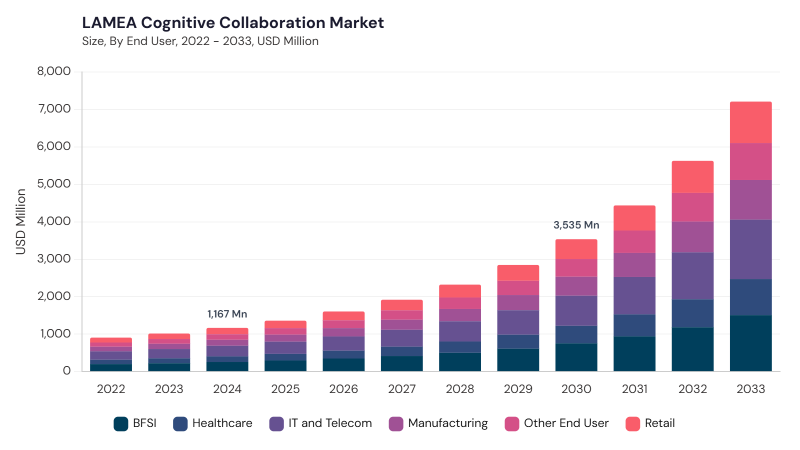
Based on End User, the market is segmented into IT and Telecom, BFSI, Retail, Manufacturing, Healthcare, and Other End User. IT and Telecom uses cognitive collaboration for network management, customer support, intelligent communication, and automated service delivery. BFSI applies these platforms across fraud detection, compliance monitoring, customer advisory, secure data exchange, and risk-related workflows, while Retail uses them for customer engagement, supply-chain coordination, omnichannel operations, and inventory planning.
Manufacturing adoption focuses on Industry 4.0, predictive maintenance, digital twins, production coordination, and human-machine interaction. Healthcare applies cognitive tools to clinical decision support, patient coordination, telemedicine, and secure information sharing, while Other End User includes government, education, energy, professional services, and SMEs adopting AI-enabled collaboration.
Free Valuable Insights: Cognitive Collaboration Market Size Worth USD 86.3 Billion billion by 2033
Based on Country, the market is segmented into Brazil, Argentina, UAE, Saudi Arabia, South Africa, Nigeria, and Rest of LAMEA. The Brazil market dominated the LAMEA Cognitive Collaboration Market by Country in 2025, and would continue to be a dominant market till 2033; thereby, achieving a market value of USD 728.6 million by 2029, growing at a CAGR of 22.4 % during the forecast period. The Argentina market is expected to witness a CAGR of 24.8% during (2026 - 2033). Additionally, The UAE market is expected to witness a CAGR of 22.9% during (2026 - 2033).
Across LAMEA, cognitive collaboration adoption is being shaped by localization, human-AI integration, cloud transformation, regulatory compliance, and infrastructure modernization. Brazil emphasizes hybrid work, localized cognitive platforms, cross-sector integration, cloud adoption, and user-centric AI, while Argentina focuses on intelligent assistants, explainable AI, Spanish-language adaptation, secure collaboration, and remote work. The UAE emphasizes sovereign cloud environments, advanced analytics, AI governance, localized platforms, and national digital transformation, whereas Saudi Arabia focuses on Arabic-language AI, ethical governance, cloud-based collaboration, national digital initiatives, and intelligent advisory platforms. South Africa is advancing multilingual AI, education-oriented collaboration, ethical AI, cloud infrastructure, and inclusive digital transformation, while Nigeria emphasizes localized language models, virtual assistants, mobile-enabled collaboration, cybersecurity, and edge computing. Rest of LAMEA continues to develop intelligent automation, contextual analytics, cloud and mobile collaboration, localized data governance, and scalable cognitive platforms suited to diverse operational environments.

By Deployment
By Component
By Application
By End User
By Country
Set to reach $2847.7 Million by 2029, growing at 23.9% CAGR during 2026-2033.
Brazil leads with $728.6 million by 2029, growing at a 22.4% CAGR during 2026-2033.
Rising adoption of cloud-based solutions, projected to reach $1751.0 million by 2029 at 24.1% CAGR during 2026-2033.
Solutions segment hits $1911.3 million by 2029, growing at 23.7% CAGR during 2026-2033.
The UAE market is expected to witness a 22.9% CAGR during 2026-2033.
Services segment is expected to witness a 24.4% CAGR during 2026-2033.
Our team of dedicated experts can provide you with attractive expansion opportunities for your business.




 Unique Offerings