The North America Coffee Roaster Market is expected to reach USD 787.6 million by 2032, growing at a CAGR of 7% during (2026 - 2033).
The North America Coffee Roaster Market evolved alongside the expansion of specialty coffee culture, progressing from small-scale artisanal operations and manually controlled roasting equipment toward digitally managed and highly precise production systems. Rising demand for consistent flavor, higher throughput, and differentiated roast profiles encouraged adoption of advanced temperature controls, automated airflow management, and data-supported roasting technologies. Growing interest in single-origin coffee, ethical sourcing, and premium consumption further transformed operating practices. Today, the market combines artisanal roasting expertise with automation, IoT-enabled monitoring, sustainable equipment, traceability, and flexible production systems designed for industrial, commercial, and residential users.
Sustainability, digital automation, specialty coffee premiumization, and supply chain transparency are increasingly influencing market development. Roasters are adopting AI-supported profiling, real-time monitoring, smart sensors, energy-efficient heating, heat recovery, and digital traceability to improve consistency and reduce operational waste. Rising demand for single-origin beans, customized roast profiles, ready-to-drink coffee, single-serve formats, and ethically sourced products is also encouraging equipment diversification. However, volatile green coffee prices, rising energy costs, stringent environmental compliance, high capital requirements, technology integration challenges, and international sourcing risks continue to affect operating economics and equipment investment decisions.
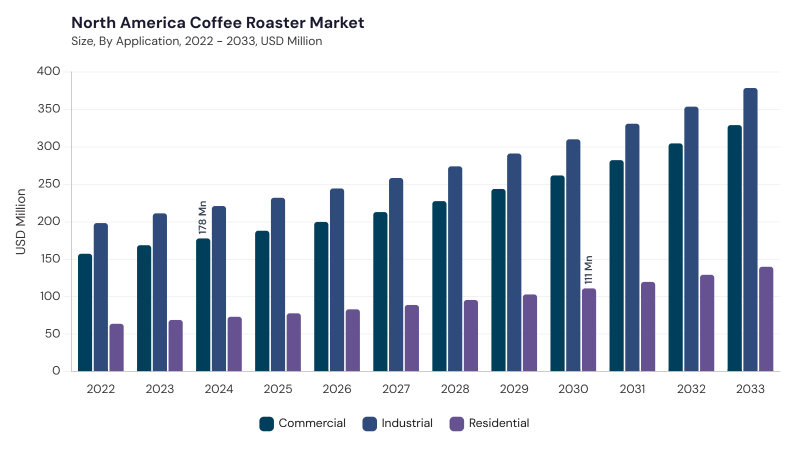
Based on Application, the market is segmented into Industrial, Commercial, and Residential. The Industrial market dominated the North America Coffee Roaster Market by Application in 2025, and would continue to be a dominant market till 2033; thereby, achieving a market value of USD 353.7 million by 2032, growing at a CAGR of 6.4 % during the forecast period. The Commercial market is expected to witness a CAGR of 7.4% during (2026 - 2033). Additionally, The Residential market is expected to witness highest CAGR of 7.7% during (2026 - 2033).
Industrial applications require high-throughput roasting systems equipped with automated controls, precision temperature management, data analytics, emissions management, and energy-efficient technologies. Commercial applications serve cafés, specialty coffee shops, restaurants, boutique roasters, and regional distributors requiring flexible equipment capable of producing differentiated roast profiles across smaller batches. Residential applications cater to home-roasting enthusiasts seeking compact equipment, simplified operation, customized roast settings, and greater control over freshness, increasingly supported by mobile applications and smart roasting functions.
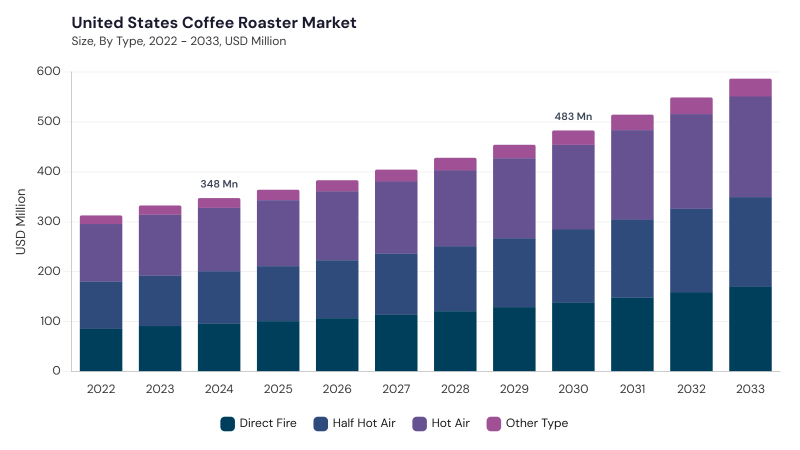
Based on Type, the market is segmented into Hot Air, Half Hot Air, Direct Fire, and Other Type. Hot Air roasters use convection-based heating to deliver consistent temperature distribution, minimize scorching, and support detailed control over roast curves. Half Hot Air systems combine convection and conductive heating, providing a balance between flavor control, roasting speed, and operational flexibility for expanding commercial roasters.
Direct Fire roasters remain relevant where faster roasting cycles, higher throughput, and traditional flavor development are prioritized. Other Type includes fluid-bed, infrared, electric, and hybrid roasting technologies that emphasize lower emissions, energy efficiency, roasting precision, and emerging sustainable operating models.
Free Valuable Insights: The Global Coffee Roaster Market will hit USD 2619.5 Million billion by 2033, at a CAGR of 7.6%
Based on Country, the market is segmented into US, Canada, Mexico, and Rest of North America. The US market dominated the North America Coffee Roaster Market by Country in 2025, and would continue to be a dominant market till 2033; thereby, achieving a market value of USD 549.0 million by 2032, growing at a CAGR of 6.3 % during the forecast period. The Canada market is expected to witness a CAGR of 9.3% during (2026 - 2033). Additionally, The Mexico market is expected to witness a CAGR of 8.1% during (2026 - 2033).
Across North America, coffee roasting development is being shaped by specialty consumption, automation, sustainability, supply chain transparency, and increasing demand for differentiated flavor profiles. The US emphasizes AI-supported roasting, digital quality control, climate-resilient sourcing, direct-to-consumer models, regional roasting facilities, and diversification into ready-to-drink and single-serve formats. Canada focuses on specialty and craft coffee, ethical sourcing, carbon-conscious roasting, traceability platforms, automated systems, and stronger relationships with coffee growers. Mexico combines its established coffee heritage with advanced roasting controls, direct-trade models, energy-efficient systems, specialty coffee development, and localized roast profiles. Rest of North America increasingly emphasizes sustainable sourcing, smart roasting technologies, direct trade, localized production, specialty coffee diversification, digital commerce, and flexible roasting systems tailored to regional consumer preferences.

By Application
By Type
By Country
Set to reach $787.6 Million by 2032, growing at 7% CAGR during 2026-2033.
The US leads with $549.0 million by 2032, growing at 6.3% CAGR during the forecast period.
The Industrial segment dominates, reaching $353.7 million by 2032 at 6.4% CAGR during 2026-2033.
The Residential market is expected to witness the highest CAGR of 7.7% during 2026-2033.
Canada's market is expected to grow at a CAGR of 9.3% during 2026-2033.
Our team of dedicated experts can provide you with attractive expansion opportunities for your business.




 Unique Offerings
