“Global Coffee Roaster Market to reach a market value of USD 2,619.55 Million by 2033 growing at a CAGR of 7.6%”
The Global Coffee Roaster Market is expected to reach USD 2619.5 million by 2033, growing at a CAGR of 7.6% during (2026 - 2033).

Growing coffee consumption, specialty coffee culture, and demand for freshly roasted premium coffee are driving the Coffee Roaster Market across cafés, restaurants, hotels, commercial roasteries, industrial processors, and household applications. Adoption is further strengthened by rising preference for flavor consistency, roast customization, energy efficiency, and greater control over coffee quality. Growth is also supported by automated roasting controls, precision temperature management, real-time roast monitoring, compact equipment designs, digitally connected systems, artisanal roasteries, micro-roasting businesses, and expanding home brewing trends.
Rising specialty coffee demand, café culture expansion, home roasting adoption, and the growing need for differentiated coffee profiles are strengthening market growth. Coffee roasters are increasingly investing in equipment that enables precise control over temperature, airflow, roast duration, batch consistency, and programmable profiles. The market is also benefiting from NIR sorting, smart modules, real-time quality monitoring, digital roast management, and automation that reduce human error and improve repeatability. At the same time, sustainability requirements are pushing manufacturers toward lower-emission burners, electric and hydrogen-compatible systems, heat recirculation, exhaust treatment, and digital traceability tools.
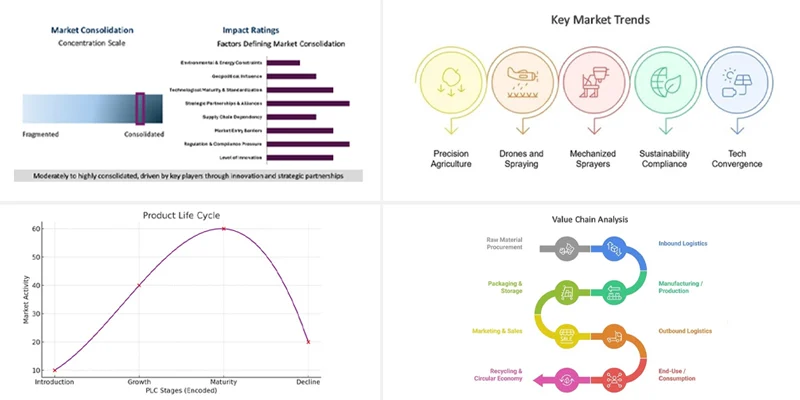
The competitive environment is engineering-driven and moderately fragmented, with global equipment manufacturers, complete plant-engineering providers, premium specialty-roaster manufacturers, and regional machinery suppliers competing across different capacity levels. PROBAT, Bühler, and Giesen hold strong positions through broad roasting portfolios, digital controls, automation, and international service networks. Loring, IMA Petroncini, NEUHAUS NEOTEC, Diedrich, IMF, Brambati, and Toper strengthen the market through energy-efficient roasting, hot-air systems, convection technologies, emissions management, integrated plant engineering, software compatibility, and specialty-to-industrial capacity coverage. Competition is increasingly shaped by energy efficiency, roast-profile precision, emissions control, automation, service support, and the ability to deliver consistent results across specialty, commercial, and industrial applications.


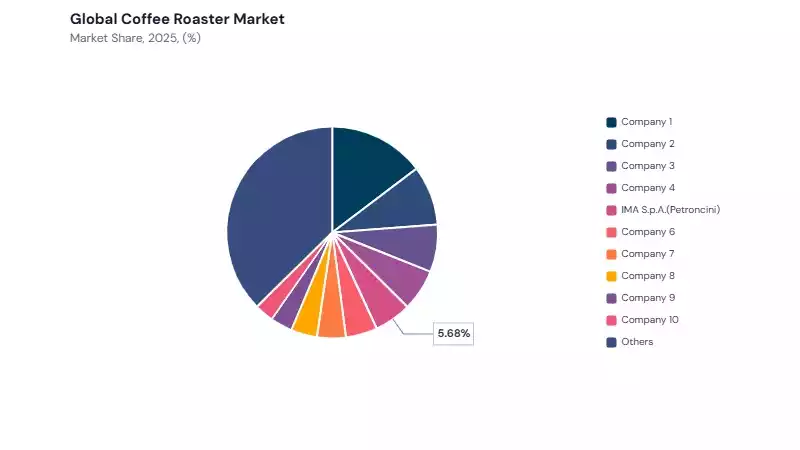
The global Coffee Roaster Market reflects a moderately fragmented and engineering-driven competitive landscape, with large industrial processing companies, premium specialty-roaster manufacturers, turnkey plant-engineering suppliers, and regional equipment providers competing across multiple capacity ranges. PROBAT SE leads the market through its specialty, commercial, and industrial roasting systems, supported by automation, process control, environmental technologies, and complete coffee-processing solutions. Bühler Group strengthens the industrial tier through RoastMaster systems, digital controls, plant engineering, and service infrastructure, while Giesen Coffee Roasters B.V. maintains a strong specialty and commercial position through precision roasting, flexible capacity options, and connected software. Loring Smart Roast, IMA Petroncini, NEUHAUS NEOTEC, Diedrich Roasters, IMF Roasters, Brambati, and Toper Roasters compete through energy efficiency, hot-air roasting, convection systems, emissions control, turnkey plants, software integration, and broad equipment capacity.
Based on Application, the market is segmented into Industrial, Commercial, and Residential. The Industrial market dominated the Global Coffee Roaster Market by Application in 2025, and would continue to be a dominant market till 2033; thereby, achieving a market value of USD 1175.5 million by 2033, growing at a CAGR of 7 % during the forecast period. The Commercial market is expected to witness a CAGR of 8% during (2026 - 2033). Additionally, The Residential market is expected to witness highest CAGR of 8.3% during (2026 - 2033).
Industrial applications remain the leading segment as large-scale coffee processors and roasting facilities require high-capacity equipment capable of consistent roasting, reliable throughput, repeatable profiles, and efficient production. These systems support wholesale supply, private-label coffee, large café chains, and industrial coffee manufacturing where process stability and scalability are essential. Commercial applications serve specialty cafés, boutique roasteries, restaurants, hotels, and mid-sized roasting businesses that prioritize flexibility, flavor development, small-batch capability, and product differentiation. Residential applications are expanding gradually as home brewing, DIY coffee culture, specialty bean access, and compact equipment designs encourage consumers to roast smaller batches at home.
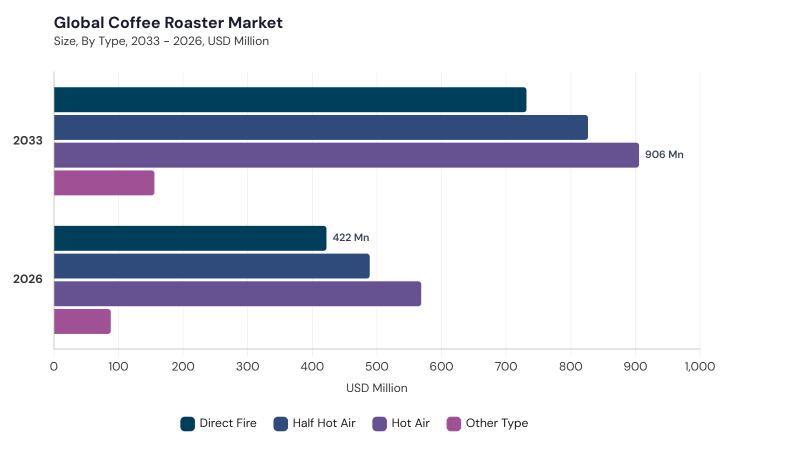
Based on Type, the market is segmented into Hot Air, Half Hot Air, Direct Fire, and Other Type. The Hot Air market dominated the Global Coffee Roaster Market by Type in 2025, and would continue to be a dominant market till 2033; thereby, achieving a market value of USD 905.7 million by 2033, growing at a CAGR of 6.9 % during the forecast period. The Half Hot Air market is expected to witness a CAGR of 7.8% during (2026 - 2033). Additionally, The Direct Fire market is expected to witness highest CAGR of 8.2% during (2026 - 2033).
Hot Air roasters remain the leading type because they provide controlled heat transfer, uniform roasting, precise temperature management, and strong suitability for specialty and commercial roasting environments. Half Hot Air roasters combine convection and conduction characteristics, offering versatility, balanced flavor development, and operational flexibility for mid-sized and specialty roasters. Direct Fire roasters remain important for traditional roasting approaches, faster heat transfer, darker roast profiles, and high-volume applications where throughput and robust flavor characteristics are prioritized. Other Type includes fluid bed, infrared, electric, vacuum, and emerging hybrid technologies that serve niche requirements around energy efficiency, experimentation, compact design, and differentiated roast outcomes.
Free Valuable Insights: Coffee Roaster Market Size to reach $2619.5 Million by 2033
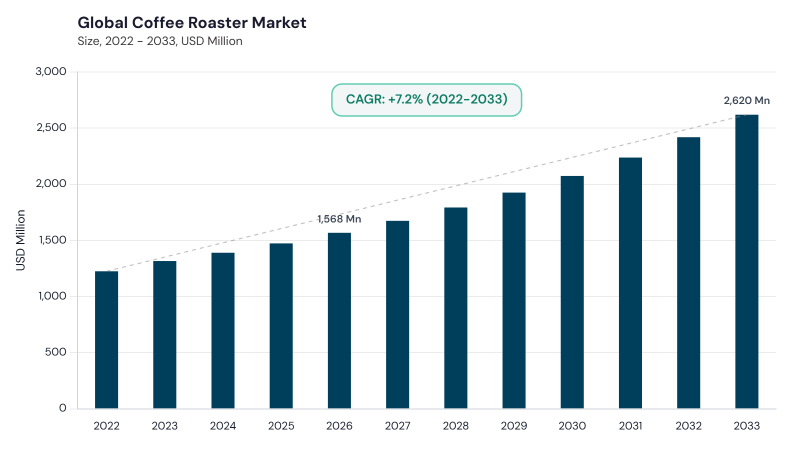
Region-wise, the Coffee Roaster Market is analyzed across North America, Europe, Asia Pacific, and LAMEA. The North America market dominated the Global Coffee Roaster Market by Region in 2025, and would continue to be a dominant market till 2033; thereby, achieving a market value of USD 847.7 million by 2033, growing at a CAGR of 7 % during the forecast period. The Asia Pacific market is expected to witness a CAGR of 8.2% during (2026 - 2033). Additionally, The Europe market is expected to witness a CAGR of 7.3% during (2026 - 2033).
North America remains the leading regional market, supported by specialty coffee consumption, independent roasteries, café penetration, home brewing interest, and adoption of automated and energy-efficient roasting technologies. Europe benefits from mature coffee culture, specialty roasting, strict sustainability expectations, EU deforestation-related traceability requirements, and strong demand for precision equipment across Germany, the UK, France, Spain, Italy, and other regional markets. Asia Pacific is expanding through rising urban coffee consumption, specialty café growth, RTD coffee demand, domestic roasting capacity, and increasing investment in automated roasting systems across China, Japan, India, South Korea, Singapore, and Malaysia. LAMEA is developing through coffee-producing economies, local roasting expansion, hospitality growth, value-added processing, and gradual adoption of efficient roasting technologies across Brazil, Argentina, UAE, Saudi Arabia, South Africa, Nigeria, and other emerging markets.
| Report Attribute | Details |
|---|---|
| Market size value in 2026 | USD 1567.6 million |
| Market size forecast in 2033 | USD 2619.5 million |
| Base Year | 2025 |
| Historical Period | 2022 to 2024 |
| Forecast Period | 2026 to 2033 |
| Revenue Growth Rate | CAGR of 7.6% from 2026 to 2033 |
| Number of Pages | 409 |
| Tables | 510 |
| Report Coverage | Market Trends, Revenue Estimation and Forecast, Segmentation Analysis, Regional and Country Breakdown, Competitive Landscape, Market Share Analysis, Company Profiling, Companies Strategic Developments, SWOT Analysis, Product Life Cycle Analysis, Value Chain Analysis, Market Consolidation Analysis, Key Customer Criteria, Pandemic Impact Analysis, and Winning Imperatives |
| Segments Covered | Application, Type, and Geography |
| Country Scope |
|
| Companies Included | PROBAT SE; Bühler Group; Giesen Coffee Roasters B.V.; Loring Smart Roast, Inc.; IMA S.p.A.; NEUHAUS NEOTEC; Diedrich Roasters LLC; IMF Roasters S.r.l.; Brambati S.p.A.; Toper Roasters |
By Application
By Type
By Geography
Expected to reach USD 2619.5 million by 2033, growing at 7.6% CAGR during the forecast period (2026-2033).
Asia Pacific is growing at a 13.1% CAGR during 2026-2033.
PROBAT SE, Bühler Group, Giesen Coffee Roasters B.V., Loring Smart Roast, Inc., IMA S.p.A., NEUHAUS NEOTEC, Diedrich Roasters LLC, IMF Roasters S.r.l., Brambati S.p.A., Toper Roasters.
Sustained surge in specialty coffee demand and integration of advanced sorting and automation enhance market dynamics.
The market is growing at 7.6% CAGR during the forecast period (2026-2033).
The market size is expected to reach USD 2619.5 million by 2033.
Our team of dedicated experts can provide you with attractive expansion opportunities for your business.






 Unique Offerings
