The Asia Pacific Coffee Roaster Market is expected to reach USD 572.2 million by 2030, growing at a CAGR of 8.2% during (2026 - 2033).
The Asia Pacific Coffee Roaster Market evolved from traditional and small-scale roasting practices into a sophisticated ecosystem combining industrial processing, specialty craftsmanship, and advanced roasting technologies. Mechanized equipment, programmable temperature controls, airflow management, and digital profiling progressively improved consistency, production capacity, and flavor differentiation. Expansion of specialty coffee culture across developed and emerging markets further encouraged adoption of precision roasting and quality-focused operating models. Current development increasingly integrates automation, IoT-enabled monitoring, traceability, energy-efficient technologies, sustainable sourcing, and localized roasting profiles suited to the region’s diverse consumer preferences.
Specialty coffee consumption, sustainability, digitalization, and ready-to-drink coffee expansion are shaping current market development. Roasters are increasingly adopting automated process controls, AI-supported profiling, smart sensors, real-time analytics, energy-efficient heating, waste minimization, and digital traceability to improve consistency and operational performance. Rising demand for single-origin coffee, customized roast profiles, ethical sourcing, home brewing, and convenient coffee formats is also encouraging equipment and product diversification. However, high equipment costs, regulatory differences, technical infrastructure limitations, volatile green coffee supply, energy expenses, and uneven access to skilled roasting expertise continue to influence modernization and scalability across Asia Pacific.
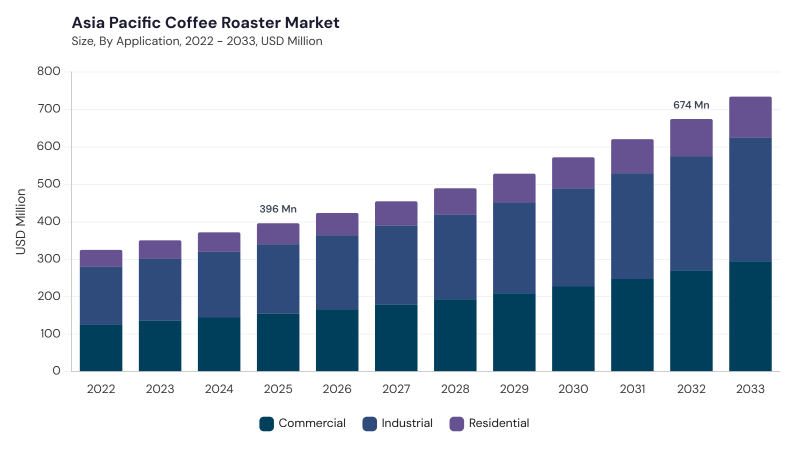
Based on Application, the market is segmented into Industrial, Commercial, and Residential. The Industrial market dominated the Asia Pacific Coffee Roaster Market by Application in 2025, and would continue to be a dominant market till 2033; thereby, achieving a market value of USD 261.3 million by 2030, growing at a CAGR of 7.6 % during the forecast period. The Commercial market is expected to witness a CAGR of 8.6% during (2026 - 2033). Additionally, The Residential market is expected to witness highest CAGR of 8.9% during (2026 - 2033).
Industrial applications require large-capacity roasting systems capable of maintaining consistent profiles across diverse bean varieties while integrating programmable controls, automation, energy management, emissions reduction, and quality monitoring. Commercial applications serve specialty cafés, boutique roasteries, restaurants, hotels, and coffee chains requiring flexible batch sizes and precise flavor customization. Residential applications cater to home enthusiasts seeking compact, user-friendly equipment, adjustable roasting parameters, and greater control over bean freshness, increasingly supported by e-commerce access and expanding coffee education.
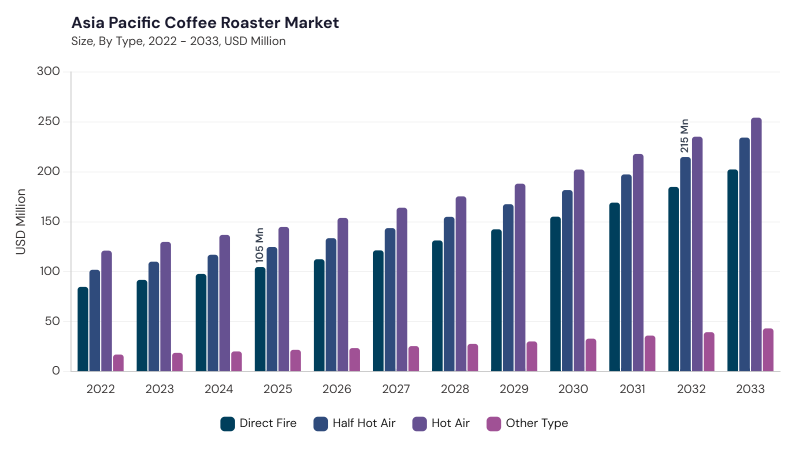
Based on Type, the market is segmented into Hot Air, Half Hot Air, Direct Fire, and Other Type. Hot Air roasters use convection-based heating to provide uniform thermal distribution and precise roast control, making them particularly relevant to specialty coffee and quality-focused applications. Half Hot Air systems combine convection and conduction, offering flexibility, faster roasting cycles, and balanced flavor development for medium-scale operators.
Direct Fire roasters remain important in higher-volume and traditional applications where rapid roasting, simplified equipment, and stronger roast characteristics are prioritized. Other Type includes fluidized-bed, infrared, microwave, electric, hybrid, and other emerging systems focused on sustainability, energy efficiency, digital control, and differentiated roasting performance.
Free Valuable Insights: Coffee Roaster Market is Predicted to reach USD 2619.5 Million billion by 2033, at a CAGR of 7.6%
Based on Country, the market is segmented into China, Japan, India, South Korea, Singapore, Malaysia, and Rest of Asia Pacific. The China market dominated the Asia Pacific Coffee Roaster Market by Country in 2025, and would continue to be a dominant market till 2033; thereby, achieving a market value of USD 159.9 million by 2030, growing at a CAGR of 6.3 % during the forecast period. The Japan market is expected to witness a CAGR of 7.5% during (2026 - 2033). Additionally, The India market is expected to witness a CAGR of 8.9% during (2026 - 2033).
Across Asia Pacific, coffee roasting development is being shaped by specialty consumption, sustainability, digitalization, localized flavor preferences, and expanding café culture. China emphasizes specialty coffee, localized roast profiles, digital quality control, sustainable packaging, Yunnan sourcing, and diversification into cold coffee and ready-to-drink formats, while Japan focuses on precision roasting, direct trade, traceability, AI-supported profiling, and provenance-led premium positioning. India is advancing specialty and single-origin coffee, sensor-driven roasting, blockchain-based traceability, localized production, and technology-enabled quality control, whereas South Korea emphasizes smart roasting, ethical sourcing, experiential retail, digital engagement, and specialty coffee differentiation. Singapore combines traditional kopi heritage with specialty roasting, automated profiling, quality assessment technologies, sustainable practices, and regional expansion, while Malaysia focuses on small-batch customization, energy-efficient equipment, data analytics, localized flavors, and integrated sourcing partnerships. Rest of Asia Pacific continues to develop programmable roasting, digital traceability, flexible production, sustainable sourcing, cloud-enabled distribution models, and specialty coffee offerings suited to diverse regional markets.

By Application
By Type
By Country
Set to reach $572.2 Million by 2030, growing at 8.2% CAGR during 2026-2033.
China leads with a market value of USD 159.9 million by 2030, growing at 6.3% CAGR during 2026-2033.
Rising demand in the residential segment with the highest CAGR of 8.9% during 2026-2033.
Industrial segment to reach USD 261.3 million by 2030, growing at 7.6% CAGR during 2026-2033.
Japan's market is expected to grow at a CAGR of 7.5% during 2026-2033.
The commercial segment will witness a CAGR of 8.6% during 2026-2033.
Our team of dedicated experts can provide you with attractive expansion opportunities for your business.




 Unique Offerings
